Kriya Śakti: The Power Of Action Moving In Your Breath
Listen to this episode on Spotify →
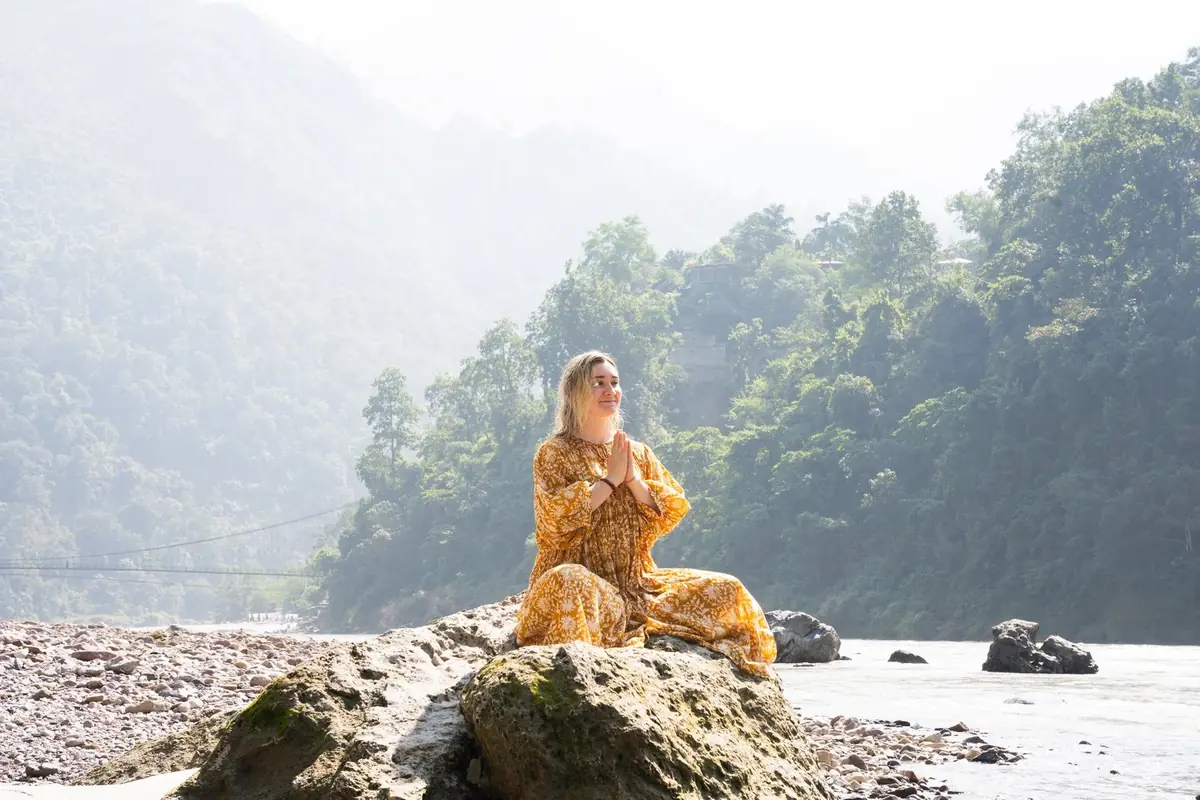
Pictured: Sasha practicing by the Ganga, Rishikesh.
Sit still for long enough and you will notice that you are not still. The chest rises and falls. The heart keeps its own time. Beneath the floorboards of attention, blood is moving and cells are dividing, and none of it waited for your permission. Stillness, looked at closely, turns out to be full of motion.
Widen the frame and the same thing is happening everywhere. Stars are forming, tides are turning, and nothing in the visible universe is holding still.
Tantra has a name for whatever it is that is doing all of that. Kriyā śakti, is the divine power of action: the force that moves the world, and the force moving in your breath right now. Which means that when you sit down to practice prāṇāyāma, you are not only regulating your physiology. You are participating, knowingly, in the thing that is making the world happen.
What is Kriyā Śakti?
Kriyā (क्रिया) comes from the verbal root kṛ (कृ), to do, to make, to act. It does not mean activity in the sense of busyness. It means action as a process, action undertaken consciously.
Śakti (शक्ति) comes from the root śak (शक्), to be able, to be capable. Śakti is capacity rather than force.
Kriyā śakti, then, is the power to act. More precisely, it is the energy by which consciousness moves from intention into manifestation.
That definition only opens up properly if you know where it sits. Kriyā śakti is the third of three, and the three belong to the Trika system of Kashmir Śaivism.
First there is icchā śakti, the power of desire, the wanting that precedes anything.
Then jñāna śakti, the power of knowing, the recognition of what is to be made.
Then kriyā śakti, the making itself.
Desire, then knowledge, then act. It is the sequence by which a universe comes into being, and it is also, on a much smaller scale, the sequence by which anything at all gets done.
Breathing is Spanda You Can Feel
There is a text called the Spanda Kārikā, and it opens by praising Śakti as the source of all manifestation, by whose vibration the universe arises and into whom it dissolves. The word it uses for that vibration is spanda (स्पन्द), the pulsation of consciousness in motion.
There is a teaching story that gets at what this means in the body.
A student came to his teacher and asked, if everything is spanda, then what is breathing?
The teacher said, breathing is spanda that you can feel.
The student asked, and what about meditation?
The teacher said, meditation is what happens when you stop being startled by it.
The student sat with that for a long while. Then he came back and asked the question underneath the other two. Is the spanda inside me, or am I inside the spanda?
And the teacher said: both, and neither.
That is not evasion. It is the honest answer, and dissolving the question is more or less what kriyā śakti is for.
Kriyā Śakti in the Classical Texts
Three passages sit behind this teaching.
The Spanda Kārikā gives the cosmic image, and it is one of the most striking in the tradition: by whose opening and closing of the eyes the universe arises and dissolves. Śakti as a goddess whose blinking makes and unmakes everything there is. The universe on the inhale, dissolution on the exhale, and the whole of it in the time it takes her to blink.
The Pratyabhijñāhṛdayam puts the same thing in the language of painting: through her own will, she unfolds the universe upon her own canvas. Note the phrase "her own will". That will is icchā, the first of the three. Desire arrives, the canvas is her own, and the unfolding is kriyā.
The Yoga Sūtra comes at it from the practitioner's side rather than the cosmos. Once steadiness of posture is established, Patañjali says, prāṇāyāma becomes the regulation of inhalation and exhalation. He describes a few kinds, and then a fourth, which transcends the domain of the internal and the external. That fourth is where this article is heading.
From the Breath to the Seasons
The practical route into kriyā śakti is not conceptual. It is the breath, because the breath is the one cosmic rhythm you can put your attention on directly.
Notice the breath, and you are not only noticing physiology. You are noticing that something is moving you, in a rhythm you did not choose and cannot stop.
Then the frame widens on its own. If you can notice the rising and falling of the breath, you can notice the rising and setting of the sun. If you can notice that, you can notice the turn from summer into winter. If you can notice that, you can start to see the longer cycles, El Niño and La Niña, the slow ones that outlast a human attention span. Each is the same pulsation at a different scale. What you eventually recognise is that everything alive is doing this, and that the force asking the universe to move is one force.
Embodied Application: Prāṇāyāma and Kevala Kumbhaka
If everything is vibration, then prāṇāyāma is the practice of feeling that vibration deliberately.
Its maturity has a name: kevala kumbhaka (केवल कुम्भक), from kevala, alone or absolute, and kumbhaka, retention. Unlike antara kumbhaka (retention after the inhale) and bāhya kumbhaka (retention after the exhale), kevala kumbhaka is not something you do. It is a spontaneous suspension of the breath that arrives on its own when the practice has ripened, and it is the fourth prāṇāyāma the Yoga Sūtra points to, the one that is neither internal nor external. In that suspension, the practitioner is said to glimpse the source of the movement itself.
There is a sequence in that, and it is worth naming. First you become aware of the breath. Then you slowly build capacity. Then you let go of the breath altogether, and kevala arrives, or it does not.
One correction worth carrying into practice. Much of the panic that comes up around retention is not a signal that you are running out of oxygen. Over a short, comfortable retention, oxygen saturation changes very little. The urge to breathe is driven far more by rising carbon dioxide than by falling oxygen, which is to say that a good deal of what we experience as air hunger is perception rather than emergency. Knowing that does not make retention safe. It makes the discomfort intelligible.
A note on safety.
Deliberate breath retention is an advanced practice and should be learned in person with a qualified teacher.
Never practice intentional retention in inversions or in headstand, in or near water, or while driving.
Take particular care, and speak to your doctor first, if you are pregnant, or living with cardiovascular conditions, uncontrolled high blood pressure, epilepsy, glaucoma, or a history of panic.
Kevala kumbhaka is not a target to chase; chasing it is the surest way not to arrive.
Nothing in this article is medical advice.
Our fuller treatment of retention is here.
From Desire to Resolve to Action
The triad is not only cosmology. It is also a fairly exact description of how anything gets made in a life, and it maps cleanly onto sankalpa.
First comes the feeling, before there are words for it. That is icchā. Then the feeling is given language and becomes a resolve. Then comes practice, the daily dedication of your own capacity towards that thing. That is kriyā śakti, and it is the least glamorous of the three.
Something happens often enough on our trainings that it has stopped being a surprise. Students journal in the first week, long before anyone mentions sankalpa. Later they draft one properly, and then we ask them to comb back through their own notes. Almost every time, someone finds they wrote the thing down on day one, in nearly the same words, and forgot about it entirely.
That is the recognition. What remains after it is the work.
The Ayurvedic Lens: Dinacharyā, Ṛtucharyā and Vāta
Yoga and Ayurveda approach this from opposite directions, and the symmetry is worth seeing.
Yoga looks inward. Watch the rhythm of your own breath, and through it recognise the rhythm of the universe. Ayurveda looks outward first. Watch the rhythms of nature, and use them to bring the body back into a rhythm of its own. This is what dinacharyā (दिनचर्या), daily routine, and ṛtucharyā (ऋतुचर्या), seasonal routine, are actually for. Not discipline for its own sake, but the deliberate matching of your individual pulsation to a larger one.
There is an ordering here that is easy to get backwards. Yoga tends to assume you have already done the Ayurveda, which is to say that it assumes a body in reasonable working order. If that is not where you are, start with the rhythms. Sleep and wake with some regularity. Eat with the day rather than against it. Move with the season, the moon, the menstrual cycle, the breath. Ayurveda calls the result svastha (स्वस्थ), literally established in one's own self, which is also the word it uses for health.
Ayurveda also names the force of movement in the body directly. Vāta doṣa governs all motion, from the obvious to the unnoticed: blinking, swallowing, coughing, the movement of thought. If kriyā śakti is the power of action at the scale of the cosmos, vāta is where that same principle shows up as physiology.
Across the Om Som system we put it this way: Ayurveda is the science of the body, yoga is the science of the mind, and tantra is the science of the energy.
Three Powers, One Goddess
To recap the series.
Icchā śakti is the desire the universe has to experience itself through another.
Jñāna śakti is the recognition that the desire exists.
Kriyā śakti is the bringing of that desire into the manifest world.
One thing is worth saying plainly before you file these away as a productivity model. In their own tradition these three are not stages of personal development. They are Śakti herself, in her three forms, in the act of creating the universe, with Śiva as both the void and the one who perceives the unfolding. We can use them at the human scale, and it is useful to, but that is a borrowing.
Tantra is in the business of putting into a box a thing that will not fit in one. The words are pointers. Both, and neither.
Common Questions About Kriyā Śakti
What is kriya shakti?
Kriyā śakti is the tantric power of action: the energy by which consciousness moves from intention into manifestation. It is the third of the three śaktis of the Trika system of Kashmir Śaivism, and it is the force behind all movement, from the turning of the seasons to the rise and fall of a single breath.
What is the difference between icchā, jñāna and kriyā śakti?
They are a sequence. Icchā is desire, the wanting that comes first. Jñāna is knowing, the recognition of what is to be made. Kriyā is the act of making it. Desire, then knowledge, then action, in the creation of a universe and in the completion of anything in a life.
Is kriyā śakti the same as spanda?
They are closely related but not identical. Spanda is the pulsation itself, consciousness in motion, the vibration underlying everything. Kriyā śakti is the power that produces that movement, the capacity to act. One is the throb, the other is what throbs.
What is kevala kumbhaka?
Kevala kumbhaka is a spontaneous suspension of the breath that arises by itself in mature prāṇāyāma, as distinct from antara and bāhya kumbhaka, which are deliberate. Classically it is the fourth prāṇāyāma, described as transcending the internal and the external. It cannot be forced, and it should never be pursued as a goal.
Key Takeaways
Kriyā śakti is the power of action, the energy by which consciousness moves from intention into manifestation.
It is the third of the triad. Icchā is desire, jñāna is recognition, kriyā is the act.
The breath is the most direct access point, because it is the one universal rhythm you can put attention on immediately.
Prāṇāyāma matures towards kevala kumbhaka, a spontaneous suspension that arrives on its own and cannot be chased.
In Ayurveda the same principle appears as vāta doṣa, and dinacharyā and ṛtucharyā are how the body is brought back into rhythm with nature.
In their own tradition these three are not psychological stages. They are Śakti's three forms in the act of creation.
Listen to the Full Episode
The conversation goes further than the article does, including a good stretch on where to actually find the classical tantric texts. Listen to the kriyā śakti episode of the Om Som Yoga & Ayurveda Podcast.
This is part three of the śakti series. Start with icchā śakti and jñāna śakti if you have not heard them, since the three build in order.
Want to Learn More?
The prāṇāyāma in this article, and the philosophy that gives it context, is taught in full on our 200-Hour Hatha Yoga Teacher Training in Sri Lanka. If you have been practicing for a while and want the tradition sitting underneath the practice, that is where we would start you.
We also explore these deep yogic concepts inside Sadhana Sangha, our online community. Practice with us online.