Vikalpa: The Stories the Mind Mistakes for Reality
Listen to this episode on Spotify →
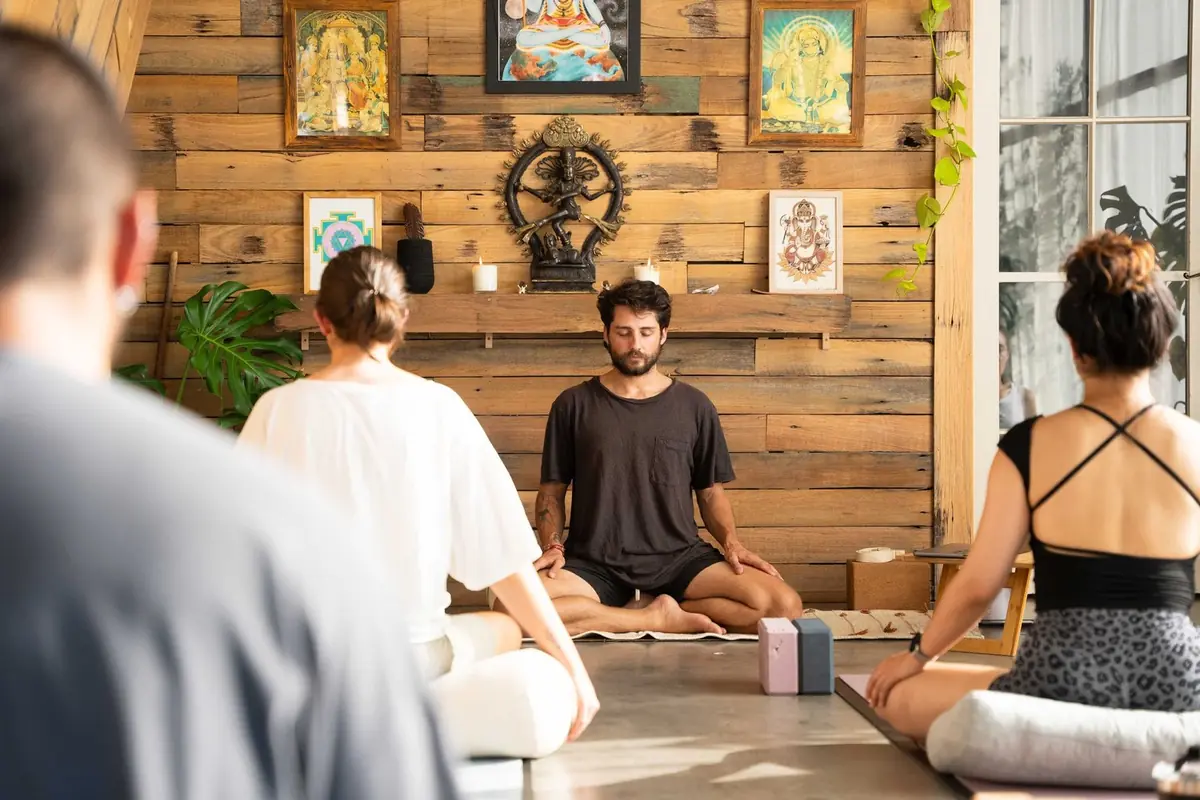
Pictured: Aaron guiding students through a meditation practice
Most of our suffering never actually happens. It happens here, inside the mind. We build a world out of a glance, a message, a silence, and then the body responds to that imagined world as though it were unfolding in front of us. To the nervous system, a hundred unread emails can register as the same threat as a tiger in the grass. The story we tell ourselves about a thing becomes more real to us than the thing itself.
Patanjali gave this tendency a name many centuries ago. He called it vikalpa. It is one of the five fluctuations of the mind, and it may be the most familiar of them all. This post looks at what vikalpa is, why we are so easily caught by it, and how the practice of yoga slowly returns us from the story to the real. The aim is not to stop thinking. It is to stop confusing our thinking with the truth.
What Is Vikalpa?
Vikalpa (विकल्प) comes from vi, meaning apart or variously, and the root kḷp, meaning to arrange, to form or to construct. Taken literally, vikalpa is a mental construction. It is the mind arranging an idea and then presenting that idea to us as reality.
In the Yoga Sutra, vikalpa is one of the pancha vrittis, the five movements or fluctuations of the mind. Patanjali lists them in this order: pramāṇa (प्रमाण), viparyaya (विपर्यय), vikalpa (विकल्प), nidrā (निद्रा) and smṛti (स्मृति). Pramāṇa is right knowledge, gained through direct perception, sound inference or reliable testimony. Viparyaya is wrong knowledge, a real object misperceived. Nidrā is sleep. Smṛti is memory. Vikalpa sits among these as a movement of its own, and Patanjali is careful to define it precisely.
His definition is one of the clearest lines in the whole text:
शब्दज्ञानानुपाती वस्तुशून्यो विकल्पः
śabdajñānānupātī vastuśūnyo vikalpaḥ
Vikalpa is knowledge that follows from words, empty of an actual object.
Empty of an actual object. This is the heart of it. Vikalpa is a kind of knowing that arises from language rather than from experience. Classical commentators give examples like the horn of a hare or a flower blooming in the sky. The words make perfect sense, and yet there is nothing there. The mind produces a reality out of language alone, and then we live inside it.
The King Who Lived a Lifetime in a Moment
There is a beautiful story from the Yoga Vasistha that describes this exactly. A king named Lavana is seated on his throne when a magician enters the court and waves a peacock feather before his eyes. In the space of a few seconds, the king lives an entire life. He is cast out of his city and wanders as a hermit through the forest. He meets a woman, marries and raises a child. Then a famine comes, and he watches everyone he loves waste away. He grieves, he loses everything, and at last he dies.
Then he wakes, back on his throne. Only moments have passed. His courtiers have not moved. But the king is drenched in sweat, shaking with terror, his body heavy with grief, longing for a family that never existed.
The experience was not there. But the grief was completely real. This is the teaching of vikalpa in a single image. The mind is powerful enough to build a world with no basis in reality, and the body cannot tell the difference. It simply receives the signals of the mind and responds. The king's suffering was genuine, even though its cause was pure imagination.
Vikalpa and Viparyaya: A Distinction Worth Making
It is worth pausing on the difference between vikalpa and viparyaya, because the two are easily confused and the distinction is quietly important.
Viparyaya is misperception. There is a real object in front of you, but you see it wrongly. It is a little like colour blindness, seeing a red lamp as yellow. The object is genuinely there. Your reading of it is simply mistaken.
Vikalpa runs deeper. Here there is no clear perception at all. It is as though a veil hangs over the object, and rather than seeing it, you construct it from words and assumptions. You look at yoga and decide it is only stretching and poses, because you have no context to understand it. Or you imagine it as levitation and purple light and angelic wings, none of which has anything to do with yoga. In both cases you are not perceiving. You are building a world from language and projecting it onto what is in front of you.
Most of us live in vikalpa far more often than we realise. Someone narrows their eyes, scrunches their brow, hunches a little as they sit across from us. We take that faint input and build an entire narrative around it. They are angry with me. They have been bottling this up. They are about to say something. They must resent me. None of it is true. But the body feels every word of the story as though it were.
From The Story To The Real
The trouble begins when we attach to the story and stop seeking the truth. We hold an interaction in our mind, replay it, and each time we replay it, it grows. A squint becomes a raised fist. A moment of quiet becomes open hostility. The mind moves and moves, and the body sits in a state of stress as if the imagined event were happening on a loop. In modern language we would often call this anxiety. In the language of the Yoga Sutra, it is vikalpa left unexamined.
The way through is disarmingly simple, though it asks for courage. First, we label the movement for what it is. This is a story. Then we return toward pramāṇa, direct and reliable knowledge, by actually checking. We have the uncomfortable conversation. We ask. We go and learn. Often the story dissolves the moment it meets reality, because the reality was never what we feared. The other person was squinting because the sun was bright. That is all. Without that direct contact with what is real, the vikalpa cannot resolve, and it slowly becomes suffering.
This can run very deep. The stories are not only about other people. They become the stories we tell about ourselves. No one is ever here for me. No one helps me. And from that quiet, unquestioned belief, our actions follow. We do not ask for help, because we already know the answer. Yet the belief was only ever a story.
It helps to remember that these patterns are usually a form of protection. A vikalpa often forms to keep us safe from a harm we once feared. Be on alert. Be careful. Stay small. When we can see how a particular story has tried to protect us, we can thank it and gently set it down. It kept us safe once. It is not needed now. That recognition is itself a kind of liberation.
The Rope and the Snake
There is a classical analogy that belongs here, drawn from the Advaita Vedanta tradition and closely associated with Shankaracharya. A man walks through a field at dusk, sees a snake coiled on the path, and freezes in fear. Then the sun rises, the light spreads, and he sees that it was only a rope. In that instant the fear has nowhere to stand.
The light that rises in that story is not only the sun. It is the dawning of awareness. Yoga asks us to cultivate exactly this, the capacity to perceive reality as it is. When awareness arises, the transformation is complete. It is not a snake. It is a rope. And there is a further layer the tradition draws out. Look at the rope more closely and you find it is not really a rope at all, only intertwined fibres of hemp. Rope is a name, a construct we place over the object. Release the name, and you meet the thing itself.
Embodied Application
On the mat, vikalpa often shows up as the story about the posture rather than the posture itself. I cannot do this pose. My body is not flexible. This will never open. These are constructions, laid over the direct sensation of the breath and the tissue. Asana becomes an opportunity to feel what is actually present, rather than what we have decided is present. The instruction is quiet and steady. Meet the sensation, not the story about the sensation.
In the breath, the same principle applies. Anxiety is a mind moving so quickly through imagined futures that the breath forgets to move at all. Returning to a slow, even breath is a return to the present, where vikalpa loses its grip. The body cannot stay braced against an imagined tiger while the breath is soft and long.
In meditation, this becomes the practice itself. The Yoga Sutra describes stages of samādhi in which we slowly release the object, the words attached to the object, and the meaning of those words. In savitarka samādhi, the object is still bound up with its name and its meaning. In nirvitarka samādhi, the name and meaning fall away, and the object alone remains, seen directly. Meditation, in this light, is the practice of releasing our vikalpas one by one, until we can rest with what is real, free of the stories we habitually place over it.
This is also why mantra is so highly regarded as an object of meditation. A word like rope points to something other than itself. A mantra does not point elsewhere. The mantra is the object itself. There is nothing to release, because the sound and the essence are already one. This is part of why we choose sattvic objects for meditation. They do not carry the mental baggage and the layered stories that ordinary objects tend to gather.
Daily Life and the Ayurvedic Lens
In Ayurveda it is often said that disease begins in the mind, and vikalpa shows us how. When we are lost in rumination we are not truly present. We are not breathing well, not eating with attention, not engaging consciously with our own experience. Prāṇa stops flowing freely, the tissues lose their steadiness, and over time the conditions for illness gather.
The classical framing for this is prajñāparādha (प्रज्ञापराध), from prajñā, wisdom or discernment, and aparādha, error. The Charaka Samhita names it as one of the fundamental causes of disease. It arises when discernment, restraint and memory falter, and we knowingly choose what harms us. This is precisely the territory of vikalpa. We construct a story that lets us do the thing we already sense is unwise. It is only one coffee, and my heritage means I need it. I cannot function without it. The claim that we cannot function is not a fact. It is imagination, repeated daily until it feels like truth, quietly contributing to the very imbalance we would rather avoid.
The way out is the one we have been describing throughout. We bring awareness to the pattern. We notice the story we are telling, and we notice how it feels in the body when we believe it. Vikalpas are exhausting. They place a constant, low burden on the nervous system, and that burden eventually reaches the organs. To meet them with honesty is to begin restoring svastha (स्वस्थ), a word that literally means abiding in one's own self. Health, in this view, is not only the absence of disease. It is the return to what is real, and to ourselves.
A gentle note is worth adding here. Some of these patterns are ordinary, everyday rumination that awareness can loosen on its own. Others, particularly those rooted in trauma, run far deeper and deserve the support of a qualified professional. Recognising a thought as a story does not make a difficult emotion any less valid. The feeling is real and fair. What changes is our relationship to the story beneath it, and our willingness to return, again and again, to the present moment where liberation actually lives.
The old teaching still holds:
असतो मा सद्गमय
asato mā sad gamaya
Lead me from the unreal to the real.
तमसो मा ज्योतिर्गमय
tamaso mā jyotir gamaya
Lead me from darkness to light.
These words from the Bṛhadāraṇyaka Upaniṣad describe the whole movement of practice. From the story to the truth. From the imagined snake to the rope resting quietly on the path.
Key Takeaways
Vikalpa is one of the five vrittis, or fluctuations of the mind, defined by Patanjali as knowledge that follows from words alone, empty of any real object.
It is the imagination that quietly becomes suffering. The body responds to an imagined threat exactly as it would to a real one.
Vikalpa differs from viparyaya. Viparyaya is misperceiving a real object, while vikalpa constructs a reality where there is no object at all.
The story of King Lavana in the Yoga Vasistha shows a lifetime of grief lived in a few seconds, entirely within the mind.
The way through is to label the story as a story, then seek direct knowledge, pramāṇa, by checking against reality.
Many vikalpas began as protection. They can be thanked and set down once they are no longer needed.
Meditation is the gradual release of our vikalpas, returning us to direct perception. This is why sattvic objects, and mantra especially, are valued.
In Ayurveda, the stories we use to justify unhealthy habits are a form of prajñāparādha, and awareness is the beginning of svastha, health as a return to oneself.
Listen to the Full Episode
This post grew out of a conversation between Aaron and Paige on the Om Som Yoga and Ayurveda Podcast, part of our exploration of moksha, or liberation. If you would like to hear the full discussion, including the reflections on mantra, meditation and the stories we carry, you can listen here.
Want to Learn More?
Ready to root your yoga practice in tradition? Join our upcoming, 200-Hour Hatha Yoga Teacher Training (2027), a 3-week immersion in Sri Lanka, grounding you and your practice in the principles of Hatha Yoga and Ayurveda.