Jñāna Yoga: The Path of Removing What You Are Not

If someone asked you to point to yourself right now, where would you point? Most people go to the chest. Some go to the head.
Jñāna yoga says that whatever you can point at is not it.
You can see the body, so you are not only the body. You can watch your thoughts arrive and leave, so you are not the thoughts. You can even watch the breath, which means the breath is being watched by something.
So this path is one question, asked with total honesty, over a long time. Who is the one watching?
What Is Jñāna Yoga?
Jñāna (ज्ञान) comes from the root jñā (ज्ञा), to know. The word means knowledge, but not the kind you collect from a book or a search engine. It means knowledge you have directly experienced.
Yoga (योग) is union. Here, the union of the individual self with the universal self, ātman with brahman.
Jñāna yoga, then, is knowledge that leads to that union. Embodied knowledge rather than remembered knowledge.
A note on the sound, because this word is almost always mispronounced. The conjunct jña (ज्ञ) is not two flat sounds. Find where your tongue sits for ja, hold it there, and let the nasal come from that same place. Jñāna. The common English rendering, "gyana", is close enough to be understood.
It is the second of the four paths we are walking this month, after karma yoga and before bhakti and rāja.
Yājñavalkya And Maitreyī
The founding instruction for this path comes from the Upaniṣads.
The sage Yājñavalkya reached the end of his life as a householder and prepared to leave for the forest. He called his wife Maitreyī and told her he would divide his wealth between her and Kātyāyanī, his other wife.
Maitreyī asked one question. If this whole earth, filled with all its wealth, were mine, would it make me immortal?
No, he said. Your life would be the life of the wealthy. There is no hope of immortality through wealth.
Then what would I do with something that cannot make me immortal, she said. Give it to her. What I want from you is what you know.
So he sat her down and taught her.
It is not for the sake of the husband that the husband is dear, he said, but for the sake of the self. Not for the sake of the wife, the children, the wealth, or anything else that is dear to you. It is for the sake of the self. Everything you have ever loved, you loved because the self was shining through it.
Then he gave her the method. If the self is to be seen, he said, it must be heard of, reflected on, and meditated upon. When the self is seen and heard and reflected on and known, everything is known, because everything is the self.
That last instruction is the whole path in one line.
The Three Stages and The Instrument
Śravaṇa (श्रवण) means hearing. You hear the teaching, from a text or a teacher. Not to be confused with śraddhā (श्रद्धा), faith, which is a different word entirely. Listening to this kind of material, including a podcast about it, is śravaṇa. It is a real stage, and it is only the first one.
Manana (मनन) means reflection, from the root man, to think. Now you sit with what you heard and reason it through yourself. I am not the body. I am not the breath. I am not the thoughts. I am the one watching them. But what does that actually mean? What is the observer? Why is it observing? Without this stage, the teaching stays a sentence you can repeat.
Nididhyāsana (निदिध्यासन) means sustained meditation on what has been reflected upon. You meditate on that truth until it stops being a conclusion and becomes your resting state, until the seat of the observer is simply where you sit.
Running through all three is one instrument: viveka (विवेक), discernment.
Viveka is what distinguishes the self from what is not the self. It is also what lets you tell, honestly, where you actually are. Am I still at śravaṇa, repeating things I have heard in someone else's words? Or have I sat with this myself?
This is also a clean description of svādhyāya (स्वाध्याय), from sva, self, and adhyāya, study. Self-study and scriptural study are the same practice, because the text is the mirror. You take the knowledge from outside, apply it to yourself, and let it become part of how you live.
Jñāna Yoga is not the Accumulation of Knowledge
Here is where this path is most often misunderstood, and the misunderstanding is expensive.
It is tempting to treat jñāna yoga as collection. Learn all of it, remember all of it, and be good at yoga. School trained most of us this way: memorise the periodic table, get scored on recall. That is not applied knowledge.
Jñāna yoga runs the other direction. It is the systematic removal of misidentification with the self.
The knowledge has exactly one job, which is to let you reflect on the nature of the seer and to sharpen your discernment. Accumulate for any other reason and you simply identify more deeply with how knowledgeable you are, which moves you further from the self rather than closer. The self-help shelf has a way of becoming the ego-help shelf.
This is also why the path does not require you to be clever. Being well read helps with the texts, but the qualities that actually matter here are curiosity, open-mindedness, and the willingness to be proved wrong. A philosophical mind rather than a retentive one.
Jñāna Yoga In The Classical Texts
Three passages carry this teaching.
The first is the instruction Yājñavalkya gave Maitreyī, which is the source of the three stages: the self is to be seen, to be heard of, reflected on, and meditated upon.
The second is a verse attributed to Śaṅkarācārya, and it is the method in miniature. The form is seen; the eye is its seer. The eye is seen; the mind is its seer. The thoughts of the mind are seen; the witness is their seer. But the witness is seen by none.
Follow the chain. Every time you find a seer, look again, and it turns out to be something seen. The chain ends where nothing can be placed behind it.
The third comes from the Kena Upaniṣad, and it is where the breath inquiry originates. By whom is the breath sent forth? That which is not breathed by the breath, by which the breath is breathed: know that alone to be Brahman.
There is also the tradition of the mahāvākyas (महावाक्य), the great sayings, one drawn from each of the Vedas and used for contemplation. Ahaṁ brahmāsmi (अहं ब्रह्मास्मि), literally "I am Brahman," is one of them. It is not a statement to agree with. It is a sentence to sit inside for ten minutes and see what happens.
Embodied Application: Watching The Body Breathe
The breath is the best object available for this practice, for one specific reason. It does not need you.
You can control the breath voluntarily. It does not require that. It continues whether you interact with it or not, which makes it the one process you can observe without any suspicion that you are the one producing it.
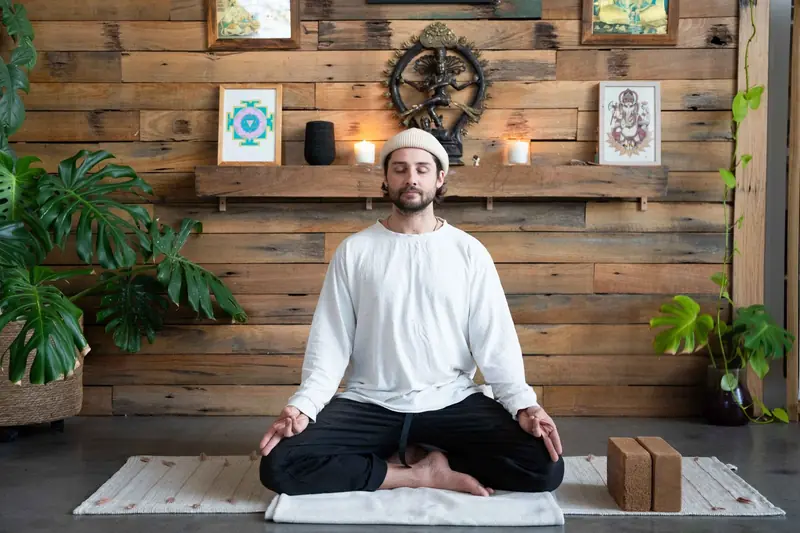
Ānāpāna (आनापान), watching the breath at the nostrils, is the practice. Sit, and rest attention where the air meets the rim of the nostrils. Do not lengthen it, count it, or improve it.
Then attend to the language, because the language is the practice. Not "I am breathing". Not even "I am watching my body breathe".
I am the one watching the body breathe.
The body becomes an object. The breath becomes an object. What is left over is the thing doing the watching, and it cannot be found by looking for it, only by noticing what it is not. This is the witness seat, and it is the same seat the Yoga Sūtra points to when it describes what remains when the movements of the mind settle: chitta vṛtti nirodhaḥ.
The same move works with thought. A thought appears, is seen, and passes, which means it belongs to the category of things seen. Our article on vikalpa covers what happens when we forget that.
Daily Life Integration
Two practical matters, and one honest disagreement.
Do your own manana.
Anyone can ask a chatbot for a perfect explanation of jñāna yoga and read it aloud with great authority. Nothing in that process is reflection. What still cuts through the noise is a person who sat down and thought something through with their own mind and arrived somewhere. That is viveka in motion, and it is rarer than it should be.
Notice what a teacher is for.
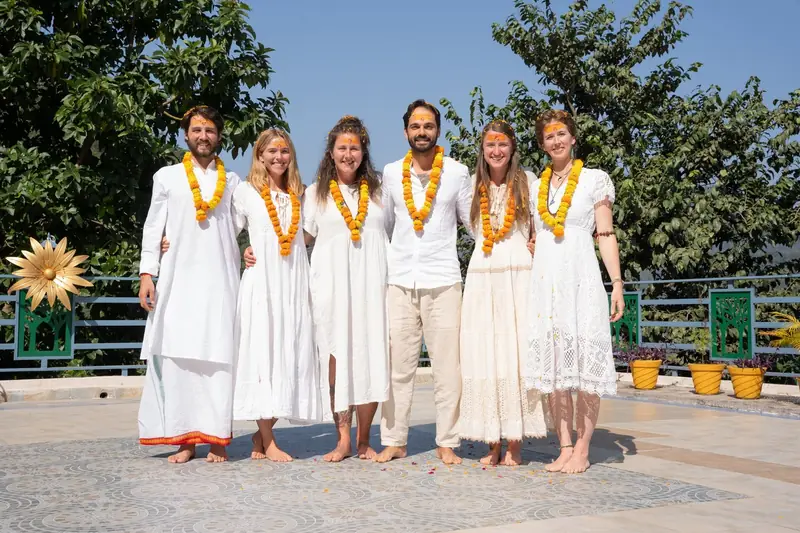
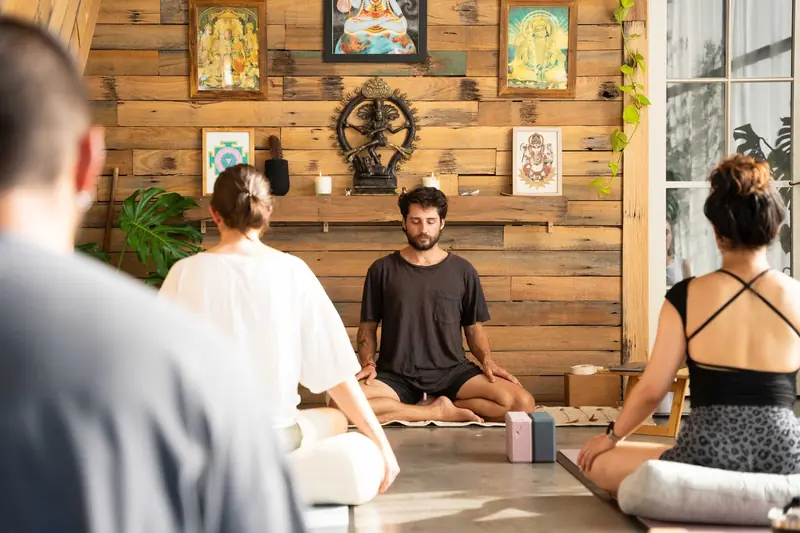
A student on our 200-hour training in Sri Lanka once asked why she should bring us her questions if we were only going to ask what she thought. That question is the teaching. An instructor supplies the answer. A teacher asks first, guides if the student has wandered, and offers insight afterwards, because the point is the moment the student discovers they had the answer.
And the disagreement.
Aaron's position is that if you are serious about this path you should go to a source text at least once, or the knowledge stays second hand all the way down. Not a whole book. One verse, read five times. Paige's position is that a teaching transmitted by a living teacher, in their own voice and out of their own experience, can land more deeply than a text read alone.
They did not resolve it, and it does not need resolving. Both are śravaṇa. Neither substitutes for the manana that comes next.
The Ayurvedic Lens: Constitution and Timing
Self-inquiry goes differently depending on the body doing it.
Vāta takes to this path immediately, which is both the gift and the risk. Air and ether are at home in liminal, conceptual space, and inquiry can spiral there rather than settle. Ground first. Warm, nourishing food, abhyaṅga (अभ्यङ्ग) oil massage, a steady practice. Then contemplate.
Pitta does well with the texts. This is the constitution that reads, annotates and studies properly, and that is genuinely its way in. The caution is competition and force. Study here works better as active surrender than as conquest.
Kapha can get caught in the momentum of familiar thoughts and settled beliefs. The medicine is to meet the same teaching as though for the first time. Anyone who co-teaches knows this: you hear the same material for the fiftieth time and something new arrives, because you were open to it.
Timing matters too. The vāta hours suit this practice best, which means before sunrise, in brahma muhūrta, when the world has not started and everything is quiet and subtle. The second vāta window, roughly two until six in the afternoon, is a reasonable substitute for householders.
There is a verse of Śaṅkarācārya's for exactly this hour, beginning prātaḥ smarāmi hṛdi saṁsphurad ātma-tattvam. At dawn I remember the reality, the self shining in the heart: existence, consciousness, happiness, the goal of the sages, the fourth state, turīya, that which always knows the waking, dreaming and deep sleep states. That partless Brahman I am, not this cluster of elements.
Contemplating the self in the first moments after waking, before the day has arrived, is among the most direct forms this practice takes.
Common Questions About Jñāna Yoga
What is jnana yoga?
Jñāna yoga is the path of knowledge, one of the four classical paths of yoga. It uses enquiry into the nature of the self, through hearing, reflection and sustained meditation, to remove misidentification with the body, breath and mind. It is not the accumulation of information.
What are shravana, manana and nididhyasana?
They are the three stages of the path. Śravaṇa is hearing the teaching from a text or teacher. Manana is reflecting on it with your own reasoning until it is genuinely yours. Nididhyāsana is sustained meditation on what you have understood, until it becomes your resting state rather than a conclusion.
Do I need to be intellectual to practice jnana yoga?
No. Being well read helps with the texts, but the qualities that matter are curiosity, open-mindedness and the willingness to be proved wrong. A retentive memory is not discernment, and viveka is what the path actually runs on.
Key Takeaways
Whatever you can observe is not the observer. Body, breath and thought are all seen, which means they are not the seer.
Jñāna yoga is the removal of misidentification, not the accumulation of knowledge.
The three stages are śravaṇa, hearing; manana, reflection; and nididhyāsana, sustained meditation.
Viveka, discernment, is the instrument, and it includes discerning honestly which stage you are actually at.
The breath is the ideal object of enquiry because it does not need you. Watch the body breathe, not your body breathe.
Ground vāta before contemplating, study without force for pitta, and meet familiar teachings freshly for kapha. Practice before sunrise where you can.
Listen To The Full Episode
The conversation includes a good debate about whether you have to read the texts, which the article reports but does not settle. Listen to the jñāna yoga episode of the Om Som Yoga & Ayurveda Podcast here. This is part two of four on the paths of yoga. Bhakti and rāja follow.
Want To Learn More?
Listening is śravaṇa. What turns it into practice is sitting with one line until it becomes yours. That is what we do each month inside Sadhana Sangha, our online community, where this month's contemplation is the mahāvākyas, one great saying at a time, held in a yin shape for ten minutes at a stretch. Practice with us online and join our community.