Sankalpa: The Quiet Resolve Beneath Every Action
Listen to this episode on Spotify →
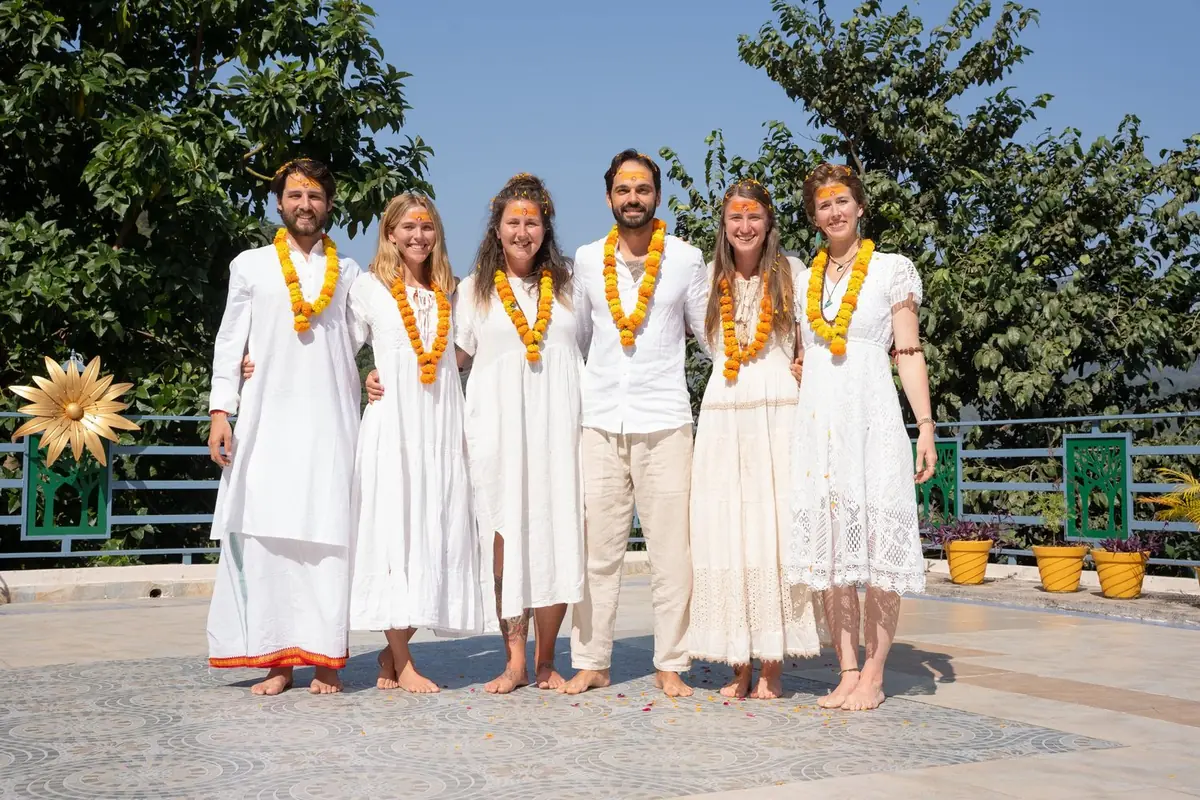
Pictured: Aaron & Paige graduating their 300 Hr Yoga Teacher Trainees
Most of us try to change our lives at the level of action. We resolve to practice more, speak more kindly, eat differently, sleep earlier. Some of it holds. Most of it does not, and we conclude that the problem is discipline.
The tradition suggests the problem is located somewhere else entirely. Beneath every action there is a resolve, and beneath every resolve there is a desire. Change the action and you change one moment. Change the resolve and everything downstream begins to move on its own.
That resolve is called sankalpa, and this is where our series on mokṣa comes to rest. We have sat with karma as the act, kriyā as the process, and vikalpa as the mental construct. All three are downstream of sankalpa, the quiet sentence the heart has decided is true.
What Is Sankalpa?
Sankalpa (सङ्कल्प) is formed from the prefix sam- (सम्), meaning complete, together or fully gathered, and the verbal root kḷp (क्लृप्), meaning to form, to fashion, to arrange or to bring into order.
Literally: a complete formation. A whole intention, gathered together and given shape.
The same root gives us vikalpa (विकल्प), where the prefix vi- carries the sense of division or apartness. Vikalpa is thought that has split, the mind constructing alternatives and turning them over. Sankalpa is thought that has gathered. The two words sit at opposite ends of the same family, which is why they are best understood side by side. One divides. One unifies.
There is a widely repeated gloss that breaks the word into sat (सत्), meaning truth or being, and kalpa (कल्प), meaning a rule held over a long period. Grammatically this is not how the word is built, but it is worth understanding why it rings so true to so many teachers. Kalpa on its own carries two live meanings in Sanskrit. It means a rule, precept or ordinance, as in the Kalpa-sūtras, the ritual manuals. It also means an aeon, a single day of Brahmā, an almost unimaginable stretch of time. So the phrase "a vow you keep across a very long time" is genuinely present in the word kalpa. The tradition simply arrives there through sam-, the mind fully gathered around one resolve, rather than through sat.
Three layers of meaning are useful to hold together:
Sankalpa as wish, which is what you want. Sankalpa as resolve, which is what you have decided is true. Sankalpa as commitment, which is what you will keep returning to regardless of circumstance. Most modern goal-setting stops at the first layer. The tradition is interested in the third.
The Seed and The Soil
There is a teaching that comes down through the yoga nidra lineage of Swami Satyananda Saraswati, who brought the practice into its modern form at the Bihar School of Yoga.
A student asked why the sankalpa is planted at the deepest stage of yoga nidra, when the mind is barely conscious and can hardly be said to be paying attention. If the resolve matters so much, surely it should be made in full daylight, with full awareness.
The answer given was that the deep stage is the only place where the seed will take. At the surface, the mind is full of weeds. Doubts, counter-arguments, and the memory of every previous time the resolve was broken. In the deep, there is only soil. The seed lands and stays.
The student pressed further. The soil is so quiet. The seed does not seem to do anything.
And the reply, in essence, was this. Look at the direction your life has already been moving. That direction is your sankalpa. You planted it long ago without noticing, and you have been watering it with every choice since.
The teaching lands in an unexpected place. The work of sankalpa is not to plant the right seed. It is to find out what you have already planted, and then to choose, with full presence, whether to keep watering it or to plant something else.
Sankalpa in the Classical Texts
The Upaniṣadic Chain
The Bṛhadāraṇyaka Upaniṣad (4.4.5) gives the sequence in its most compact form:
sa yathākāmo bhavati tat kratur bhavati, yat kratur bhavati tat karma kurute, yat karma kurute tad abhisaṃpadyate
Literally: as his desire is, so is his resolve. As his resolve is, so is the action he performs. As the action he performs is, so is what he attains.
The word the Upaniṣad uses in the second position is kratu (क्रतु), meaning will, determination or intention. Later tradition and most contemporary teaching read sankalpa here, and the reading is sound in substance even though the word itself is kratu. The point stands either way. A life is the visible end of an invisible sequence that begins in desire, hardens into resolve, expresses as action, and settles as destiny. Sankalpa is the second link, the place where intention first becomes structure.
The Refinement Of Sankalpa
The Bhagavad Gītā treats sankalpa with more caution, because a resolve that has not been examined generates craving as readily as it generates clarity.
BG 6.24: saṅkalpa-prabhavān kāmān tyaktvā sarvān aśeṣataḥ
Literally: having abandoned, without remainder, all desires born of sankalpa.
BG 6.4: sarva-saṅkalpa-sannyāsī yogārūḍhas tadocyate
Literally: one who has renounced all sankalpas is then said to have ascended to yoga.
Read quickly, these verses seem to argue against having a sankalpa at all. Read in context, they describe a maturing. The undisciplined resolve pulls the mind outward and multiplies wanting. The path is not the absence of resolve but its progressive purification, from self-serving wish toward something quieter and more aligned.
One Principle, Practiced
Yoga Sūtra 1.32: tat-pratiṣedhārtham eka-tattva-abhyāsaḥ
Literally: for the prevention of those, the practice of one principle.
Patañjali is addressing the obstacles that scatter the mind, and his instruction is essentially a sankalpa without the word attached. One principle. One practice. One return-point, held steadily enough that the scattering has nothing to catch on.
The Yoga Nidra Tradition
In the yoga nidra taught by Swami Satyananda Saraswati, sankalpa is structural rather than decorative. It is planted at the entry to the deepest stage of relaxation and repeated again at the close, bookending the practice with the same resolve, held in the window where the conscious, arguing mind has stepped aside.
Embodied Application
On the mat, sankalpa is what makes a practice a practice rather than a sequence of movements. Before the first breath, hands at the heart, the resolve is stated silently and without elaboration. It does not need to be about the practice. It is not an instruction to the body. It is the ground the practice will happen on.
In pranayama, sankalpa reveals itself in what happens when the breath becomes uncomfortable. The resolve is not the decision to hold on. It is the quality of steadiness that was already there before the discomfort arrived, and which does not need to be summoned in the moment because it was established beforehand.
In meditation, the sankalpa is stated at the beginning and again at the end. This bookending matters. The mind that closes the practice is not the mind that opened it, and repeating the resolve at the end plants it in different soil.
The phrasing carries more weight than people expect. A sankalpa is short, present-tense and positive. Not "I will stop drinking" but "my body is becoming whole." The negative construction requires the mind to hold the very thing it is trying to release. The present tense allows the resolve to be true now rather than pending.
Daily Life Integration
Away from the mat, sankalpa is easier to notice in hindsight than in the moment. It shows up as the sentence you find yourself returning to before sleep. As the decision you no longer have to make because it was made years ago. As the direction your life has been moving even when any single day felt entirely random. As the thing you would still want if no one were watching.
Because sankalpa operates beneath deliberation, it also does much of the nervous system's work of reducing internal argument. A resolve that has genuinely settled removes a whole class of decisions from daily negotiation. The practitioner who has resolved to sit each morning is not choosing each morning. The choice was made once, upstream, and the body simply carries it.
This is also why the most durable sankalpas are not invented on a weekend retreat. They are recognised. Uncovered from beneath what has already been in motion, then consciously confirmed or consciously changed.
A practical rhythm: choose one sentence, stay with it for at least forty days, and resist the urge to improve the wording. The improving is usually vikalpa dressed up as diligence.
The Āyurvedic Perspective
In Āyurveda, sankalpa is understood as a function of buddhi (बुद्धि), the higher discriminating intelligence, operating through sattva (सत्त्व), the quality of clarity. When sattva is low, the resolve wavers not because the person lacks conviction but because the instrument through which resolve operates is clouded.
The doṣas each meet sankalpa differently.
Vāta-predominant individuals often struggle with consistency. The resolve is sincere, but the mind moves, and yesterday's clarity feels distant today. The medicine is rhythm. Same time, same place, same words, so that the sankalpa is carried by structure rather than by memory.
Pitta-predominant individuals can hold a sankalpa fiercely, and the risk is attachment. The resolve becomes a campaign to be won, and failure becomes personal. The medicine is softness. Sankalpa held as offering rather than conquest.
Kapha-predominant individuals can sustain a sankalpa for years, which is a considerable strength, and may keep watering one that has quietly stopped serving. The medicine is honest review. Not abandonment, but the willingness to ask whether this resolve still points where the heart is actually going.
A few practical supports. Plant the sankalpa at sunrise or sunset, the threshold times when the mind is most receptive. Speak it aloud at the close of practice with the hands at the heart, so the body learns through repetition. Pair it with one small physical ritual, such as lighting a candle or sitting in the same place, so the body recognises the moment before the mind does. Review it quarterly, not to replace it but to confirm it.
Key Takeaways
Sankalpa (सङ्कल्प) comes from sam- (complete, gathered) and the root kḷp (to form, to fashion). Literally, a complete formation, a whole-hearted resolve.
Sankalpa is not a goal. A goal is future-oriented and external. Sankalpa is present-oriented and internal.
The Bṛhadāraṇyaka Upaniṣad gives the chain: desire, resolve, action, destiny. The leverage point is the resolve, not the action.
The Bhagavad Gītā points to the shadow side. Unexamined sankalpa multiplies craving, so the practice is refinement rather than accumulation.
In yoga nidra, sankalpa is planted at the deepest stage of relaxation, beneath the layer of doubt, and repeated at the close.
The phrasing matters. Short, present-tense, positive.
The strongest sankalpas are recognised rather than invented. The work is to find what you have already planted, and to choose consciously whether to keep watering it.
Stay with one sentence for at least forty days before assessing it.
Listen To The Full Episode
In this episode we sit with sankalpa as the closing teaching of our series on mokṣa, tracing the chain from desire through resolve to action, and asking what changes when we work from the seed rather than the symptom. We also look ahead to icchā śakti (इच्छा शक्ति), the first stir of desire before it has taken any shape at all.
Listen to the full episode here.
Want to Learn More?
Ready to root your yoga practice in tradition? Join our upcoming, 200-Hour Hatha Yoga Teacher Training (2027), a 3-week immersion in Sri Lanka, grounding you and your practice in the principles of Hatha Yoga and Ayurveda.