Kumbhaka: The Sacred Pause That Seals The Vessel Of Prana

Listen to this episode on Spotify →
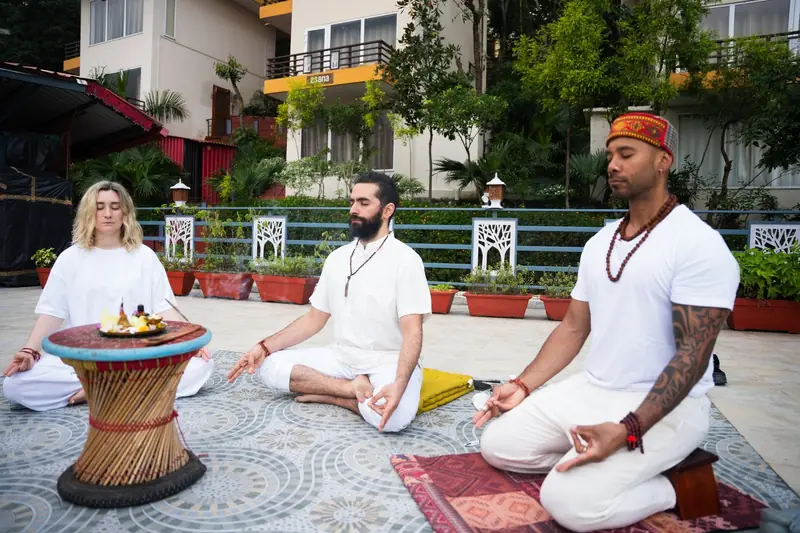
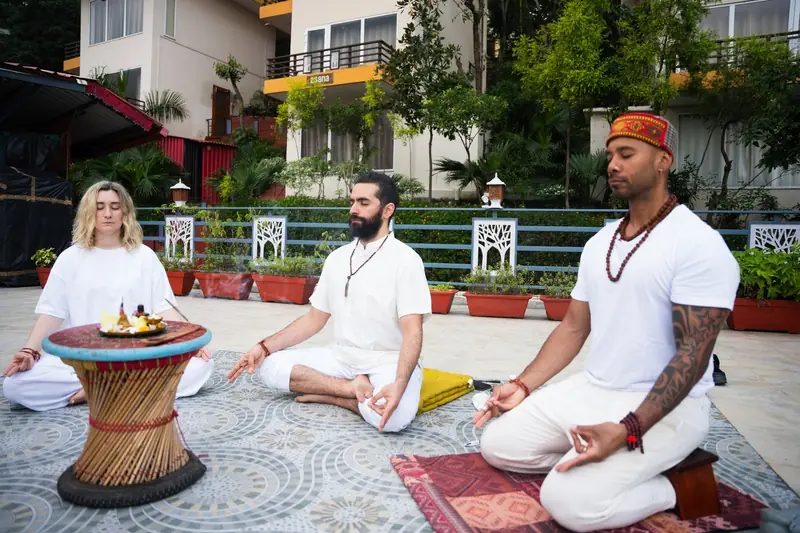
Pictured: Aaron practicing Uddiyana Bandha (Upward Abdominal Lock) with Bāhya Kumbhaka (breath retention after exhalation)
The Space Between The Breaths
Have you ever noticed the small pause that lives between your inhale and your exhale? For most practitioners, this pause passes unnoticed. The body rushes from one breath into the next because not breathing feels, at some primal level, like a threat to life. The body clings.
But the pause is not a gap. It is not absence. In the yogic tradition, that small still point is a doorway. Learning to remain there with steadiness changes the practice entirely. This is kumbhaka, the breath retention, and it is one of the most refined teachings in the Hatha tradition.
Before going further, a note. Breath retention is an advanced practice. It belongs after a foundation of natural, diaphragmatic breath has been established, and after the body has been prepared through asana and steady pranayama. Nothing in this article is medical advice. Approach kumbhaka with patience and discernment.
What Is Kumbhaka?
The word kumbhaka (कुम्भक) comes from the Sanskrit root kumbha (कुम्भ), meaning pot or vessel. The literal sense of kumbhaka is therefore that which makes the body into a pot, a vessel that holds.
In Hatha Yoga, kumbhaka refers to the deliberate retention of the breath. There are two primary forms.
Antar kumbhaka (अन्तर् कुम्भक) is the internal retention, the held space after a full inhalation.
Bāhya kumbhaka (बाह्य कुम्भक) is the external retention, the held space after a full exhalation.
The classical tradition also speaks of kevala kumbhaka (केवल कुम्भक), the spontaneous retention that arises on its own through long practice, where the breath simply suspends without effort or counting. This is considered the highest form.
The Story Of The Potter
There is an old teaching story passed through the oral tradition of Hatha Yoga. A student comes to his teacher and asks to learn pranayama. Instead of teaching him to breathe, the teacher takes him in silence to the village potter.
They sit and watch. The potter shapes a lump of clay on the wheel, hollows it, lifts the walls, forms the mouth of the pot. When the form is complete he sets it aside to dry. The student turns to his teacher and asks if the pot is finished.
The teacher says no.
First the pot must be fired in the kiln. Then it must be glazed. Without the firing and the glaze, the pot may look complete, but it is porous. Pour water into it and the water will seep through the walls and disappear. The form is there but nothing is contained.
They wait. The pot is fired. The pot is glazed. Water is poured in, and this time the vessel holds.
The teacher turns to the student.
Your body is the pot. Your prana is what fills it. You have spent years shaping the vessel through asana and through the inhale and exhale. But without its seal, without kumbhaka, everything you pour in leaks out. Prana enters and prana leaves, and nothing is sustained. To seal the pot, you learn to pause.
This is the heart of kumbhaka. Not a technique of force, but the sealing of the vessel.
Kumbhaka In The Classical Texts
The Hatha Yoga Pradīpikā, one of the foundational texts of Hatha Yoga, is unambiguous about the importance of breath retention. In Chapter Two, Svātmārāma writes:
Yāvad baddho marud dehe yāvac cittaṃ nirākulamYāvad dṛṣṭir bhruvor madhye tāvat kālabhayaṃ kutaḥ
The literal translation is: As long as the breath is held in the body, as long as the mind is undisturbed, as long as the gaze is fixed between the brows, where then is the fear of death?
The text places kumbhaka at the centre of the pranayama practice. The inhale and the exhale are described as preparations. The retention is where transformation occurs, because in the held breath the fluctuations of the mind begin to settle.
This connects directly to Yoga Sūtra 1.2 of Patañjali:
Yogaś citta vṛtti nirodhaḥ
Yoga is the stilling of the fluctuations of the mind.
The breath and the mind move together. Hold one with care, and the other begins to quieten. The Hatha Yoga Pradīpikā goes further in 2.2: Cale vāte calaṃ cittaṃ niścale niścalaṃ bhavet. When the breath is unsteady the mind is unsteady. When the breath is still the mind becomes still.
Kumbhaka is the practical bridge between these two truths.
The Bandhas And The Sealed Pot
The bandhas (बन्ध), the energetic locks of the Hatha tradition, are intimately connected to kumbhaka. They are what allow the retention to be safe and to gather the prana rather than scatter it.
Jālandhara bandha (जालन्धर बन्ध), the throat lock, contains the upward movement of prana during antar kumbhaka.
Mūla bandha (मूल बन्ध), the root lock, contains the downward movement of apāna.
Uḍḍīyāna bandha (उड्डीयान बन्ध), the abdominal lock, draws the prana upward and is most often used with bāhya kumbhaka.
Together, the three locks form what is called mahā bandha (महा बन्ध), the great seal. This is the firing and glazing of the pot. The bandhas are not separate from kumbhaka. They are how the vessel holds.
Embodied Application
In Asana
Kumbhaka does not need to live only in the formal pranayama portion of the practice. The pause is already present in every asana you hold. When you settle into a posture and the breath naturally suspends for a moment at the top of the inhale or the bottom of the exhale, you are touching kumbhaka.
A gentle way to begin is to slow the breath in standing postures and notice that small pause. Do not force. Do not extend. Simply observe that the pause exists, and let the awareness rest there.
A practical caution. Never practice intentional breath retentions in inversions or in headstand. The pressure dynamics of inverted postures combined with held breath are not appropriate. Keep retentions for upright, seated, or grounded postures.
In Pranayama
In a formal seated pranayama practice, kumbhaka is often introduced gradually through ratios. A common starting ratio is 1:1:2, where the inhale is one count, the retention is one count, and the exhale is two counts. As capacity matures, this evolves to 1:2:2 and eventually to 1:4:2, the classical ratio described in many Hatha texts.
These numbers are not goals. They are scaffolds. The intention is not to achieve a long retention but to allow the breath to become smooth, even, and unhurried within whatever ratio is comfortable today.
A teaching that has been emerging in our own practice is this. On the inhale, draw the prana inward and gather it gently at the centre of the forehead. On the exhale, the breath leaves the body but the prana itself is retained. The breath is the vehicle. The prana is the cargo. Kumbhaka is the moment when the cargo is fully received.
In Meditation
The deepest expression of kumbhaka is kevala kumbhaka, the spontaneous suspension of breath that arises in deep meditation. The practitioner is not holding the breath. The breath has simply paused on its own, because the mind has paused.
This cannot be forced. It arises as a natural consequence of long, patient practice. But it can be invited. When the mind becomes very quiet in meditation, notice whether the breath also becomes very quiet. The two move together. Where the mind goes, the breath follows.
A core teaching from the meditation tradition is worth remembering here. Holding the breath unconsciously is a sign of overthinking. When a person is anxious or caught in mental loops, the breath becomes shallow and held. The first work of meditation is to learn to breathe effortlessly into the belly, to dissolve that unconscious holding. Only then is the conscious holding of kumbhaka useful.
Daily Life Integration
The Three Doṣas And The Breath
From the Ayurvedic perspective, kumbhaka must be approached differently depending on constitution.
Vāta predominant practitioners often have a leaner, less stable physical container. The vessel itself is more porous. For vāta types, aggressive retentions can be destabilising and can amplify fear and anxiety. The recommendation is to work intuitively. Notice the natural pauses between inhale and exhale. Linger there for a moment without counting. When the urge to breathe arises, follow it. Build the container patiently through consistent asana before working with formal ratios.
Pitta predominant practitioners are often competitive and may turn breath retention into a measured contest. For pitta types, the more beneficial focus is on the exhale retention, bāhya kumbhaka, which has a cooling and pacifying quality on the mind and the heart.
Kapha predominant practitioners often carry heaviness, lethargy, and congestion in the chest. For kapha types, the inhale retention, antar kumbhaka, is enlivening. It opens the chest, expands capacity, and moves the stuck quality that kapha tends to accumulate.
This is the intelligence of the tradition. The same practice meets different bodies in different ways.
The Nervous System
Modern physiology echoes what the tradition has known for centuries. Long, slow exhalations and gentle exhale retentions stimulate the parasympathetic branch of the nervous system, the rest and digest response. Inhale retentions, used carefully, can support alertness and clarity.
The work is not to override the nervous system, but to learn its rhythms and to use kumbhaka as a way of speaking to it directly.
Key Takeaways
Kumbhaka means pot or vessel, and refers to the retention of the breath that seals prana within the body.
The two primary forms are antar kumbhaka, the internal retention after the inhale, and bāhya kumbhaka, the external retention after the exhale.
Kevala kumbhaka is the spontaneous retention that arises through deep practice and quiet mind.
The Hatha Yoga Pradīpikā places kumbhaka at the centre of pranayama, where the breath and mind become still together.
The bandhas are the energetic locks that contain prana during retention. Without them, the practice scatters rather than gathers.
Kumbhaka is an advanced practice. Build a foundation of natural diaphragmatic breath and steady asana before introducing formal retentions.
Approach retentions according to your constitution. Vāta works gently and intuitively. Pitta benefits from exhale retentions. Kapha benefits from inhale retentions.
Never practice breath retentions in inversions or headstand.
Listen & Watch the Full Episode
If this exploration of kumbhaka has resonated with you, listen to our full conversation on the Om Som Yoga and Ayurveda Podcast, where we unpack the practice in detail and share more on the relationship between breath, prana, and the doṣas.
Listen here.
Want to Learn More?
Ready to root your yoga practice in tradition? Join our upcoming 200-Hour Hatha Yoga Teacher Training in Sri Lanka (July 2026), a six-month immersive journey grounding you in the principles of Hatha Yoga and Ayurveda.