Prithvi—the Earth Element in Yoga and Ayurveda
Listen to this episode on Spotify →
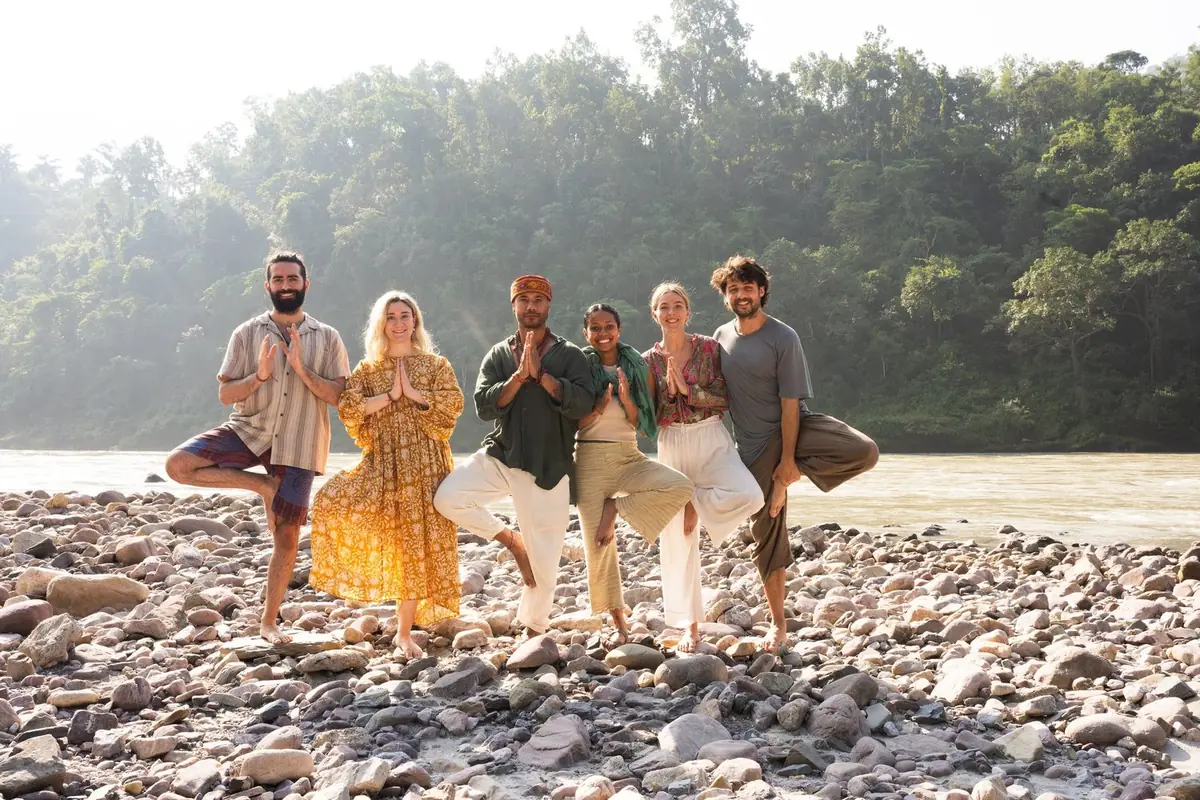
(Pictured: 300 Hr YTT graduates practicing Vrksasana (tree pose) by the Ganges River, Rishikesh)
What is Prithvi Tattva?
Prithvi means Earth, and Tattva means quality or element.
Earth symbolises heaviness, stability, hardness, and slowness — the qualities that form the physical structure of the body and mind.
As Aaron explains:
“Bones are heavy, stable, hard, and slow-moving — much like the Earth element. Our physical body’s tissues, bones, ligaments, and muscles embody this quality of Earth.”
Bhumi Devi: The Earth Goddess
In yogic and Vedic traditions, Earth is personified as Bhumi Devi, the nurturing goddess who supports and nourishes without judgment. She represents abundance and motherly care — a reminder that the Earth gives freely and sustains all life.
Paige shares:
“Bhumi Devi sits calmly on a lotus, often holding healing herbs. She embodies the endless support and nourishment Earth provides.”
Recognising Earth in Body and Mind
Excess Earth can manifest as lethargy, dullness, stagnation, attachment to possessions, slow digestion, and physical heaviness.
Deficient Earth may appear as spaciness, instability, anxiety, brittle bones (like osteoporosis), or poor balance.
As Aaron notes:
“People with too much Earth tend to have rigid routines and physical heaviness. Those with depleted Earth might be creative but struggle to ground their ideas or feel anxious and unsettled.”
View this post on InstagramA post shared by Traditional Hatha Yoga, Meditation & Ayurveda (@omsom.yoga)
Cultivating Earth in Practice
Asana
Focus on grounding through your feet and pelvis — yielding your weight to the Earth to receive stability.
Postures like Tadasana (Mountain Pose), Vrikshasana (Tree Pose), forward folds like Paschimottanasana, and squats such as Malasana cultivate Earth’s qualities of stability and rootedness.
Pranayama
Slow, deep breathing with an emphasis on extending the exhale fosters calmness and grounding.
The exhale activates abdominal muscles that support the spine, enhancing physical stability.
Meditation
Meditate on the Muladhara (Root) Chakra, the energetic centre associated with Earth.
Use the bija mantra “Lam” and visualise a steady yellow square at the base of the spine to cultivate Earth’s stability and strength.
Reflect on the elephant, symbolising strength and groundedness.
Bringing Earth Off the Mat: Everyday Practices
Walk barefoot on natural earth to connect physically and energetically with the planet.
Practice forest bathing or spend time in nature, surrounded by trees, mountains, or any Earth-rich environment.
Develop and maintain consistent routines and structures in your daily life to anchor your mind and body.
Why Earth Matters in Yoga and Ayurveda
The five great elements — Earth, Water, Fire, Air, and Space — form the building blocks of the universe and our bodies. Understanding Earth’s role helps us diagnose imbalances and tailor practices for individual needs.
Aaron sums it up:
“The elements are ordered from dense to subtle: Earth is the most dense and stable, laying the foundation for the other elements to arise.”
Want to Learn More?
Listen to the full episode, Prithvi: The Earth Element in Yoga & Ayurveda, on the Om Som Yoga & Ayurveda podcast for a deep dive into how Earth shapes our body, mind, and practice.
Ready to root your yoga practice in tradition? Join our upcoming 200-Hour Hatha Yoga Teacher Training (October 2025) in Berwick, Victoria — a six-month immersive journey grounding you in the principles of Hatha Yoga, Ayurveda, and the elements.