Vyana Vayu: The Prana That Holds Everything Together
Have you ever taken a deep breath and felt as though it stopped somewhere in the chest? The lungs fill, there is volume, there is effort, but something in the body does not quite receive it. The breath moves, but it does not distribute.
This is not a breathing problem. It is a vyana problem.
In the yogic understanding of the body, it is not enough to draw prana in. The body must also be capable of circulating it, of sending nourishment from the centre to the peripheries, from one system to the next. This quality of spreading and pervading is vyana vayu, and it is the subject of this post.
What Is Vyana Vayu?
Sanskrit: vyana vayu (व्यान वायु)
Romanised transliteration: vyana vayu
Literal meaning: the wind or force that spreads, pervades, or expands outward in all directions
Vyana derives from the Sanskrit root vyá, which means to spread, to pervade, or to expand outward in all directions. Vayu means wind or movement of energy.
In the framework of the five prana vayus, which includes prana, apana, samana, udana, and vyana, each vayu governs a distinct movement of life force in the body. Prana vayu draws energy inward and upward. Apana vayu releases downward. Samana vayu integrates at the centre. Udana vayu governs upward expression. Vyana vayu is the one that moves between all of these, circulating and distributing so that each can do its work.
Physiologically, vyana corresponds to circulation: the movement of blood through the body, the warmth that reaches the fingertips, the colour that returns to the face. In the breath, it is the smoothness between the parts of the inhale, the continuity from the belly to the ribs to the chest, without pausing or catching in between. It is the fullness of the breath, not its volume, but its distribution.
The Story from the Prashna Upanishad
The Prashna Upanishad contains a remarkable story that places vyana vayu within the larger context of the five pranas.
The five pranas are engaged in an argument. Each believes itself to be the most essential force of life. Prana says it is the most important. Samana disagrees. Apana makes its case. Udana and vyana do the same. To settle the debate, they agree on a test: each will leave the body in turn, and they will observe what happens.
When apana withdraws, elimination is disturbed and the body becomes ungrounded, but life continues. When samana leaves, digestion weakens and assimilation becomes difficult, but the body carries on. When udana departs, speech falters and clarity diminishes, yet life remains. When vyana withdraws, energy no longer reaches the limbs, the blood ceases to circulate, and the body becomes fragmented, but it does not collapse entirely.
Then prana begins to leave. As it does, all of the other pranas follow. The body does not merely weaken. Life itself begins to depart.
In that moment, all five pranas understand the truth: prana is the most vital, but it cannot act alone. The deeper teaching is one of interdependence. All five functions are required. Each depends on the others. And it is vyana, the force of circulation and cohesion, that holds them all in relationship so that they can work as one integrated system rather than five separate forces.
What the Texts Say
The Hatha Yoga Pradipika describes vyana vayu as the force that governs circulation, peripheral movement, and the integration of bodily systems. Imbalance in vyana often presents as fatigue, poor circulation, restlessness, or a sense of disconnection from the limbs. The text also states that vyana pervades the entire body, supporting the movement of prana throughout. Without vyana, prana is received but not distributed. It arrives and then sits, unable to reach where it is needed.
This is a significant teaching. So much attention in yoga and Ayurveda goes toward building prana: deeper breathing, more nourishing food, restorative practices. All of that is valuable, but if vyana is depleted, the prana that is gathered simply stagnates at the centre. You can think of it as a river that collects water but has no current to carry it to the fields.
Vyana in the Body and Breath
In Asana
Vyana vayu is most clearly felt in the transitions. Not the poses themselves, but the way the body moves from one to the next. A practice with strong vyana has a sense of flow and cohesion: from standing to the floor, from backbend to forward fold, from asana into savasana. The body feels like one integrated thing rather than a series of disconnected parts.
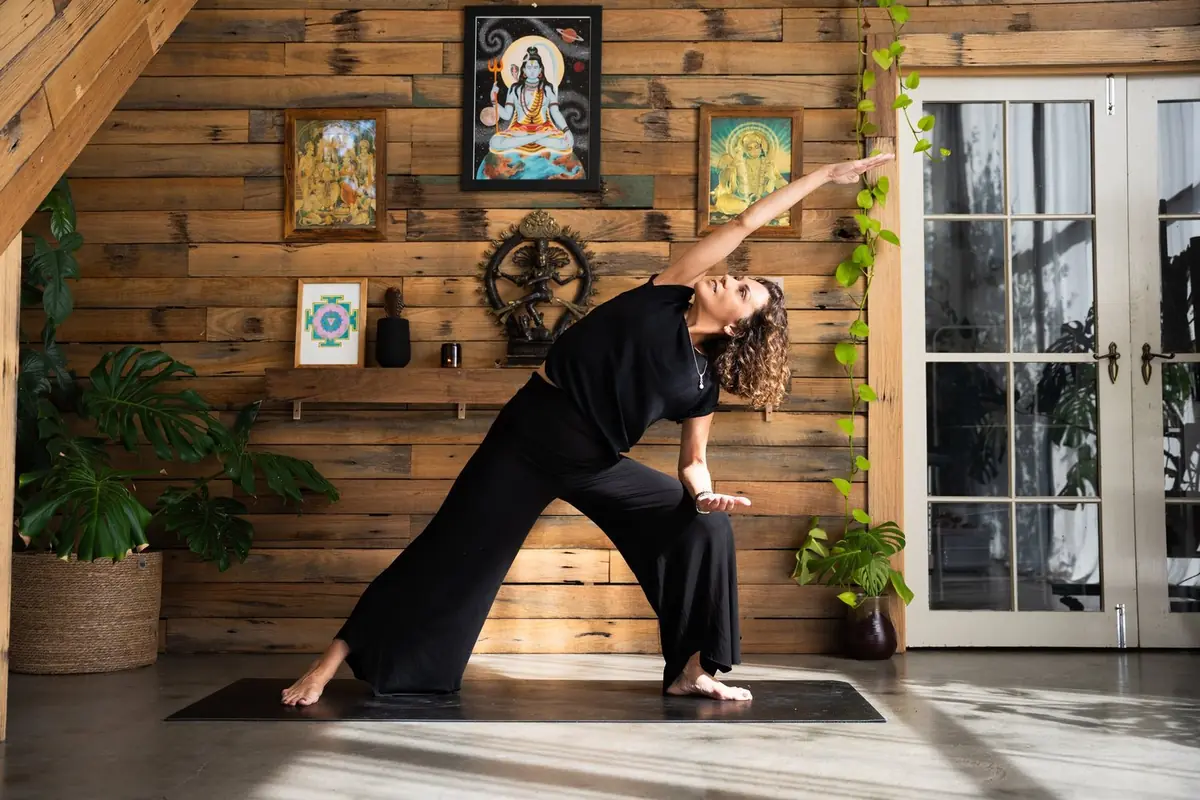
Practices that specifically cultivate vyana include lateral bending, backbending, Surya Namaskar, and what the tradition calls brahmana practices: expansive movements paired with the inhale that encourage the breath and prana to spread. Spinal rolls are another excellent example. When done slowly and with awareness, you can feel how each vertebra connects to the next, creating a wave through the entire spine rather than isolated segments of movement.
Vyana also relates to the synergy within movement. When you internally rotate your shoulder, for instance, that action does not begin at the shoulder joint alone. It begins at the hand, travels through the wrist, the forearm, the elbow, and arrives at the shoulder. Each part is connected. Vyana is the energetic principle that makes this connectedness functional rather than theoretical.
In Pranayama
Vyana is the quality of smoothness and continuity in the breath. It is the absence of pause or break between the belly rising, the ribs expanding, and the chest lifting on the inhale. An inhale with good vyana feels full and unobstructed. Practices that support vyana include extended inhales and kumbhaka, the retention of the inhale, which encourages the breath to spread and reach into the peripheries of the body.
In Meditation
Vyana is what allows awareness to be distributed throughout the whole body rather than localised in one place. The instruction to become aware of the entire body at once, of breath in the belly and the ribs and the chest simultaneously, is an instruction to activate vyana. Without it, awareness stays local. With it, the body is experienced as a unified whole.
Vyana in Daily Life
Vyana vayu relates to adaptability. When it is strong, a person can move fluidly between circumstances, environments, and social situations. They can enter a new environment, read it, adjust to it, and move on. When vyana is depleted, there is a quality of rigidity or stuckness: difficulty adapting to change, an inability to move between states, a sense of being fixed in one way of experiencing things even when the circumstances call for something different.
This extends across the gunas and doshas as well. Vyana is what allows movement from tamas into rajas, from rajas into sattva. It is the energetic mobility that prevents fixation in any one quality. A person stuck in tamas needs vyana to begin moving. A person agitated by excess rajas needs vyana to transition toward calm. The movement itself is vyana.
It is also worth noting what vyana is not. It is not the kind of movement that agitates. It is not busyness or restlessness. It is the capacity to move from stillness into action and back again, according to what is needed. If you find yourself unable to rest, that may be a problem of excess movement rather than a lack of vyana. The quality being cultivated is adaptability, not constant activity.
Stillness, too, depends on vyana. Savasana is still, but the breath continues to move. The blood continues to circulate. Without vyana, even stillness stagnates. Vyana is what gives stillness its nourishing quality and ensures that when the time for rest is complete, the body and mind can return to movement with ease.
Vyana Vayu Mudra
A simple and accessible practice for cultivating vyana vayu is the vyana vayu mudra.
To form it: bring the tip of the thumb to touch the tips of both the index finger and the middle finger simultaneously, at the fingerprints. The ring finger and little finger extend outward. Hold this in one or both hands, with the palms resting comfortably.
This mudra is most useful when you feel stuck, when you need to shift between states or adapt to a new circumstance. It is also supportive when there is poor circulation to the hands or feet, when the body feels fragmented or disconnected, or when different areas of life feel as though they are operating in isolation from one another rather than as a coherent whole.
Key Takeaways
Vyana vayu derives from the root vyá, meaning to spread or pervade outward in all directions.
Vyana governs circulation, peripheral movement, and the integration of all bodily systems, both physically and energetically.
The Prashna Upanishad teaches that the five pranas function through interdependence, and it is vyana that holds their collective functioning together.
In the breath, vyana is the smoothness and continuity between each part of the inhale: belly, ribs, and chest moving as one wave.
In asana, vyana is most apparent in the transitions between poses and in the overall sense of a practice feeling holistic rather than disjointed.
Practices that support vyana include lateral bends, backbends, Surya Namaskar, and extended inhale retentions.
In daily life, vyana is the capacity to adapt: to move between states, environments, and circumstances without becoming stuck in any one of them.
The vyana vayu mudra, thumb touching index and middle finger with ring and little fingers extended, can be used whenever you feel stuck, depleted, or disconnected from the peripheries of your body or life.
Listen to the Full Episode
Aaron and Selenna explore vyana vayu in depth in this episode, including the story from the Prashna Upanishad, the relationship between vyana and the other pranas, and how this quality shows up across the gunas and doshas.
Listen to the full episode here:
Want to Learn More?
Ready to root your yoga practice in tradition? Join our upcoming 200-Hour Hatha Yoga Teacher Training in Sri Lanka (July 2026), a six-month immersive journey grounding you in the principles of Hatha Yoga and Ayurveda.