What Is Sthiram Asanam? Meaning, Benefits & Practice Explained
Listen to this episode on Spotify →
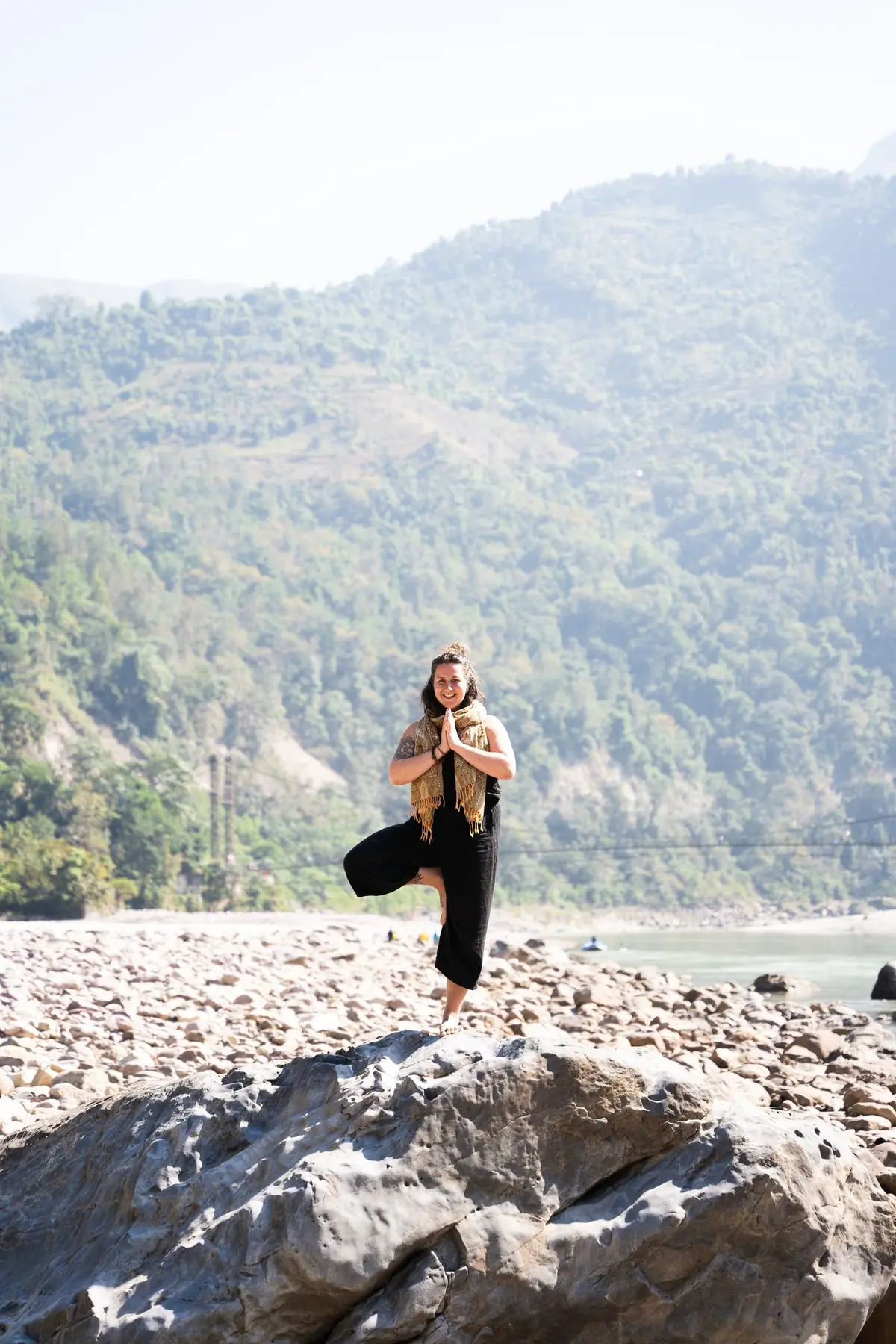
Pictured: Lina practicing Vriksasana by the Ganges River
Building Steadiness Before Flow
Does your body ever feel busy but not actually steady? You might be moving constantly, putting in effort everywhere, yet still feel unsupported underneath it all. In yoga practice, this often gets mistaken for laziness or lack of motivation. In reality, the body does not feel safe enough to settle. We explore Sthiram Asanam and why steadiness must come before movement, flow and ease.
What Does Sthiram Asanam Mean?
Sthiram Asanam comes from Sanskrit. Sthiram means steady, stable, firm, supported, grounded and unmoving. Asanam means seat, posture or a place where we establish ourselves. Together, Sthiram Asanam refers to a posture that is truly inhabitable. It is not something we force or endure. It is a position where the body feels held, supported and able to rest into itself. This concept forms the foundation of classical yoga practice and appears repeatedly across the Yoga Sutras and Hatha Yoga texts.
Why Stability Comes Before Flow
Many modern yoga practices prioritise movement, pace and variety. We flow quickly from one posture to the next, often without ever fully arriving. The result is a practice that looks dynamic but does not feel grounding. As discussed in the episode, stability comes before flow. If the body is not rooted, everything else feels hard. Without steadiness, effort increases, breathing becomes shallow and the nervous system remains alert rather than settled. When stability is established first, movement becomes lighter and more sustainable.
The Body Needs Support Before It Can Relax
A powerful teaching comes through the story of Bhumi Devi, the Earth Goddess, from the Puranas. Bhumi Devi collapses under the weight of neglect and sinks into the cosmic ocean. She does not need to become stronger. She needs to be held correctly. Vishnu, in the form of Varaha the boar, lifts her and places her back into her rightful position. Only then does order return. This story mirrors our physical practice. The body does not need to try harder. It needs correct support. When alignment distributes weight through the bones rather than the muscles, steadiness arises naturally and the mind can take its seat within the body.
Where Steadiness Is Built In Asana
In Hatha Yoga, stability begins at the feet. The misconception that a straight spine creates steadiness overlooks the foundation beneath it. By spreading the toes, increasing surface area and yielding weight into the earth, the body receives support back from the ground. This is the push and yield relationship with the earth element. From there, stability travels upward through the ankles, knees and hips. When joints are stacked correctly, gravity moves cleanly through the structure and effort decreases. Alignment is not about forcing shapes or creating straight lines. It is about where bones and joints sit in relation to each other.
View this post on InstagramA post shared by Traditional Hatha Yoga, Meditation & Ayurveda (@omsom.yoga)
Holding Postures Builds True Strength
The episode highlights an important physiological insight. There are two types of muscle fibres, fast twitch and slow twitch. Fast twitch fibres develop through repetitive movement and dynamic effort. Slow twitch fibres develop through sustained holding and isometric work. Many people are strong but unstable because they have not developed the muscles that hold and stabilise. This is why holding standing postures, rather than constantly flowing through them, builds a deeper kind of strength. As the Hatha Yoga Pradipika states, asana steadies the body, destroys disease and gives lightness to the limbs. Steadiness is not something we force. It is something that arises through consistent practice.
Steadiness Of Body Leads To Steadiness Of Mind
Across classical texts, a clear relationship is established between body and mind. The Hatha Yoga Pradipika states that steadiness of the body leads to steadiness of the mind. Patanjali echoes this in the Yoga Sutras where he places Sthiram before Sukham. Steadiness comes before ease. When effort is relaxed through correct alignment and awareness, the posture becomes mastered. Over time, this steadiness extends beyond the mat. The body feels more grounded. The mind becomes less reactive. Decisions are made with clarity rather than urgency.
Practicing Sthiram On And Off The Mat
Practically, cultivating Sthiram begins with simplicity. Choose a few standing postures such as Tadasana, Warrior poses or Goddess and practice them slowly. Pay attention to the feet first. Avoid rushing transitions. Move slowly enough to maintain stability throughout the movement rather than losing it and trying to regain it. Off the mat, Sthiram shows up as routine, boundaries and pacing. It looks like not rushing into the next thing. It feels like pausing before acting. It means establishing yourself before stepping forward. Steadiness in the body becomes steadiness in life.
Key Takeaways
Sthiram Asanam means building steadiness before seeking flow or ease. Stability begins at the feet and travels upward through alignment rather than muscular effort. Holding postures develops the muscles responsible for true support and balance. Classical yoga texts consistently place steadiness as the foundation of asana practice. When the body is steady, the mind naturally follows. Sthiram is not something we try to create but something we allow by positioning ourselves correctly.
Want to Learn More?
Listen to the full episode, Sthiram Āsanam - The Foundation of Asana Practice, on the Om Som Yoga & Ayurveda podcast for an in-depth discussion.
Ready to root your yoga practice in tradition? Join our upcoming 200-Hour Hatha Yoga Teacher Training in Sri Lanka (July 2026), a six-month immersive journey grounding you in the principles of Hatha Yoga and Ayurveda.