What Is Soma in Yoga? Nourishment, Rest & the Nectar Within
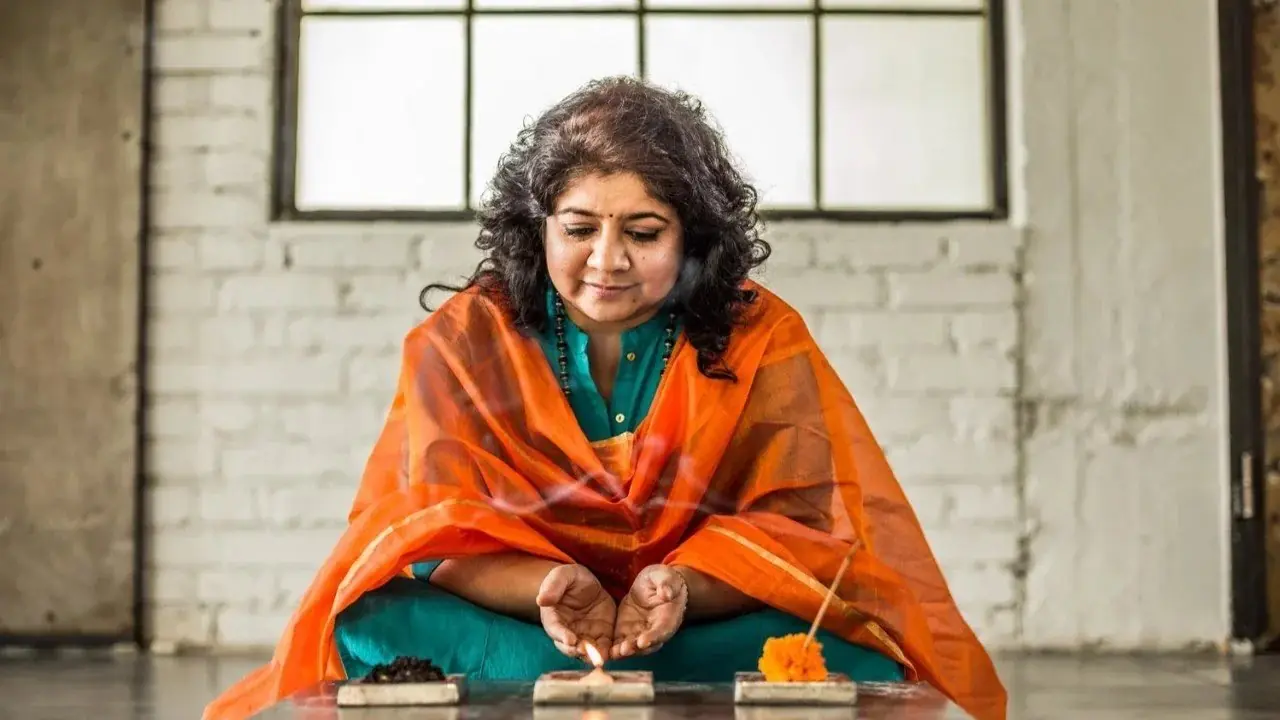
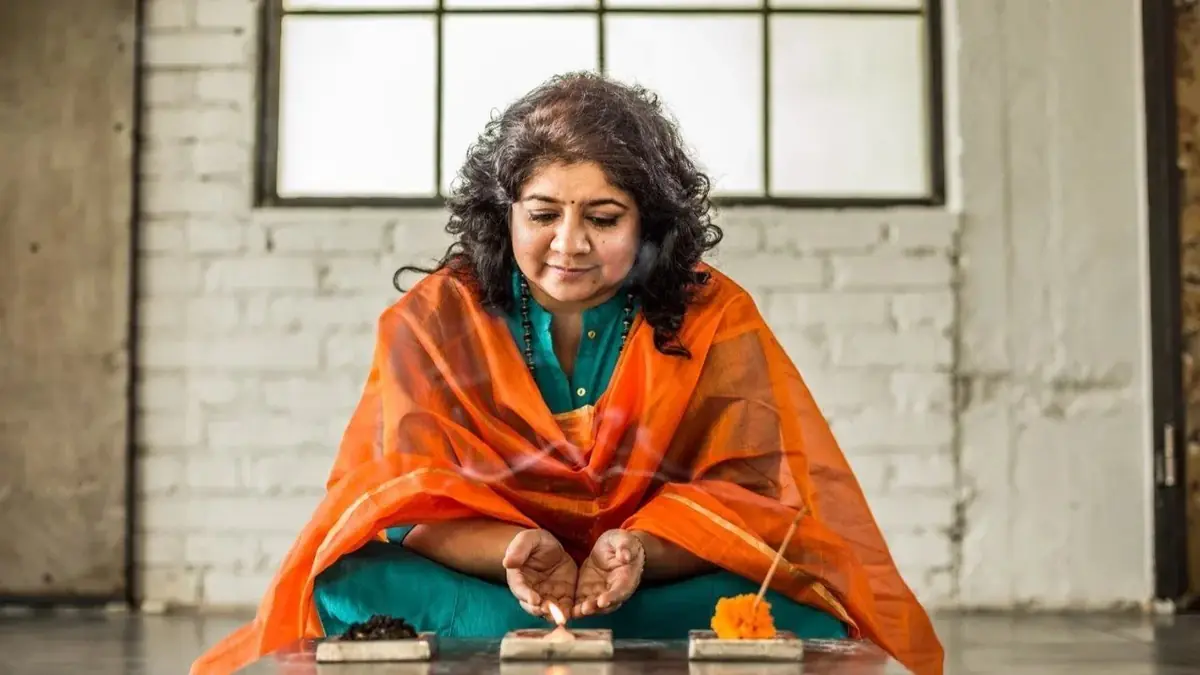
Pictured: Indu Arora
Have you ever left a yoga class feeling more depleted than when you arrived? More wired, more tired, more caught in the loop of doing? If so, you are not alone. And according to teacher and author Indu Arora, this experience points to something worth examining honestly: the difference between yoga as a work-out and yoga as a work-in.
In a recent conversation on the Om Som Yoga and Ayurveda Podcast, Indu Arora shared her understanding of soma, one of the most quietly powerful concepts in the yogic and Ayurvedic traditions. The word points toward something we may already sense but rarely name: a quality of restfulness, nourishment, and inner cohesion that is not found by doing more, but by learning how to settle.
What Is Soma?
Soma (Sanskrit: सोम, romanised: soma) comes from the ancient Vedic tradition. Literally, soma refers to the juice, sap, or nectar of a sacred plant offered into fire ceremonies as an invocation of immortality and divine blessing. In the Rigveda, the oldest of the four Vedas, soma is both a ritual offering and a cosmic substance associated with the moon, with nourishment, and with life itself.
In yoga, however, the external ritual is turned inward. What once belonged to the fire ceremony is realised within the practitioner's own subtle body.
As Indu explains it, soma in the yogic context is "a state of mind. When someone has soma, they are called somya, which means they have soma. There is a calming, quietening, steady presence. There is a nurturing, nourishing, steady presence. So soma is a quality of the mind, something invisible, but something palpable."
This is soma not as a substance to be obtained, but as a state to be uncovered.
The Moon and the Tides of Mind
Classical yogic texts often compare the mind to the moon, and soma to its lunar essence. Just as the moon governs the ocean's tides, this subtle lunar energy governs the rising and falling of our inner states. The high tides are excitement, motivation, courage. The low tides are fear, sadness, worry, and anger. These rhythms, the emotional weather of our lives, are the ordinary expression of the mind in flux.
Soma is what remains when that flux becomes still. It is the condensed drop of nectar at the centre of an otherwise restless ocean.
In the subtle body, the seat of soma is located within the Sahasrara chakra (the crown energy centre). Within it sits what is known as the soma chakra, also called the bindu chakra or indu chakra. Indu (इन्दु) means moon. From this point, when the mind is calm and the conditions are right, a drop of that nectar descends through the subtle channels and can be tasted in practice. When the mind is agitated, that same nectar is continuously consumed by the digestive fire, what Ayurveda understands as the ongoing process of catabolism and ageing.
This is why rest, in the deepest yogic sense, is not passive. It is a practice of preservation.
Yoga Is a Remembering, Not a Doing
In her conversation with Aaron Petty, Indu returned again and again to a single thread: that yoga is not something we acquire, but something we recognise. She shared a traditional ritual observed at birth in India, in which the very first words whispered into a newborn's ear are:
Tvam vedosi.
Tvam: you are. Vedosi: wisdom itself.
"Basically," she says, "just a reminder. Don't forget that."
The infant is, by nature, already in the state of yoga. Already soma. It is through the gradual accumulation of names, identities, ambitions, and habits that we forget. The whole of practice, then, is not a building but a returning. Not an achievement but a remembering.
This reframe has significant implications for how we practice, and for what we are actually seeking when we step onto a mat.
Philosophical Context
The concept of soma as inner nectar is elaborated across several classical texts. In the Hatha Yoga Pradipika and related tantric texts, practices such as viparita karani (a mild inversion) and khechari mudra are described specifically as methods for preserving or reversing the downward flow of soma, preventing its consumption by the digestive fire below.
In Kashmir Shaivism, the tradition in which Indu Arora is also deeply trained, the nature of the self is understood as inherently luminous and already whole. The obscurations are many, but they are not the ground. The ground is already in samadhi.
Indu offered a grounded etymology of this: "Samadhi is made up of dhi. Dhi means your mind. The mind is scattered. Samadhi means all of that gathered. A means to move forward and gather. When we gather all the scattered pieces of mind together, that is samadhi."
Soma is what becomes available when gathering happens. Not a peak experience reserved for advanced practitioners, but the ordinary luminosity of a mind that has, even briefly, stopped fragmenting itself.
Embodied Application
In asana:
The invitation is to approach each posture as a listening rather than a doing. Indu describes a sequence of feel, visualise, enter, hold, experience, release, reflect. This is not the performance of shapes. It is the cultivation of awareness within form. When that awareness is present, even a simple forward fold becomes an inquiry into the internal landscape.
In pranayama:
Breath is described in the yogic subtle body not as wind energy, but as prana, a fluid, cohesive force that Indu calls an extension of soma itself. When the breath is smooth, unbroken, and unhurried, it mirrors and invites the qualities of soma. A simple starting point is four counts of inhalation, four counts of exhalation, kept fluid like an unbroken circle. "There," she says, "you get three times a day a taste of soma."
In yoga nidra:
Yoga nidra is often reduced to a relaxation script or a technique for sleep improvement. Indu is clear that this misses the point entirely. In the classical texts, yoga nidra is not a practice but a state, sometimes described as a goddess, sometimes as a dissolution of ordinary consciousness into its source. The modern practice offers a structured pathway toward that state, but the destination remains: not nidra (sleep), but yoga. The nourishment of soma arises as a consequence of that depth, not as the goal of the technique.
In meditation:
The practice is not to do meditation, but to explore it. "We are always in the state of meditation," Indu says, "just like in the depth of the ocean there is always stillness. There is that place which is beyond the waves and the surfs and the tides. Our mind is very much like that." The deepest layer is already still. Practice is the art of stopping identification with the surface.
Daily Life Integration
Indu's most accessible instruction for integrating soma into ordinary life is also one of her most disarming: keep your forehead relaxed.
While cooking, while commuting, while speaking. Simply notice. Is the jaw clenched? Are the shoulders lifted? Are the toes curled? These micro-tensions are not incidental. They are the signatures of unresolved emotion, habitual reactivity, the ongoing cost of carrying the mind's restlessness in the body.
When we begin to identify and ease physical tension, we gain access to subtler layers. The body, the breath, and the mind form a continuum. Working at any one point begins to shift the others.
The larger principle is this: yoga need not be reserved for a single hour on a mat. It is designed to be, as Indu puts it, "sprinkled throughout the day." Thirty seconds of a smooth breath. A moment of releasing the forehead. A pause before responding. These micro-observations are not lesser practices. In some ways, they are the practice itself, because they bring the quality of awareness, the one thing that distinguishes yoga from any other form of movement or stillness, into lived experience.
"The difference between an ordinary activity and calling it yoga," Indu says, "is awareness."
Key Takeaways
Soma (सोम) is a Vedic and yogic concept referring to the inner nectar of the mind, associated with nourishment, lunar energy, and a state of settled, cohesive awareness.
In the subtle body, soma is seated at the soma or bindu chakra within the crown centre. It is preserved through restful, inward-oriented practice and depleted by agitation, overexertion, and scattered attention.
Yoga Nidra, mudra, pranayama, and asana are all pathways toward the experience of soma. None is the goal in itself.
True rest is not physical stillness with mental activity. It is pratyahara, the conscious withdrawal of the senses and attention inward, which may lead naturally toward relaxation, contemplation, or meditative states.
The simplest daily entry point is body awareness: releasing the forehead, the jaw, the shoulders, as an ongoing micro-practice throughout the day.
Yoga is a remembering. The state we are seeking was never absent.
Listen To The Full Episode
This blog draws from a conversation with Indu Arora recorded on the Om Som Yoga and Ayurveda Podcast. Indu shares her understanding of soma, yoga nidra, mudra, and the deeper purpose of practice with a clarity and warmth that is worth hearing in full.
Want to Learn More?
Indu Arora is coming to Om Som in Melbourne this May. She will be offering a series of workshops and trainings that explore the very teachings discussed in this episode, drawn from decades of study across the Himalayan, Kriya, and Kashmir Shaivism lineages.
If the ideas in this post have opened something for you, these offerings are a rare opportunity to go deeper with one of the most respected voices in traditional yoga and Ayurveda teaching today.
Listen to the full episode, Indu Arora on Soma, Samadhi & the Promise of Yoga, on the Om Som Yoga & Ayurveda podcast for an in-depth discussion.
Ready to root your yoga practice in tradition? Join our upcoming 200-Hour Hatha Yoga Teacher Training in Sri Lanka (July 2026), a six-month immersive journey grounding you in the principles of Hatha Yoga and Ayurveda.