So'ham and Hamsa: The Mantra You Have Been Repeating Your Whole Life

Listen to this episode on Spotify →
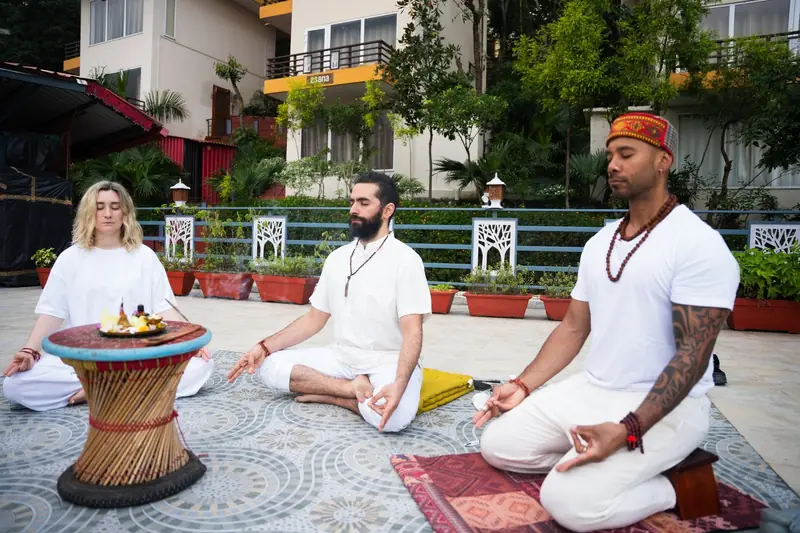
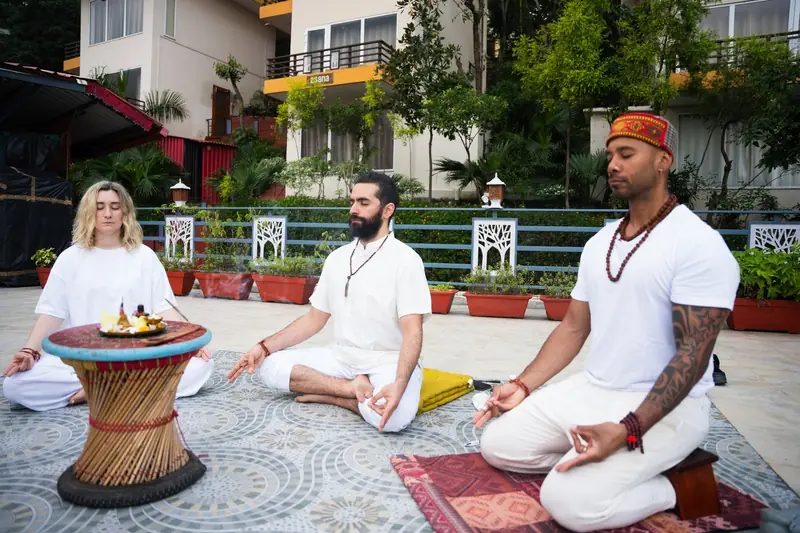
Pictured: Aaron practicing Soham Hamsa Pranayama
A Mantra You Did Not Choose
What if there were a mantra you had been repeating your entire life without knowing it? One you did not learn, one you did not choose, one that lives inside every breath. Every inhale: so. Every exhale: ham. Reverse it and it becomes hamsa, the swan, the one who moves between worlds without getting caught in them.
This is the teaching of So'ham Hamsa. It is not something we are learning today. It is something we are listening to. A mantra already happening, already woven into the rhythm of the body, waiting for our attention to turn toward it.
What Is So'ham Hamsa?
The mantra is written in Sanskrit as सोऽहम् (so'ham) and हंस (haṃsa). These two words are mirror images of one another, formed from the same syllables breathed in opposite directions.
So'ham is a compound of saḥ, meaning "that," and aham, meaning "I am." Together it translates literally as "I am that." The "that" here is not vague. It points to the vast, unbounded awareness that the yogic tradition recognises as the ground of being. The same emptiness we explored in our episode on śūnya, the void.
Haṃsa means "swan." When the same two syllables are reversed and observed in the natural rhythm of breathing, the inhale carries the sound ham and the exhale carries sa. The mantra is therefore both a statement of identity and a sound already moving through the body.
Because these syllables arise spontaneously with the breath, the tradition gives this mantra a special name. It is called the ajapa mantra. Japa means to repeat. Ajapa means the unrepeated repetition, the mantra that is not recited because it is always already sounding. We do not perform it. We tune into it.
The Swan Who Drinks Only Milk
In the mythology of India there is a celestial swan called Hamsa. This swan is said to possess a singular and remarkable ability. When milk and water are mixed together, Hamsa can drink only the milk and let the water glide past. The swan extracts what nourishes and leaves the rest untouched.
This mythology teaches viveka, the faculty of discernment. The capacity to distinguish what truly sustains us from what merely fills space. There is nothing wrong with water in this image. Water sustains a great deal of life. But it is not enough on its own. In the same way, the world is not bad, and we are not asked to reject it. We are asked to discern within it. To draw the deeper nectar from our experience and let the rest pass through without disturbance.
The yogi who embodies Hamsa moves through the world like the swan moves across the lake. Present, graceful, unhurried, and never compromised by what they touch.
Mantra as Protection for the Mind
Before going further, it is worth defining what a mantra actually is. The word breaks into two parts. Man means mind. Tra means to protect. A mantra protects the mind. From what? From its own habit of overthinking.
A mantra gives the mind a single thought to hold, repeated in a closed loop, until the constant proliferation of thinking begins to settle. Eventually the repetition itself dissolves into the silence underneath it. This is the practical function of mantra, though the tradition also speaks of mantra as vibration, as energy, as a gateway into deeper consciousness, and as the embodied form of a particular quality of awareness.
So'ham Hamsa is unique among mantras because it does not require us to begin. The breath has already begun it for us.
The Two Movements of the Mantra
So'ham and Hamsa are not two separate mantras so much as two directions of the same one. They describe two complementary movements of practice.
So'ham, "I am that," is the inward turning. It is the recognition that what we truly are is not the small story of the personality but the vastness in which all stories arise. This is the contemplative half of the mantra, the half that points us toward the silence we explored in the teachings on śūnya.
Hamsa, the swan, is the outward expression of that same realisation. Having recognised our nature as awareness, we move through the world with discernment. We drink the milk and let the water pass.
Together they describe the full arc of a mature practice. Inward into stillness, outward into wise action, and back again, breath after breath.
Embodied Application
In asana, So'ham Hamsa can be carried silently through the postures. Letting so arrive with each inhale and ham release with each exhale gives the mind a steady anchor while the body works. The practice becomes less about achievement and more about presence. Over time the mantra ceases to be something we are repeating and becomes something we are noticing.
In pranayama, the mantra deepens. Because the syllables already live inside the breath, pranayama becomes the practice of refining and lengthening that natural sound. In the current cycle of Sadhana Sangha we are working with So'ham Hamsa as a pranayama technique, combined with subtle kriya, to draw the awareness inward through the breath itself.
In meditation, the practice eventually becomes effortless. We are not generating the mantra. We are listening for it. The breath is already producing the sound. The work is simply to notice. This is what makes ajapa such a profound meditation. It removes the doer from the practice and leaves only the witness.
Daily Life Integration
The teaching of Hamsa is the teaching of discernment, and discernment is something we exercise constantly outside of practice. What we read, what we eat, who we spend time with, what we agree to, what we say no to. Each of these is a moment of separating milk from water.
A simple practical application is to pause before eating. Before sitting down to a meal, take one full breath and listen for so'ham. Let the mantra remind you that you are fueling the body for a clear, frictionless movement through your day. Then eat with that discernment intact.
The same approach can be used before opening a difficult message, before entering a stressful conversation, or before making a decision you have been turning over for too long. One breath. One round of the mantra. A return to the part of you that already knows the difference between nourishment and noise.
For those who tend toward negative thought loops or anxious spiraling, So'ham Hamsa offers a reliable anchor. You do not need to understand it intellectually for it to work. The repetition itself begins the work. Over time the experience catches up to the words, and what began as a tool becomes a recognition.
Key Takeaways
So'ham translates literally as "I am that," pointing to identification with the vast awareness underlying experience.
Hamsa means "swan" and symbolises viveka, the capacity to discern nourishment from distraction.
The mantra is called ajapa because it is already sounding in the breath. We tune into it rather than recite it.
So rides the inhale, ham rides the exhale. Reversed, ham and sa form the name of the celestial swan.
The mantra can be carried into asana, refined within pranayama, and rested in during meditation.
In daily life, So'ham Hamsa is a practice of pausing, listening, and choosing what truly nourishes.
Listen & Watch the Full Episode
If this exploration of Soham has resonated with you, listen to our full conversation on the Om Som Yoga and Ayurveda Podcast, where we unpack the mantra in detail and share more on the this rich yogic concept.
Listen here.
Want to Learn More?
Ready to root your yoga practice in tradition? Join our upcoming 200-Hour Hatha Yoga Teacher Training in Sri Lanka (July 2026), a six-month immersive journey grounding you in the principles of Hatha Yoga and Ayurveda.