What Is Pūrṇa? A Grounded Guide To The Mantra Of Wholeness

Listen to this episode on Spotify →
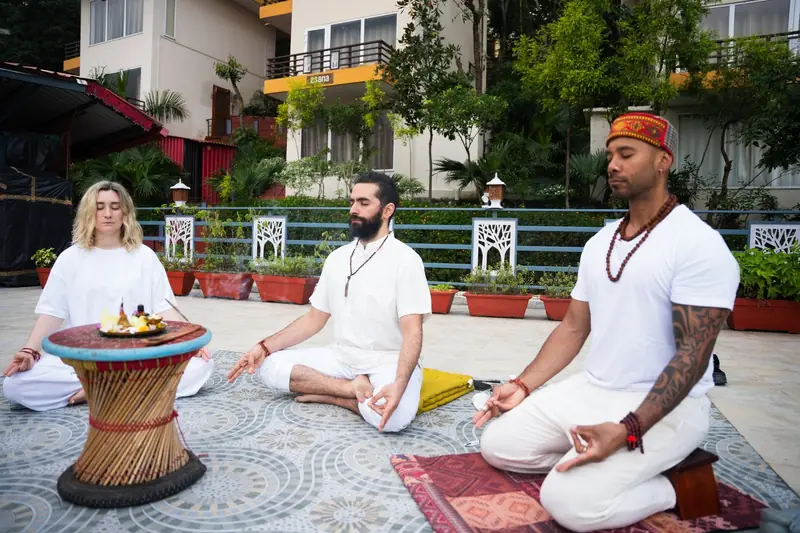
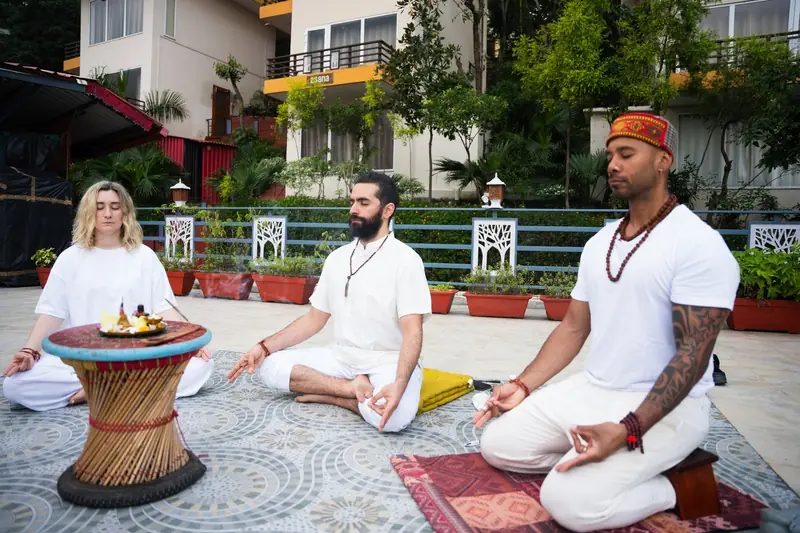
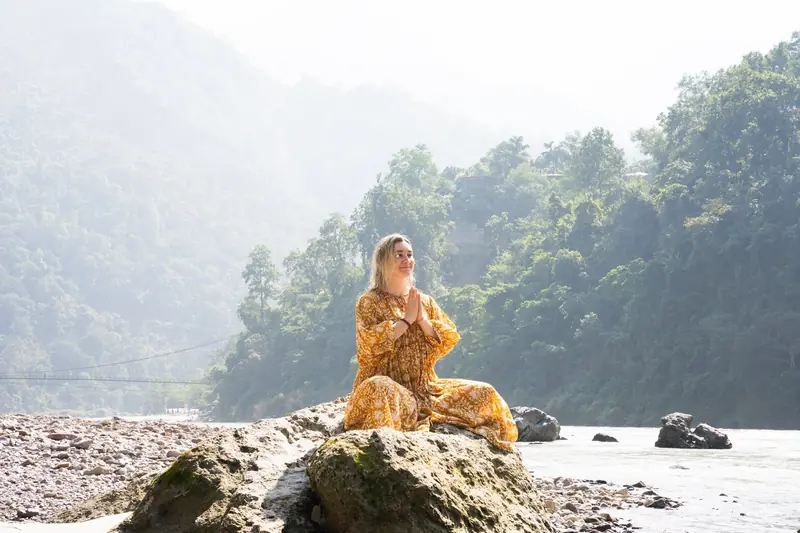
Pictured: practicing by the Ganga, Rishikesh
Have you ever noticed that when you give your time, your care or your energy, a quiet fear tends to follow close behind, the sense that you will now have less? We keep a running tally without meaning to. I gave this much, I received that much, and I would rather not end up short. It is a subtle accounting, and most of us run it all day long.
Purna is the teaching that gently interrupts that arithmetic. It is a Sanskrit word for fullness, and it points to something in us that has never been able to be spent. This post looks at what Purna means, the mantra that carries it, and how the recognition of wholeness can change the way we move through an ordinary day.
What Is Purna?
Purna is written पूर्ण in Devanagari and transliterated as pūrṇa. Its literal meaning is full, complete or whole. It is the same word used for the full moon, as in Guru Purnima, the full moon on which the teachers are honoured. When the moon is entirely full, it is purna.
In the yogic and Vedantic traditions the word carries this ordinary sense of fullness and then extends it. Purna is not fullness that has been added up or accumulated. It is a wholeness that was never partial to begin with, and therefore a wholeness that cannot be subtracted from. That single idea, that the whole remains whole no matter how much is drawn from it, is the heart of the teaching.
The Story Of The Lamp
There is a teaching story that carries this idea simply. A student comes to a teacher with an honest question. If I give my love away, will I have less love for myself?
The teacher answers with a lamp. Take one lamp, he says, and light another from it. Does the first flame grow any smaller? No, says the student, it stays exactly the same. Light a hundred lamps from it, a thousand, a million, and look again at the first flame. Is it any smaller now? No. It is unchanged.
From this the teacher offers the teaching on Purna, on fullness that cannot be reduced. Whatever is drawn from the whole leaves the whole undiminished. The student, still honest, presses further. Surely as a person I lose something when I give. My time, my energy, my care, even my sense of self. The teacher agrees, but draws a careful line. You will lose from what is countable, from what has taken form, from the person. Your hours are countable. Your thoughts are countable. The source they arise from is not.
The mantra of Purna is offered as a way to remember this. Chanting it is not a way of pretending to be whole or claiming to have everything. It is a way of remembering that you have never been anything other than whole.
Philosophical Context: The Non-Dual View
Purna is a non-dual teaching, and it belongs to the stream of thought known as Vedanta. The word is worth pausing on. The knowledge we gather is often called veda, and vedanta means the end of that knowledge, or that which lies beyond it. We come to know things by naming and measuring them, yet the moment we place a label on something it becomes a separate thing, cut out from the whole. Vedanta points to what remains when naming ends, and what remains, in this view, is that everything is one. This is the source of the familiar teaching that all is one.
Yoga is interesting here because it does not resolve the tension between this view and its opposite. Classical yoga rests on Samkhya, and Samkhya holds a non-negotiable duality between purusha, the one who observes, and prakriti, the world that is observed. There is the seer and there is the seen. Vedanta, by contrast, says the seer and the seen are ultimately one and the same. These are genuinely different pictures of reality, and yoga asks us to hold both, moving between them as each becomes useful. There is a yoga of living skilfully within the world of separate things, and there is a remembrance that beneath all of it there is only wholeness.
This same fullness appears in the Bhagavad Gita, where Krishna describes his own nature. In the ninth chapter he says, in his unmanifest form the whole universe is pervaded by him; all beings rest in him, yet he does not rest in them (Bhagavad Gita 9.4: mayā tatam idaṃ sarvaṃ jagad avyakta-mūrtinā, mat-sthāni sarva-bhūtāni na cāhaṃ teṣv avasthitaḥ). The forms rest within the whole, but the whole rests only in itself. It is an invitation to step out of the particular role we are playing and to rest, for a moment, in something larger.
The Mantra, Word By Word
The Purna Mantra reads:
ॐ पूर्णमदः पूर्णमिदं पूर्णात्पूर्णमुदच्यते ।
पूर्णस्य पूर्णमादाय पूर्णमेवावशिष्यते ॥
ॐ शान्तिः शान्तिः शान्तिः ॥
oṃ pūrṇam adaḥ pūrṇam idaṃ pūrṇāt pūrṇam udacyate,pūrṇasya pūrṇam ādāya pūrṇam evāvaśiṣyate,oṃ śāntiḥ śāntiḥ śāntiḥ.
The words unfold gently. Pūrṇam is fullness, the whole. Adaḥ means that, and here it points to the unmanifest, the source that lies before all form, so pūrṇam adaḥ is "that is whole." Idam means this, the manifest world we can see and touch, so pūrṇam idam is "this is whole." Pūrṇāt means from the whole, and udacyate means arises, so from the whole the whole arises. In the final line, ādāya means having taken and avaśiṣyate means that which remains, so having taken the whole from the whole, the whole alone remains. The closing oṃ śāntiḥ śāntiḥ śāntiḥ is the threefold invocation of peace.
Read plainly, it says: that is whole, this is whole, from the whole the whole arises, and when the whole is taken from the whole, only the whole remains. In the language of number it is even simpler. Infinity taken from infinity is still infinity. Words strain to hold the idea, yet the arithmetic of the infinite states it without effort.
Embodied Application
The Purna Mantra is not really a mantra to concentrate on the way we might use a seed mantra in meditation. It is a mantra to contemplate, and it can be used as an invocation, a way of setting a tone before practice or before the day. In the traditional language it helps create bhavana, a felt atmosphere or mood. Reciting it, or simply resting with its meaning, can invoke the feeling of fullness rather than the idea of it.
On the mat, this changes the quality of attention more than the shape of any posture. Practicing from fullness means arriving already complete, rather than practicing in order to become enough. The steadiness Om Som returns to again and again, stability before fluidity, less force and more intelligence, grows naturally out of this. There is nothing to chase when nothing is lacking.
In the breath, the teaching lands quietly. The breath is given and received without our needing to hoard it, an ordinary and constant demonstration that what sustains us is not owned but passes through us. In meditation and contemplation, Purna becomes an object to rest with rather than to analyse. We sit with the recognition that the awareness we are looking from has not increased or decreased across the whole of our lives, and we let that recognition settle.
Daily Life Integration
Where Purna becomes most practical is in the way we relate to what feels scarce. Time, attention, energy and love are, by their nature, inexhaustible, yet we tend to treat them as though they were countable and running low. In a world where the cost of living rises and the sense of not having enough is easy to absorb, that scarcity mindset quietly spreads from money into everything else, and we begin to guard our attention and our care as if they too might run out.
The teaching offers a different posture. If there is warmth in you, giving that warmth to someone else does not require you to feel less of it. Give an hour and there is still endless time. Give some attention and there is still endless attention. This is also, in its own way, a teaching on non-attachment, since it loosens the grip of what is mine and yours.
Om Som has long framed this as choosing relationship over transaction. A class is not simply something given in exchange for something received, after which everyone leaves unchanged. There is a relational element in which people are welcomed and seen, and in which the one teaching also receives. The traditions hold this same reciprocity in their care for those who renounced material things, feeding and sheltering the ascetic in return for the taste of the infinite their presence offered. The old household practice of treating any guest as though the divine had entered the home, atithi devo bhava, comes from the same source. When we recognise our own fullness, generosity stops feeling like loss.
The Ayurvedic Lens: Purna, Ojas And The Subtle Essences
Ayurveda gives fullness a very concrete meaning through Ojas. Purna, with its link to the full moon, relates closely to Ojas, the subtle essence of vitality, immunity, nourishment and the quiet nectar that keeps us steady and alive.
Ojas is one of three subtle essences, alongside Prana and Tejas. These are the most refined expressions of the three doshas: Prana as the subtle form of Vata, Tejas as the subtle form of Pitta, and Ojas as the subtle form of Kapha. Prana is life force and movement, Tejas is the fire of discernment and intelligence, and Ojas is the stable, nourishing essence that holds it all. The important teaching here is that these three rise together. Fullness is not one of them at its peak but all three in balance.
This matters because raising one alone tends to end in depletion. When Tejas is driven up on its own, through intense study, sudden spiritual opening or other forceful means, without Ojas to contain it and Prana to move it, the result is burnout, a being that has been burned dry. True fullness, described in Ayurveda as the natural state, is Prana, Tejas and Ojas held in even balance, each supporting the others.
Seen this way, the Purna Mantra is a medicine for the mind. Ayurveda regards the mind as the root of imbalance, so tending the mind tends everything downstream of it. The sense of lack, the feeling that our vitality is running out, is treated here as a disturbance of perception rather than a fact, because these subtle forces are inexhaustible at their source. Resting in the felt sense of wholeness allows them to replenish from the inside out.
Key Takeaways
Purna (पूर्ण, pūrṇa) means full, complete or whole, and points to a fullness that cannot be diminished by giving.
The lamp lit from another lamp is the classic image: the first flame is never made smaller by the flames it kindles.
The Purna Mantra is a non-dual, Vedantic teaching. It appears as the peace invocation of the Brhadaranyaka and Isha Upanishads.
The mantra says, in essence, that the whole remains whole even when the whole is taken from it.
Time, attention, energy and love feel scarce but behave like inexhaustible resources when we stop treating them as countable.
In Ayurveda, fullness is Ojas, and true vitality asks Prana, Tejas and Ojas to rise together in balance.
Purna is best contemplated rather than concentrated on, used as an invocation to evoke the felt sense of wholeness.
Listen To The Full Episode
This post draws on our conversation exploring the Purna Mantra as the closing episode of Mantra June. In it we sit with the lamp story, work through the mantra line by line, and follow the teaching into relationships, money and the Ayurvedic view of vitality.
Want to Learn More?
Ready to root your yoga practice in tradition? Join our upcoming 200-Hour Hatha Yoga Teacher Training in Sri Lanka (July 2026), a six-month immersive journey grounding you in the principles of Hatha Yoga and Ayurveda.