Aum & the Meaning of Pranava: Why Om Is the First Mantra in Yoga
Listen to this episode on Spotify →
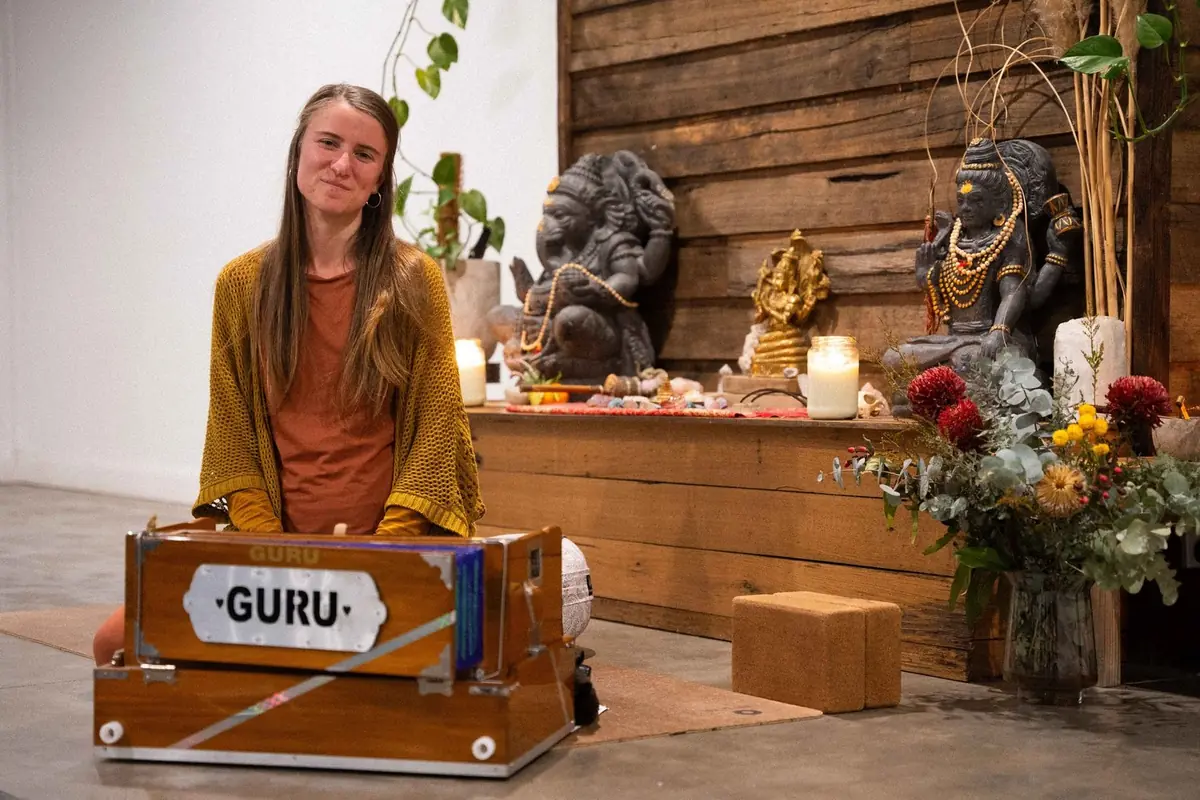
Pictured: Brooke chanting mantra with the harmonium
What Is Aum?
Before the sound, a little context on the word mantra itself, because it is so often misunderstood.
Mantra (मन्त्र, mantra) is usually broken into two parts. Man points to manas, the mind, and tra comes from the root meaning to protect. A mantra is therefore a tool that protects and works with the mind. Another common rendering is vehicle, the means by which the mind is carried toward its intended destination.
This is an important distinction. A mantra is not an affirmation. An affirmation points toward something, for example a statement such as "I open myself to the love of the divine". A mantra does not point. A mantra is the expression of the thing itself. The closest parallel in English is onomatopoeia, where the way a word is spoken is what the word means. When we sound Om, we are not labelling reality. The vibration of Om is the thing it names.
Now to the sound. It is commonly written O-M, which is simply the phonetic English spelling. The more accurate transliteration is Aum (ॐ, auṃ), three sounds gathered into a single syllable.
Try it slowly. The A, the U and the M are the only sounds the mouth can make without involving the tongue. We begin with an open mouth, aaa, then slowly close the lips, ooo, then seal them completely into mmm. An opening, a narrowing, a closing. The full arc of sound from beginning to end.
The Story: The Bow, the Arrow and the String
This teaching comes from the Mundaka Upanishad, where a teacher offers a student an image that has been carried through the tradition ever since.
Take the great knowledge of the Upanishads, the teacher says, as your bow. Take the sharpened, concentrated mind as your arrow. Take the mantra Om as the string. And take Brahman, the infinite, as your target.
The student does not understand, so the teacher elaborates. The bow alone does not reach the target. The arrow alone does not reach the target. Even the most focused mind cannot reach the infinite on its own.
So what reaches the target? The string. The string is the connection between the bow and the arrow, and more than that, the string is what releases the vibration that carries the arrow across the distance. Om is that string. It is the connection between the form of the practice and the formless goal of the practice. The knowledge is the decoration. It is the string, the mantra, that allows the arrow of the mind to fly toward the infinite.
There is one last piece. The student asks about the release. The teacher answers that the release is not something you do. This speaks directly to abhyāsa and vairāgya, practice and surrender. Abhyasa is everything you actively do, concentrating the mind, repeating the mantra, studying the texts. But the release is not a technique. It is the surrender into experience. There comes a point on the path where the tools are no longer needed, where even the knowledge is no longer needed, and what is required is simply the willingness to let go.
This is the principle of eka-tattva-abhyāsa (एकतत्त्वाभ्यास), the practice of one thing. Choose a single practice, then give the arrow the time it needs to be released and to reach its target. That can take years.
Philosophical Context
Pranava: The Sound That Resounds
In the Yoga Sutra, this sound is never called Om. It is called pranava (प्रणव, praṇava). The word comes from the root praṇu, to resound, and it describes a continuous resounding vibration rather than a single struck note.
The tradition tells us that the sound was deliberately codified under another name. The concern was that someone repeating Om too freely might be drawn so far inward that they lost the capacity to live and act in the world, a sudden pull toward complete renunciation. Naming it pranava allowed teachers to speak about the sound without endlessly repeating it in casual conversation.
Pranava is described as a bīja (बीज), a seed mantra, a root sound. The image is agricultural. Plant this seed in the mind and it will sprout, and what it sprouts into is the experience of the infinite.
Patanjali on Om
In the first chapter of the Yoga Sutra, Patanjali is describing the qualities of Ishvara (ईश्वर, īśvara), a deliberately non sectarian name for the divine, often translated as the ruler of all. He says:
तस्य वाचकः प्रणवः tasya vācakaḥ praṇavaḥ Its expression is pranava. (Yoga Sutra 1.27)
The expression, the vācaka, of that vast something greater than ourselves is the sound Om. He then gives the practice:
तज्जपस्तदर्थभावनम् taj-japas tad-artha-bhāvanam The repetition of it, together with contemplation of its meaning. (Yoga Sutra 1.28)
This is the crucial instruction. We do not repeat the mantra mindlessly, because mindless repetition is simply another kind of sleep. We repeat it consciously, while contemplating what it means and how it feels. And the following sutra describes the fruit of this practice: the awareness turns inward, and the obstacles on the path of yoga, among them illness, doubt and agitation of the mind, begin to fall away. Practice Om with attention, Patanjali suggests, and you become naturally more drawn toward yoga as a state rather than as a performance.
The Mandukya Upanishad and the Four States
The Mandukya Upanishad consists of only twelve verses, and all of them concern Om. It is here that the three sounds are mapped to the states of consciousness.
The A sound relates to the waking state, where we engage the senses and the world. The U sound relates to the dreaming state, where the senses are gated and the mind interacts only with itself. The M sound relates to deep, dreamless sleep, where the mind casts its net of unconsciousness and produces no images.
Then comes the part most easily overlooked. There is a fourth element of the mantra, and it is the silence after the M. This silence relates to turīya (तुरीय), which literally means "the fourth". It is pure awareness, awareness with nothing else added. This is the state yoga is concerned with. We can practice yoga while awake, and we can reflect on our dreams, and sleep itself is not the same as yoga nidra. The distinction is this: in the silence after the M sound, you move from deep sleep into pure awareness.
The same syllable carries other layers in the tradition. A as the past, U as the present, M as the future. Or A as Brahma the creator, U as Vishnu the sustainer, M as Shiva the destroyer, and the silence as śūnya (शून्य), the void that exists before and after all manifestation. It is worth remembering that this void is never empty in a negative sense. It is the fertile ground from which anything could arise.
Krishna in the Bhagavad Gita
Krishna offers the same teaching in the Bhagavad Gita, simply phrased another way. The one who utters the single syllable Om, remembering the divine, and so departs from the body, reaches the supreme destination (Bhagavad Gita 8.13). Utter the sound, contemplate what it expresses, turn inward, and the journey carries you toward the goal. It is Patanjali's instruction in a different voice.
The Nine Stages of the Silence
The Upanishads and the Yoga Sutra tend to treat the silence after Om as one undifferentiated state. The tantric traditions, particularly the Nada Yoga lineage that comes through Kashmir Shaivism, take a different view. They hold that the silence is not nothing, and that it unfolds through stages that move from gross to subtle.
It helps to first notice where the sound lives in the body. When we chant, A begins in the belly and rises, U moves from the heart to the throat, and M travels from the throat into the centre of the head and up toward the crown. The silence then begins where the sound leaves off, at ājñā, the centre of the eyebrows, and from there it refines through nine stages:
First, bindu (बिन्दु), the point, where the silence contracts into a single pulsing point. Then ardha candra (अर्धचन्द्र), the half moon, as that point begins to disperse outward. Then nirodhinī (निरोधिनी), the one who restrains, a sustaining quality that prevents awareness from slipping back down into ordinary consciousness. Then nāda (नाद), subtle sound, the energy that flows through the nāḍī. Then nādānta (नादान्त), the end of that sound, refining into an even subtler vibration. Then śakti (शक्ति), pure energy, the awareness of the force that nourishes the whole universe. Then vyāpinī (व्यापिनी), awareness without location, where you lose your place in time and space. Then samanā (समना), a balanced equanimity within that boundless awareness. And finally unmanā (उन्मना), beyond the mind, beyond all dualities, where no words remain to label the experience.
Different texts name these stages differently, and some lineages count seven or twelve rather than nine. The point is not the exact map. The point is that chanting the mantra is only half the practice. The other half is releasing into the silence and using the sound as a doorway into mauna (मौन), true quiet. When you reach that silence in your practice, the journey really begins. The arrow leaves the string and begins to move toward its target.
Embodied Application
In the breath and the voice
The simplest place to begin is to chant Aum slowly, with a tall, awake spine, letting the sound travel from the belly to the crown. Separate the three sounds so you can feel them. Take a full breath in, then aaa in the belly and chest, ooo through the throat, mmm into the centre of the head, and then let the silence gather at the eyebrow centre. Feeling where the vibration moves in the body is part of the practice, not a distraction from it.
In asana
Use Om as a frame for your physical practice. Traditionally we chant it three times at the beginning, once each for the waking, dreaming and deep sleep states, and once at the end, which is the condensation of everything back into a single point. Before you move into your sun salutations and your flow, three rounds of Om, chanted aloud from the belly. Finish the same way. The mantra becomes a kind of vessel that holds the whole practice.
In meditation
Sit and repeat Om as japa (जप), the classical count being 108 repetitions. What matters most is not the count but what follows it. Let yourself rest in the residue of the sound. The silence after sustained chanting can feel thick and palpable, as though it could be cut with a knife, and it is in that silence, rather than in the chanting, that the real meditation happens.
Daily Life Integration
Mantra was never meant to stay on the mat. One of the most useful applications is internal repetition during ordinary moments. When you notice the mind looping into negative thought patterns, limiting beliefs or simple distraction, you can return to Om silently, slowly and spaciously. Not a rushed om om om, but a settled, unhurried sound.
Over time something shifts. The practice moves from japa, something you are repeating, to ajapa (अजप), something that repeats itself. Like a screensaver that appears when a computer has been left alone, the mantra eventually becomes the default sound of the mind, arising on its own whenever there are no thoughts to think. This is the real purpose of mantra.
There is also a quieter daily practice available to anyone. Om is described as the hum of the universe, the background sound of reality. The low hum of traffic, the drone of a fridge, the layered noise of the bush at dusk, all of it can become Om if you attune yourself to it. We so rarely let ourselves be quiet, yet a moment of genuine stillness reveals that reality is always sounding underneath our noise.
Finally, a small and gentle note. Chanting Om near an upset baby tends to settle them quickly. The sound is soothing in a way that needs no explanation, which is perhaps the simplest evidence that this is something inherent rather than learned. Om does not really need translation. It is inherent to the universe, to you, and to yoga, and to repeat it is both to be reminded of your essence and to be returned to it.
The Ayurvedic Lens
Mapping Om onto the doṣas is more art than formula, but the contemplation is a rich one. If we arrange the doshas from dense to subtle, kapha is the densest, pitta sits in the middle, and vāta is the most subtle. The three sounds follow the same line. The A sound, low and dense and grounding, is the most kapha like. The U sound carries the movement and drive of pitta. The M sound, fine and internal and dwelling in that liminal space of the mind, is the most vata like.
For balance, the opposite quality is often what serves. A vata constitution, forever thinking, may find the contemplative mmm compounds the restlessness, and might instead linger in the open, relaxing aaa. A kapha constitution, which loves to lounge and settle, already lives in the aaa of lying back, and might benefit from a little more stimulation. As ever in Ayurveda, the honest answer is that it depends on the person in front of you and what they need.
The clearer application is through the mahāguṇas, the three qualities of mind. Sattva is balance and clarity, rajas is movement and activity, and tamas is dullness and inertia. Mantra can be used to work with these states.
For a busy, rajasic mind, internal repetition can actually backfire, becoming just one more thing to rush through. Here, chanting aloud is more useful. As one teaching puts it, you cannot hum and think a thought at the same time, so verbalising the mantra naturally lowers the volume of the mind and opens space between thoughts. External mantra is said to work on the conscious mind. For a dull, tamasic or kapha heavy state, sluggish and inward, the stimulating pulse of repetition, often internally, can generate spanda, a kind of momentum that helps the mind begin to move, to create and to engage with the world again.
The reassuring point is this. Whether you are working with a rajasic mind or a tamasic one, the repetition of Om draws you toward sattva, toward balance and clarity. In that sense Om is tridoṣic, a practice that every constitution can use. For those who want to go deeper here, David Frawley's book Ayurveda and the Mind is a worthwhile companion.
Key Takeaways
Om is not a warm up. It is pranava, the first mantra and the foundation of the entire sound tradition in yoga.
A mantra is not an affirmation. It does not point toward something, it is the expression of the thing itself.
The accurate spelling is Aum. The three sounds map to the waking, dreaming and deep sleep states, and the silence that follows maps to turīya, pure awareness.
The classical instruction is to repeat the mantra while contemplating its meaning, never mindlessly.
Chanting is only half the practice. The other half is releasing into the silence.
The tantric traditions describe that silence unfolding through subtle stages, reminding us that the quiet after Om is full rather than empty.
Om is tridoṣic and moves every state of mind toward sattva, balance and clarity.
Listen To The Full Episode
This post is drawn from our conversation on Aum and pranava on the Om Som Yoga and Ayurveda Podcast, where we sit with the story of the bow and the arrow, the four states of consciousness, and the nine stages of silence in much greater depth.
Listen here.
Want to Learn More?
Ready to root your yoga practice in tradition? Join our upcoming 200-Hour Hatha Yoga Teacher Training in Sri Lanka (July 2026), a six-month immersive journey grounding you in the principles of Hatha Yoga and Ayurveda.