The Maha Mrtyunjaya Mantra: Unlocking the Mantra for Conquering the Fear of Death
Listen to this episode on Spotify →
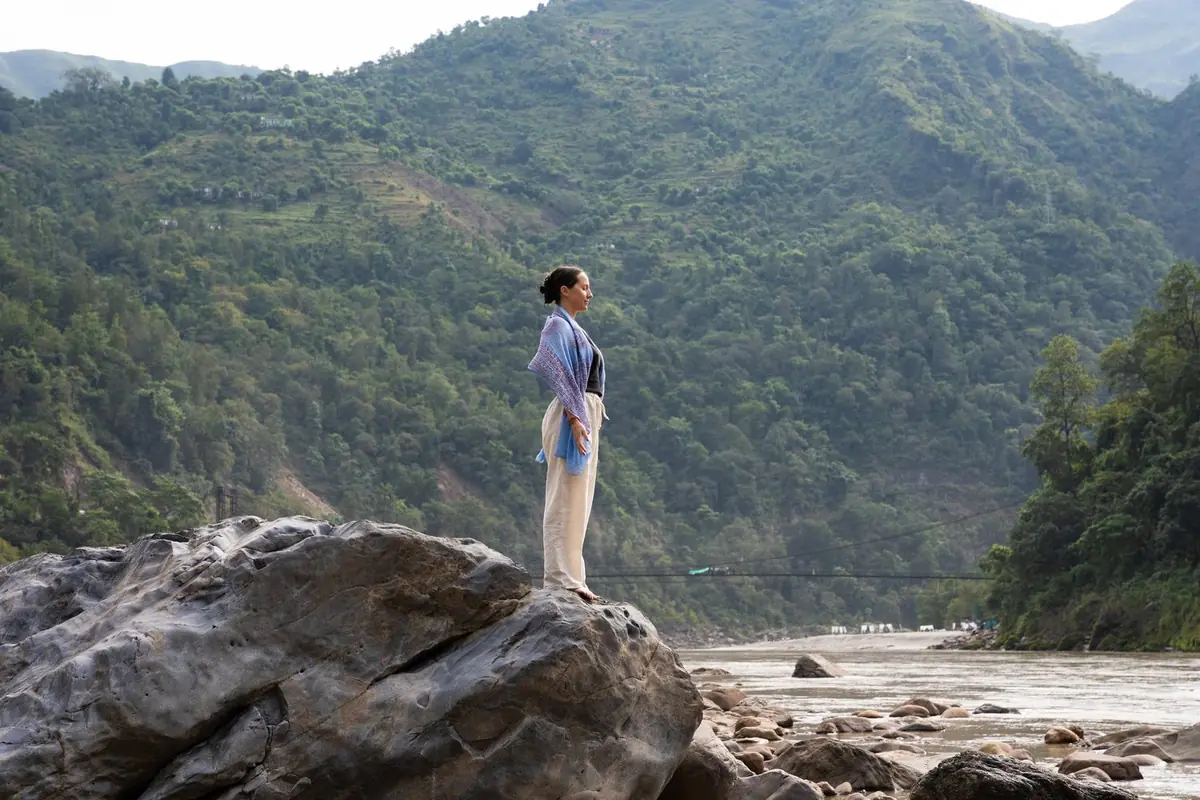
Pictured: Annie practicing by the Ganga, Rishikesh
Of all the mantras in the tradition, this is the one people reach for when something goes wrong. When someone is sick. When someone is dying. When someone is afraid. The Maha Mrtyunjaya Mantra, often translated as the great death conquering mantra, is chanted for strength when life is falling apart. What is interesting is that it does not ask to never die. It asks not to die before we are ready. That is a subtle and important difference, and it changes how we understand the whole prayer.
What Is The Maha Mrtyunjaya Mantra?
In Devanagari the name is written महामृत्युञ्जय (Mahāmṛtyuñjaya).
It breaks down clearly:
Mahā (महा) means great, ultimate, the greatest.
Mṛtyu (मृत्यु) means death.
Jaya (जय) means victory.
So Mahāmṛtyuñjaya is the great victory over death. The teaching beneath the name is that death, as we usually fear it, is an illusion. The body is impermanent, but the ātman (आत्मन्), the soul or pure awareness, is eternal. The mantra is not a charm against the body's dissolution. It is a remembrance that what we truly are does not die.
The Mantra And Its Meaning
The full mantra reads:
ॐ त्र्यम्बकं यजामहे सुगन्धिं पुष्टिवर्धनम् । उर्वारुकमिव बन्धनान् मृत्योर्मुक्षीय मामृतात् ॥
In transliteration:
Oṃ tryambakaṃ yajāmahe sugandhiṃ puṣṭi-vardhanam urvārukam-iva bandhanān mṛtyor mukṣīya mā'mṛtāt
Taken line by line:
Oṃ tryambakaṃ yajāmahe.
We worship the three eyed one. The three eyed one here is Rudra (रुद्र), a primal form of Shiva.
Sugandhiṃ puṣṭi-vardhanam.
The fragrant one, the one who increases nourishment. This points to spiritual sustenance, not material gain.
Urvārukam-iva bandhanān.
Like the urvāruka fruit from its binding. The urvāruka (उर्वारुक) is commonly mistranslated as a cucumber, because it is similar in shape and grows on a vine. The translation matters. A cucumber must be twisted or cut from the vine. The urvāruka does not. When it is ripe it turns yellow and falls of its own accord. That is the whole image. Not something torn away, but something that releases naturally when its time has come.
Mṛtyor mukṣīya mā'mṛtāt.
May I be freed from death, but not from immortality. As the ripe fruit falls freely from the vine, may I be loosened from death when I am ready, while never being loosened from the immortal nature of the soul.
Read together, the mantra says something like this. Rudra, three eyed one, fragrant like the essence of life, increaser of nourishment, when I am ready, and only when I am ready, free me from the fear of death and let me remember that I am not this body, that my awareness lives on.
The Story Of Markandeya
The traditional story attached to this mantra is the story of Markandeya.
A couple named Mrikandu and Marudvati longed for a child and undertook sadhana to seek the blessing of the gods. Shiva appeared and offered them a choice. They could have a hundred sons who were dull but long lived, or a single son who was brilliant and enlightened but would live only sixteen years. They chose the one bright child.
Their son was Markandeya, and he was extraordinary. He could recite the Vedas, he sat in meditation for hours, and he could hold his own in debate with the great sages. His parents kept the limit of his life a secret, but as his sixteenth birthday drew near he saw the grief in their faces and they finally told him the truth.
Markandeya went to the temple, sat beside the Shiva lingam, and entered the deepest samadhi. When Yama (यम), the god of death, arrived to take him, there was no one there to take. So absorbed was Markandeya that his awareness had withdrawn from the body entirely. Yama's messengers tried to bind him, and Markandeya threw his arms around the lingam. Shiva emerged, and in his anger he struck Yama down.
This created a problem. With death itself defeated, no soul could pass on. Shiva agreed to restore Yama on one condition, that Markandeya be allowed to live. The original agreement said the boy could not live a day past sixteen. Shiva resolved it simply. Markandeya would never grow a day older than sixteen. He lived on as a luminous sixteen year old, and he is honoured ever after as one of the great immortal sages of the tradition.
The mantra is associated with Markandeya's state of samadhi in the moment before Yama came for him. To chant it is to incline the mind towards that same steadiness in the face of death.
Philosophical Context
The three eyed one invoked in the first line is Rudra, one of the earliest deities named in the Rig Veda. The name Rudra is often connected to the idea of howling, and here it is read as howling with compassion, the one who feels the suffering of all beings most keenly. This is why the mantra calls on Rudra in particular. We turn to the one who understands our pain.
The mantra itself appears in the Rig Veda, in the seventh mandala associated with the sage Vasiṣṭha. It is one of the oldest and most carefully held prayers in the tradition.
The fear that the mantra addresses has a precise name in yoga philosophy. In the Yoga Sutras of Patanjali, the fear of death is abhiniveśa (अभिनिवेश), described as the deepest and most instinctive of the afflictions, the clinging to life that lives even in the wise. The Maha Mrtyunjaya Mantra speaks directly to this root fear.
The same theme runs through the wider tradition. In the eighth chapter of the Bhagavad Gita, Krishna teaches that whoever leaves the body while remembering the divine at the moment of death attains that state. This single idea shapes a great deal of practice, including the devotional repetition of the name in the Hare Krishna tradition, where the aim is to have the name present in the mind at the final moment.
The story of Markandeya is itself widely preserved. Its earliest source is the Mahabharata, where Markandeya recounts teachings to Yudhishthira, and it recurs across several Puranas, including the Markandeya Purana, the Bhagavata Purana, the Shiva Purana, and the Skanda Purana. Its presence across so many texts is a measure of how central the teaching is.
Embodied Application
The teaching of this mantra is not abstract. It is built into the shape of every practice.
In asana, the clearest expression is Shavasana (शवासन). The word comes from shava (शव), the corpse. To lie down in Shavasana at the end of a class is to practice becoming the corpse, to practice letting go of the body. It is, in a quiet sense, a rehearsal. We release the body gently so that when the time comes we might meet that release with grace rather than fear, and return to awareness.
In pranayama and chanting, the mantra is the practice. It is a long mantra with many syllables, and that is part of its value. Learning to hold its four lines steadies the mind and trains memory, what the tradition calls smṛti (स्मृति). There is a simple truth in this. If we cannot hold four lines of a mantra, it is worth asking how we expect to hold an hour long sequence in the body.
In meditation, the mantra is taken to the cushion and repeated with attention, traditionally one hundred and eight times on a mala, or eleven times when that is what the moment allows. The point is not quantity. It is presence, and a willingness to sit with the feeling the mantra evokes.
This is also a mantra to approach with respect. It is one of the more powerful and tightly held prayers in the tradition, and it is best taken up when there is a genuine pull towards it, ideally with the guidance of a teacher.
Daily Life Integration
Beyond formal practice, the mantra has a long history of being chanted on behalf of others.
It is very commonly offered for someone who is sick. If a friend or relative is unwell, the mantra can be chanted for them. It is also chanted at the time of death and through the period of mourning. In many families, particularly across India, it is repeated for a relative who has passed, sometimes for one hundred and eight days, both to soften grief and to support the essence of the one who has died as it moves into whatever comes next.
It can also become a small daily offering. One simple example shared on the episode is chanting the mantra a few times when passing trucks carrying animals to slaughter, as a wish that they be freed from fear. Practices like this give the feeling that we have something to offer in the face of suffering, rather than only turning away from it.
A gentle note on this whole subject. Death is treated as taboo in much of modern life, kept out of sight and rarely spoken of. If sitting with this material feels heavy, it is completely reasonable to set it down and return to it when the time is right. The mantra itself teaches exactly this. We do not force ripeness.
The Ayurvedic Lens
Although it is a mantra about death, the Maha Mrtyunjaya Mantra is deeply nourishing. In Ayurvedic terms it is strongly ojas building. Ojas (ओजस्) is the subtle essence of kapha doṣa, the basis of vitality, immunity, and our underlying joy and vigour for life. The mantra's own central image, ripeness, is the very quality of ojas. To wish to be ripe and full before we release is to honour ojas directly.
It also speaks to each doṣa in its own way:
For vāta
Which tends towards fear and anxiety when imbalanced, the mantra is grounding. Releasing the fear of death settles the most unsettled part of us.
For pitta
Which can drive itself to burnout and lose sight of life's fullness, the mantra is a reminder to actually live, to arrive at ripeness rather than rushing past it.
For kapha
Which can sink into grief and heaviness around loss, the mantra offers solace and śraddhā (श्रद्धा), a steady faith that there is something beyond death and that it is a kind of liberation.
For those drawn to ojas building as a wider practice, gentler everyday supports include nourishing foods such as ghee and dates. The mantra simply takes this nourishment to a subtler level.
Key Takeaways
The Maha Mrtyunjaya Mantra is the great death conquering mantra, but it asks for ripeness and readiness, not for endless physical life.
Mahā means great, mṛtyu means death, and jaya means victory.
The image of the urvāruka fruit, often mistranslated as a cucumber, is the heart of the mantra. As the ripe fruit falls freely from the vine, may we be released from death when our time has come, while never being released from the immortality of the soul.
It is dedicated to Rudra, the compassionate three eyed form of Shiva, and it appears in the Rig Veda in the mandala associated with Vasiṣṭha.
It directly addresses abhiniveśa, the fear of death named in the Yoga Sutras.
Shavasana is its embodied form, a daily practice of releasing the body with grace.
It is traditionally chanted for those who are sick or dying, and through periods of mourning.
In Ayurveda it is strongly ojas building and supportive for all three doṣas.
It is a powerful mantra best approached with care, and ideally with a teacher, when you feel genuinely ready.
Listen To The Full Episode
This post is drawn from our conversation on the Om Som Yoga and Ayurveda Podcast, where we sit with the meaning of the mantra, tell the story of Markandeya in full, and explore why this teaching is so often misunderstood.
Want to Learn More?
Ready to root your yoga practice in tradition? Join our upcoming 200-Hour Hatha Yoga Teacher Training in Sri Lanka (July 2026), a six-month immersive journey grounding you in the principles of Hatha Yoga and Ayurveda.