Kriya Yoga: The Three Meanings of Kriya In Yoga & Ayurveda
Listen to this episode on Spotify →
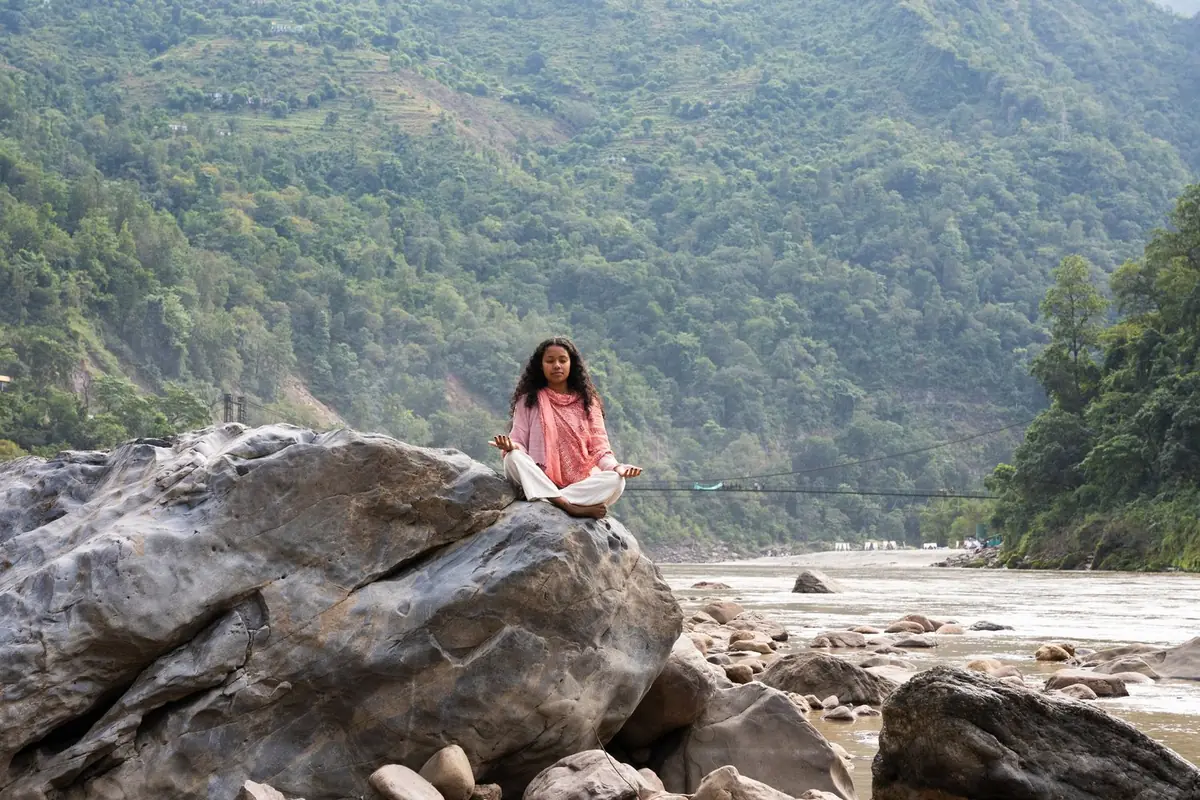
Pictured: Soilau practicing by the Ganga, Rishikesh
What is the difference between an action and a process?
An action ends, and then begins again. A process is something designed to shift you into a new state of being. You can take a breath every day of your life and never once be aware of it. You can eat every day of your life and never once attend to the process of digestion. Those are actions. They happen. They accumulate. They leave residue.
A process is different. A process is something you enter deliberately, repeat over time, and allow to change you. The tradition has a word for this, and the word is kriya.
Most practitioners meet the word kriya in one of three narrow ways. They read Autobiography of a Yogi and hear Kriya Yoga as an initiation lineage. They read the Yoga Sutra and find Patanjali naming Kriya Yoga as a path. Or they attend a breathwork class and are told that the pumping breaths they are doing are called kriyas. Each of these is accurate. None of them is complete. This article looks at all three, and at what holds them together.
What Is Kriya?
क्रिया, kriyā, comes from the Sanskrit verbal root √कृ, kṛ, meaning to do or to make. Its literal translation is action, doing, or performance. It is a feminine action noun, formed from the root by a primary suffix, and it names the doing itself rather than the thing done.
This matters, because kriyā shares that root with another word we spent the previous episode with. कर्म, karma, also derives from √कृ. Its literal translation is action, or work. Karma and kriya are grammatical cousins. They come from the same source and describe the same territory, and yet the tradition uses them to mean two quite different relationships to that territory.
Karma is action that plays out. It is what you do while you are not paying attention, driven by tendencies laid down long before this moment, producing results you did not consciously choose. Kriya is action you perform on purpose, toward a specific result, and the result kriya is aiming at is purification.
So kriya is not a category of technique. It is a category of relationship. Anything that purifies through repetition is kriya. This is the action that transforms the one who performs it. Every inhale can be kriya. Every exhale can be kriya. Not because the breath is special, but because you are present to it, and you are doing it again tomorrow.
The slow shaving away of what is not you, in order to reveal the truth of who you are, is what we mean by Kriya Yoga.
The Accountant Who Became A Yogi
When people hear the phrase Kriya Yoga, one name usually arrives first: Paramahansa Yogananda. And if you follow that name back one generation, you arrive at his teacher's teacher, and at one of the more instructive stories in the tradition.
Shyama Charan Lahiri, later known as Lahiri Mahasaya, worked as an accountant in the Military Engineering Department of the British Indian government. He was married, he had children, and he lived with his family in Varanasi rather than in a temple or a monastery. He was not a renunciate. He had a desk, a salary, and a long list of things to do. By the eye of anyone in the world, he was an ordinary man.
In the autumn of 1861 he was stationed in Danapur when a telegram arrived transferring him to Ranikhet, where an army post was being established. He travelled roughly five hundred miles by horse and buggy, arriving thirty days later at the Himalayan site. His duties there were light, and he spent many hours roaming the hills, until one afternoon he heard a distant voice calling his name.
The man who called him was Babaji. He told Lahiri that it was he who had silently prompted the transfer, and asked whether the cave they stood near seemed familiar. Then he touched Lahiri on the forehead, and the memory of a previous life returned. There in the mountains, Lahiri Mahasaya was initiated into Kriya Yoga, a practice built on the breath and on movement of awareness through the spine.
Here is where the story does something unusual. In most stories of this kind, the master takes the student away. They live in caves. They roam the hills. Instead, Babaji told him to go home. When Lahiri returned to the office, a letter soon arrived from head office saying that his transfer to Ranikhet had occurred by error and that he should return to Danapur. He went back, and again took up the business and family obligations of a householder.
And then he practiced. Every spare second, internally, silently, while the accounting continued. He kept the job until 1886, when he retired on a pension, teaching Kriya the whole time. He went on to become one of the great yogis of the tradition, and the lineage he seeded is still active today.
There is a moment in that story worth sitting with. Yogananda recorded his wife Kashi Moni saying that it was years before she came to realise the divine stature of her husband, until one night she woke in the small room they shared to find him levitating in lotus posture in the centre of the room, surrounded by light. She told him that from that night he was no longer her husband but her guru, and asked to be accepted as his disciple.
She had lived beside him for years and seen a husband. That is the point. Nobody knows what process you are going through. Someone can look like the most ordinary person on the planet and be fully realised in yoga.
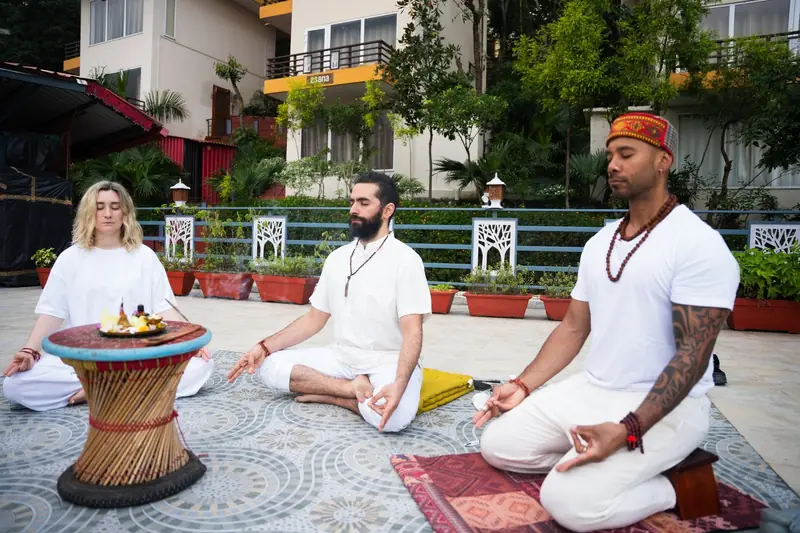
This is worth grappling with in the modern world, because we carry a picture of what a spiritual person is supposed to look like. Someone starts practicing, and suddenly there is white linen, long hair, a headband, and Om Shanti chanted down the street with no shoes on. That is playing a character. It says nothing about your process. The people who take the external process and make it internal, and stay with it for a long time, tend to be the ones having the experience inwardly, and they tend to have very little desire to broadcast it.
That does not mean it must be secret. It means it does not need an audience.
Kriya As Technique: The Shat Karmas Of Hatha Yoga
The first and most common meaning of kriya is a specific cleansing technique.
Hatha Yoga gives us six of them. The Hatha Yoga Pradipika names them in a single verse:
धौतिर्बस्तिस्तथा नेतिस्त्राटकं नौलिकं तथा।
कपालभातिश्चैतानि षट्कर्माणि प्रचक्षते॥
dhautir bastis tathā netis trāṭakaṃ naulikaṃ tathākapālabhātiś caitāni ṣaṭkarmāṇi pracakṣate
Dhauti, basti, neti, trataka, nauli and kapalabhati: these are declared to be the six actions. Note the text's own word. It calls them षट्कर्म, ṣaṭkarma, the six karmas, not shat kriyas. Both names are in circulation and both are used at Om Som. They point at the same six.
Each has a specific site and a specific purpose. Neti pours water through the nasal passages. Dhauti cleanses the digestive tract. Basti cleanses the colon. Nauli churns the abdomen. Trataka steadies and clears the eyes. Kapalabhati, the Pradipika says, is performed like the bellows of a blacksmith, and dries up disorders of phlegm.
The logic is straightforward and physical. You walk around all day drawing smoke and dust and whatever else through your nose. Then you sit down to practice pranayama and draw all of it further in. So first you wash the nose with water and settle a little oil there. You clear the lungs with kapalabhati. You clear the eyes with trataka. You clear the digestive tract with nauli. These are the primary points where prana enters and is absorbed. Clean them, and you arrive at pranayama primed to receive.
Some traditions have taken this idea and extended it, so that any vigorous pumping breath now gets called a kriya. Bhastrika sits in this territory too, filling all the way up and clearing all the way out to cleanse the lungs.
Why A Kriya Is Not Pranayama
This is where a distinction is worth making carefully, because the two are constantly conflated.
The purpose of a kriya is to purify. The purpose of pranayama is pranayama: to expand the prana. These are different aims, and they are served by opposite mechanics.
Most kriya techniques involve breathing more. Big, heavy, fast breaths. That is not an expansion of prana. It is a scouring of the tubes. The nasal tube, the throat, the lungs, the digestive tract. Pranayama is what happens afterwards, when the breath slows right down and something in you opens to receive.
If you have ever done fast breathwork for an extended period, you know the shape of it. It feels enormous while it is happening. There may even be a sense of altitude. And then there is a crash. That crash is the honest signal that the practice was doing what a kriya does, which is not the same as what pranayama does.
The Gheranda Samhita is unusually clear about sequence here. It places purification first among its seven limbs:
षट्कर्मणा शोधनं च आसनेन भवेद् दृढम्।
मुद्रया स्थिरता चैव प्रत्याहारेण धीरता॥
ṣaṭkarmaṇā śodhanaṃ ca āsanena bhaved dṛḍhammudrayā sthiratā caiva pratyāhāreṇa dhīratā
Purification comes through the six actions, firmness through asana, steadiness through mudra, and patience through pratyahara. The following verse continues: lightness through pranayama, direct perception of the self through meditation, and non-attachment through samadhi.
Read that sequence and the architecture is obvious. In Hatha Yoga, the kriyas are a pre-practice. A pre-practice to asana, to mudra and bandha, to pranayama, to meditation. In many modern traditions they have quietly become the whole practice, because a big experience is easy to sell and meditation is not. Asana has undergone the same drift. So has breathwork.
None of this is an argument against doing them. It is an argument for doing them with intention, and letting them open you into the subtle practice they were built to serve.
Kriya As Path: Patanjali's Definition
The second meaning of kriya is the broadest, and it is Patanjali's. Yoga Sutra 2.1:
तपःस्वाध्यायेश्वरप्रणिधानानि क्रियायोगः
tapaḥ svādhyāya īśvarapraṇidhānāni kriyāyogaḥ
Discipline, self-study, and surrender to ishvara constitute Kriya Yoga.
तपस्, tapas, literally heat. Here it means discipline, the willingness to generate friction against your own defaults. स्वाध्याय, svādhyāya, literally one's own study, or study of the self. Sit down and look. ईश्वरप्रणिधान, īśvarapraṇidhāna, literally placing down before, or laying before, ishvara. Surrender to a higher power, offering the fruit of the process upward rather than gripping it.
Notice what Patanjali does not do. He does not name a technique. He names three conditions, and any technique held inside those three conditions becomes Kriya Yoga. He goes on elsewhere in the text to describe specific practices, but the definition itself stays open. You can practice Kriya Yoga this way with almost anything.
The same openness applies to ishvara. Patanjali's ishvara is not tied to one sectarian deity, which is why this instruction has travelled across so many faiths and none. The requirement is the orientation, not the object.
Then he tells us what it is for. Yoga Sutra 2.2:
समाधिभावनार्थः क्लेशतनूकरणार्थश्च
samādhi-bhāvana-arthaḥ kleśa-tanū-karaṇa-arthaś ca
Its purpose is the cultivation of samadhi and the attenuation of the kleshas.
क्लेश, kleśa, literally affliction or torment. These are the five we met in the karma episode as the ground the karmas grow from: अविद्या, avidyā, ignorance; अस्मिता, asmitā, I-am-ness; राग, rāga, attraction; द्वेष, dveṣa, aversion; and अभिनिवेश, abhiniveśa, clinging to life, the fear of death.
तनूकरण, tanūkaraṇa, literally making thin. Patanjali does not promise that Kriya Yoga eliminates the kleshas. It thins them. It reduces their grip, so that they have less power over what you do next, and so that you can see more clearly. And clear seeing, sustained, is samadhi.
Put the two sutras together and you have the whole mechanism. Kriya Yoga uproots the karmas. That is why tapas has to be in there. Changing your actions away from their default costs something. It takes effort, it takes discipline, and it is going to be uncomfortable for a while.
Which is why, when someone says the practice was uncomfortable and they hated it, the useful answer is often: do it again, ten times. That discomfort is precisely the thing worth inspecting. If a practice feels too slow for you, ask why you cannot move slowly. If you could move through the resistance to slowness, what would transform?
Kriya As Initiation: The Lineage
The third meaning is the narrowest and the most specific. This is the lineage of Mahavatar Babaji, Lahiri Mahasaya and Paramahansa Yogananda: a defined technique transmitted through initiation. Teacher sits, student comes, and that particular practice is given. It involves movement of awareness up and down the spine with specific points of attention.
We name it here for completeness and clarity, because when someone says Kriya Yoga they may mean this, and it is a different claim from the other two.
What is worth seeing is that all three meanings are processes. Every one of them is designed to transform the individual practicing it. That is the thread. Kriya Yoga is any process that purifies us of past karma and lets us be more intentional about the outcomes our actions produce.
The Ayurvedic Lens: Panchakarma
Ayurveda approaches the same work from another direction, and it uses the sibling word.
पञ्चकर्म, pañcakarma, literally five actions. पञ्च, pañca, five. कर्म, karma, action. It is an extensive detoxification and rejuvenation protocol, and the crucial thing to understand is that it is prescribed, not applied wholesale. You sit with an Ayurvedic doctor. Your conditions, symptoms and dosha imbalance are assessed. Then a protocol is drawn from the five. Nobody receives all five. A traditional Panchakarma runs a minimum of twenty one days, sometimes longer, though shorter versions are now widely offered.
The five are these.
वमन, vamana, literally vomiting. Therapeutic emesis, generally indicated for kapha conditions such as excess mucus and congestion in the chest.
विरेचन, virecana, literally purging. Purgation downward, usually brought on with castor oil or herbal compounds, most often used for pitta conditions.
बस्ति, basti, literally bladder, and by extension the enema. In the West we tend to associate enema with water or coffee, both drying. In Ayurveda, basti is generally administered with oil, because vata dosha resides in the colon and oil is inherently nourishing and warming there. Basti also carries the sense of retaining. The oil is introduced and held until the urge to release arrives. The experience is less confronting than most people expect, closer to a gentle awareness of the pelvic region, which is itself good for vata.
नस्य, nasya, literally relating to the nose. Nasal administration of medicated oils and herbal preparations, and in some clinical settings inhalation of a medicated herbal smoke, followed by oil applied to the nasal passages. Indicated for respiratory conditions such as asthma and allergies, often kapha in nature, and useful for headaches, migraines and conditions of the head.
रक्तमोक्ष, raktamokṣa, literally blood-release. रक्त, rakta, blood. मोक्ष, mokṣa, liberation. Traditionally performed with leeches, and inherently related to pitta. It is the least common of the five today, requiring a specific species of leech and a practitioner who knows the work, though it is still performed in Panchakarma clinics in India.
Sit with that last name for a moment. In a month spent on moksha, we find liberation turning up as a clinical term for letting the blood go.
And notice the underlying logic, because it is the same logic as the shat karmas. These are the processes of the body we assume we have no control over. Digestion. Circulation. Elimination. Ayurveda says otherwise. It says we take responsibility for them, through diet, through lifestyle, through the active purification of those systems.
If you do Panchakarma once a year, you can do your shat karmas every day. It is not to say you have to be unwell to undertake Panchakarma. It is often suggested once a year or once every few years, and it is traditionally considered before conception, for both partners, so that body and mind are in the best possible state before a child is conceived.
Kriya In Practice: Asana, Breath, Meditation
So how does this land on the mat?
In asana, kriya is what makes a shape into a process. The same posture, held with attention, repeated across weeks, will transform your nervous system, your mind, your prana and your emotions. Held absent-mindedly, repeated absent-mindedly, it is just movement. The posture did not change. Your relationship to it did.
In the breath, kriya is the difference between breathing and practicing. You will take somewhere in the order of twenty thousand breaths today regardless. Kriya begins the moment one of them is deliberate. The shat karmas are the formal expression of this, and they earn their place when they are pointed somewhere: they clear the tubes so that pranayama can do its own quite different work.
In meditation, kriya is the whole architecture. Everything before it, in Gheranda's sequence and in Hatha Yoga generally, exists to make sitting possible. This is where the process becomes genuinely internal. It starts in the body, moves into the breath, moves into the mind, moves into the subtler emotional layer, and then moves into the self.
Yoga is awareness. Kriya is what you do to bring awareness into the things that have been running in the background of your experience all along.
Kriya In Daily Life
Here is the picture the tradition keeps returning us to.
You are at your desk, crunching numbers, drinking a coffee with a bit of milk you took from the shared office fridge. Outwardly, nothing is happening. Internally, a process is taking place. A process of liberation. You are not bound by the actions you are undertaking. You are undertaking them because that is what life has put in front of you.
That is Lahiri Mahasaya's story, and it is available to almost anyone reading this.
The daily life integration is not complicated, but it is exacting. It asks for something small, done deliberately, repeated. And it asks you not to perform it. You do not have to announce that you are changing. You do not have to tell everyone you meet about the shift you are experiencing. You let the practice shape you over time, and people notice on their own. You are thinking differently. You are speaking differently. You are moving differently. You have changed. We often treat that as a threat. It is not. Change is evolution.
Your process is your daily practice. It is the thing you step onto your mat and do, every single day, with the intention of clearing the karma. And if sixty minutes is more than your life currently allows, then it is five deep breaths.
The question is not how much. The question is: what is one thing you can do every single day, deliberately, that begins to work on the backlog?
Key Takeaways
Kriya (क्रिया, kriyā) means action or doing, from the root √कृ, kṛ. It shares that root with karma (कर्म). Karma is action that plays out unconsciously. Kriya is action performed deliberately for the purpose of purification.
The word carries three main meanings: a specific cleansing technique, Patanjali's path of practice, and an initiation lineage. All three are processes designed to transform the one practicing.
The Hatha Yoga Pradipika names six: dhauti, basti, neti, trataka, nauli and kapalabhati. The text itself calls them shat karma. Both shat karma and shat kriya are in use.
A kriya is not pranayama. Kriya scours the passages. Pranayama expands the prana. They use opposite mechanics and serve different aims.
In classical Hatha Yoga the kriyas are a pre-practice, not the practice. The Gheranda Samhita places purification first among seven limbs, with pranayama fifth and meditation sixth.
Yoga Sutra 2.1 defines Kriya Yoga as tapas, svadhyaya and ishvara pranidhana. No technique is specified, which means almost any technique held in those three conditions qualifies.
Yoga Sutra 2.2 gives the purpose: to cultivate samadhi and to thin the kleshas. Not eliminate. Thin.
Ayurveda works the same ground through Panchakarma (पञ्चकर्म), five therapeutic actions prescribed individually according to condition and dosha, never applied as a set.
The process is silent. It does not require an audience, a costume, or an announcement.
If a full practice is beyond your day, five deliberate breaths is a kriya. Repetition is the mechanism, not duration.
Listen To The Full Episode
Aaron and Paige work through all three meanings of kriya in this episode, including the full Lahiri Mahasaya story, the distinction between kriya and pranayama, and Paige's account of each of the five Panchakarma treatments from her own training and clinical experience. Listen here.
Want to Learn More?
Ready to root your yoga practice in tradition? Join our upcoming, 300-Hour Hatha Yoga Teacher Training (2026/2027), a seven-month journey online, plus 2-week immersion in Rishikesh, India, advancing you in the principles of Hatha Yoga and Ayurveda.