Kaya Sthiram - The Yogic Foundation Of Mental Steadiness
Listen to this episode on Spotify →
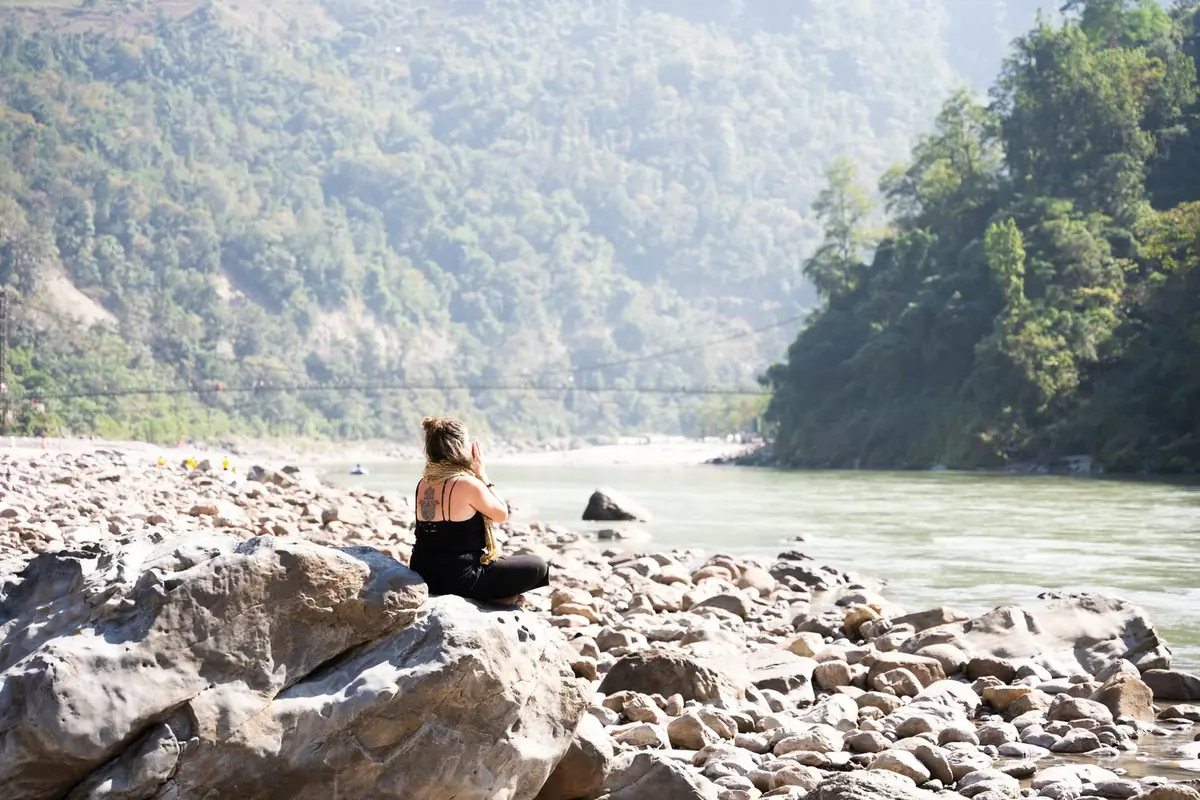
Pictured: Lina practicing by the Ganges River, Rishikesh
Many people say, “I just can’t meditate, my mind won’t stop.” In the yogic tradition, this is rarely seen as a problem of the mind. More often, it is the body that has not yet found stillness. We keep trying to think our way into calm, when what is actually needed is to arrive fully in the body first. This principle is known as Kaya Sthiram, and it sits at the very foundation of meditation, nervous system regulation, and embodied awareness.
What Is Kaya Sthiram?
Kaya Sthiram is a Sanskrit term made up of two words. Kaya refers to the body, the physical form, and also the field of embodiment. Sthiram means steadiness, stability, or stillness without rigidity. Together, Kaya Sthiram means the steadiness of the body. It is not about forcing the body to be immobile, but about allowing the body to settle so completely that the nervous system recognises safety. When the body becomes still, the breath naturally slows, and only then does the mind gain the capacity to rest.
Why The Body Must Settle Before The Mind
Across yogic teachings, there is a simple observation. A restless body cannot house a steady mind. The sages noticed this by observing nature. Animals do not truly rest until their bodies feel safe. A deer only lies down once its legs are folded beneath it, its breath slows, and vigilance dissolves. Humans are no different. When the body remains tense, alert, or unresolved, the mind continues to roam. Stillness is impossible not because the mind is broken, but because the body has not yet arrived. Kaya Sthiram teaches us that stillness does not start with the mind. It starts with the body.
Kaya Sthiram In The Classical Texts
Although Kaya Sthiram is rarely named explicitly in classical texts, it is implied everywhere. In the Yoga Sutras, Patanjali places asana before pranayama, and pranayama before meditation. This is not a hierarchy, but a necessity. Asana prepares the body for steadiness. Pranayama settles the movement of prana. Only then can meditation arise naturally. The well known sutra Sthiram Sukham Asanam describes asana as a posture that is steady and easeful. In this context, asana refers not to modern posture practice, but to the seated meditation posture. Mastery of asana is achieved when the body is steady enough that the mind becomes absorbed. The Hatha Yoga Pradipika reinforces this by stating that asana steadies the body and gives firmness. Later it adds, “When prana moves, the mind moves. When prana is still, the mind becomes still.” The message is consistent. Steady the body first. Everything else follows.
Kaya Sthiram As A Nervous System Practice
Kaya Sthiram can be understood as a doorway between the sympathetic and parasympathetic nervous systems. Modern life keeps us in constant motion and alertness. The body remains vigilant even when there is no immediate threat. Kaya Sthiram works by consciously recognising safety. When the body senses that it is safe, the nervous system down regulates. Breath slows. Awareness softens. This is why Kaya Sthiram is such a powerful entry point into meditation. It does not rely on concentration, visualisation, or mantra. It relies on something far more accessible. The body itself.
How Kaya Sthiram Is Practiced
Kaya Sthiram begins with grounding awareness in physical contact. Noticing where the body meets the earth. Feeling the weight of the body being held. From there, small movements are allowed so the body can release restlessness before settling. Once the body becomes still, awareness naturally moves to the breath and the subtle pauses between breaths. Over time, awareness expands outward to include the stillness of the surrounding space and eventually the stillness between thoughts. Rather than trying to stop thinking, the practitioner discovers the gaps that already exist. Stillness is revealed rather than created.
Kaya Sthiram In Asana Practice
In physical practice, Kaya Sthiram is cultivated by doing less rather than more. Fewer postures held for longer periods allow the body to settle. Excessive movement often leads to exhaustion rather than steadiness. While holding an asana, minimising fidgeting, adjusting, or distraction allows awareness to anchor in the body. A simple internal reminder such as “I am here” or “Where are my feet?” helps the mind take its seat in the body. Yin yoga is a clear expression of Kaya Sthiram in action, using stillness and sensation as anchors for awareness.
Kaya Sthiram In Daily Life
Off the mat, Kaya Sthiram shows up as pausing between tasks. Noticing the residue of what has just been done before moving on to the next thing. Settling the body before responding rather than reacting. These small moments of stillness restore the ability to sense basic needs like thirst, hunger, fatigue, or emotional overwhelm. When the body feels heard and supported, the mind becomes more willing to rest. Kaya Sthiram becomes a daily practice of checking in, slowing down, and choosing presence over urgency.
Why Kaya Sthiram Matters
Kaya Sthiram reminds us that meditation is not a mental technique, but an embodied state. The body must feel safe before the mind can let go. Stillness is not something we force. It is something we recognise. By settling the body first, we create the conditions for breath to soften, prana to stabilise, and awareness to naturally turn inward. This is why Kaya Sthiram is not an advanced practice, but a foundational one. It is where yoga truly begins.
Key takeaways
Stillness of the body precedes stillness of the mind.
Kaya Sthiram supports nervous system regulation through embodied safety.
Asana prepares the body for meditation rather than replacing it.
Doing less in practice often creates deeper steadiness.
Pausing in daily life is a form of Kaya Sthiram.
Want to Learn More?
Listen to the full episode, Kaya Sthiram: The Yogic Foundation of Mental Steadiness, on the Om Som Yoga & Ayurveda podcast for an in-depth discussion.
Ready to root your yoga practice in tradition? Join our upcoming 200-Hour Hatha Yoga Teacher Training in Sri Lanka (July 2026), a six-month immersive journey grounding you in the principles of Hatha Yoga and Ayurveda.