Jñāna Śakti: The Power Of Knowing What You Already Are
Listen to this episode on Spotify →
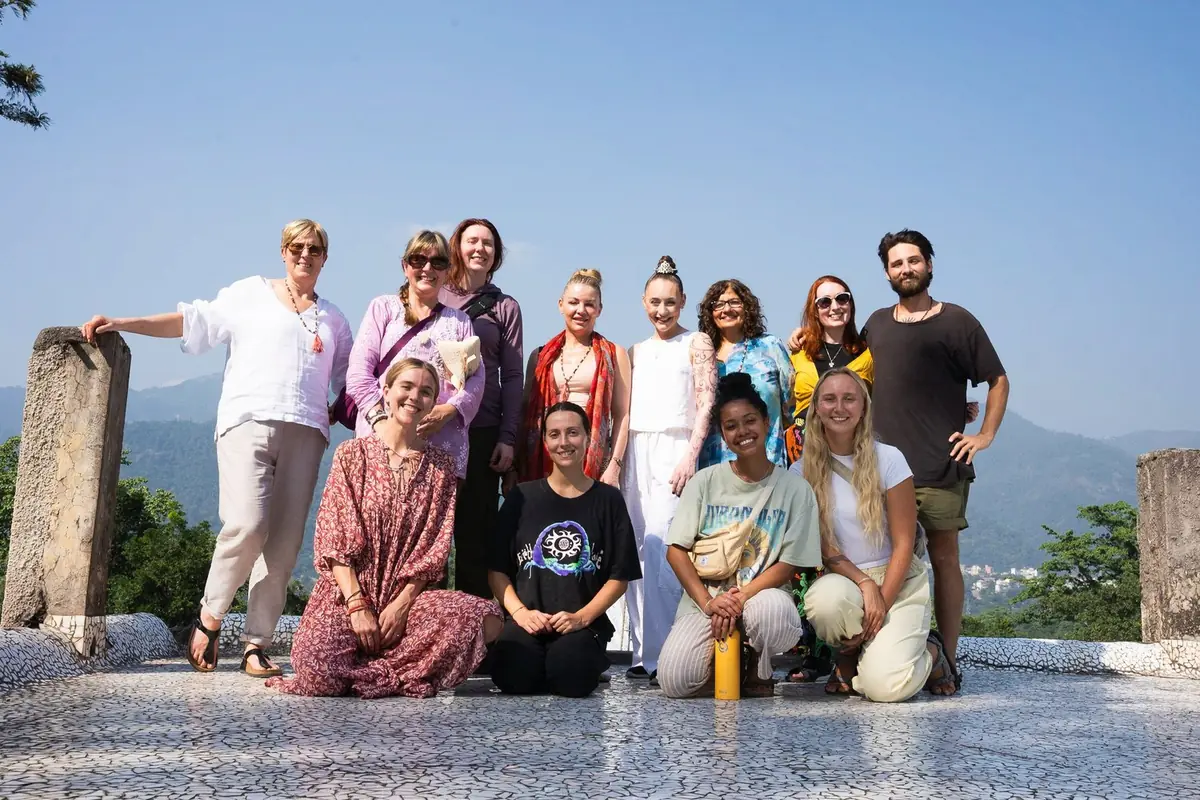
Pictured: Aaron & Paige with retreat participants at Chaurasi Kutia (Beatles Ashram), Rishikesh
Most of us assume that knowing happens in the head. We locate it somewhere behind the eyes, in the machinery of thought, and when we want more of it we go looking in the same place: more reading, more courses, more words. The tantric traditions place knowing differently. In these teachings it is said to live at three gates, the head, the heart and the navel, and the kind of knowing they care about most is not something you acquire at all.
Jñāna śakti, is the name for that capacity and is the power of knowing. It describes the moment when something you have carried your whole life finally becomes something you can say.
You have had it. A sentence comes out of your mouth in conversation and you hear yourself say a thing you did not know you knew. The tradition calls that moment pratyabhijñā, recognition, and it treats it as the whole point.
What Is Jñāna Śakti?
Jñāna śakti (ज्ञानशक्ति) is a compound of two words.
Jñāna (ज्ञान) comes from the verbal root jñā (ज्ञा), to know. It is an old root, one of the oldest we have, and it travels a long way; the English word "know" and the Greek gnōsis come from the same ancient source.
Śakti (शक्ति) comes from the root śak (शक्), to be able, to be capable, to have the power to. Śakti is your capacity.
Put together, jñāna śakti is the power of knowing. Not the knowledge, the knowing.
That distinction is the whole teaching, and Sanskrit is precise about it. Vidyā (विद्या) is knowledge you have received from someone else, learning that has been handed to you. Pramāṇa (प्रमाण) is knowledge that has been tested against a reliable means, verified rather than assumed. Jñāna sits underneath both. It is not the content of what you know. It is the capacity by which knowing happens at all.
Which is why a student can arrive with the whole vocabulary and still be missing the thing. Do you know this as something you have learned, or do you know this as something you are? There is a difference, and it is not a small one.
A note on the sound, since the word is almost always mispronounced. The conjunct jña (ज्ञ) is not "gy" and not a flat "j" followed by "n". It is built from the palatal series: ca, cha, ja, jha, and the nasal of that same family, ña (ञ). Find where your tongue sits for ja, keep it there, and let the nasal come from that spot. Jñāna. The tongue position is the pronunciation.
The Woman Who Was Looking For Her Necklace
The teaching that jñāna śakti belongs to is called Pratyabhijñā, the doctrine of recognition, and it comes out of Kashmir Śaivism in around the ninth century. It makes a strange claim: liberation is not something you achieve. It is something you recognise. If the language of consciousness pulsing and recognising itself is new to you, read our article on Spanda.
A student once put the obvious objection to his teacher. If liberation is already here, why practice? Why meditate if I am already free?
The teacher told him this.
A woman loses her necklace. She looks in every room of the house. She pulls the cupboards apart, empties the drawers, asks her friends, her neighbours, her family. Days pass. Weeks pass. She is still looking.
One day a friend comes over and says, hey, weren't you looking for your necklace? The woman says yes, I have been looking for months. And the friend says, have you looked in the mirror?
She goes to the mirror. The necklace is around her neck. It has been there the whole time.
The student said: so the practice is the friend who told her to look in the mirror?
No, the teacher said. The practice is the mirror. The friend is your teacher. And the necklace is the realisation of what you already are.
Jñāna śakti is the moment she sees it.
Pratyabhijñā: Recognition Is Not Learning
Pratyabhijñā (प्रत्यभिज्ञा) means recognition, and the English word is unusually helpful here if you slow it down. To re-cognise is to know again. Not to receive something new, but to meet something already present and finally have a name for it.
This is a very specific experience, and it has a particular quality: something you have always known reveals itself through language. You had the feeling. You had the sense of it. You could not say it. Then a word arrives, and the whole thing resolves. Ah. That is what that was.
The consequence for practice is significant. In this view, practice does not produce liberation. It removes the forgetting that obscures it. Which also settles the question of what a teacher is for, if the knowledge is already inside you. The teacher's job is to keep pointing you back at the mirror. That is all. If you keep forgetting the mirror is there, you need someone to keep pointing.
It is why the first response to a good question, at Om Som, is usually another question. What do you think? Not because the teacher is withholding, but because the student almost always already knows, and the work is getting it out rather than putting it in.
There is a trap in this, and it is worth naming plainly. The mind is the obstacle. The wanting to know is the thing standing between you and the knowing. Reading one more explanation of samādhi, collecting one more definition of enlightenment, asking a chatbot how long it takes; all of that is motion in the wrong direction. Recognition is not a research problem.
Jñāna Śakti In The Classical Texts
Three references sit behind this teaching.
The Pratyabhijñā tradition offers a line that is startling in its generosity: tad-bhūmikāḥ sarva-darśana-sthitayaḥ, the positions of all the philosophical systems are stages of that same recognition. Bhūmikā means a ground, a stage, a role. Read plainly, every darśana, every way of seeing, is a stage in one unfolding recognition rather than a rival to the others.
The Yoga Sūtra approaches knowing from a different angle. Sūtra 1.7 gives the three valid means of knowledge: pratyakṣa anumāna āgamāḥ pramāṇāni. Pratyakṣa is direct perception, seeing the thing yourself. Anumāna is inference, this is the case therefore that is the case. Āgama is reliable testimony, knowledge from a source you trust. Together they are the pramāṇas, the valid means. Of the three, pratyakṣa sits closest to the tantric idea, because direct perception is the one that does not travel through anybody else. Sūtra 1.7 arrives just five lines after the definition of yoga itself, which we unpack in Chitta Vritti Nirodhah.
The Upaniṣads divide knowing in two. Parā vidyā is higher knowledge, the knowledge that comes from the divine source. Aparā vidyā is lower knowledge, the knowledge that comes from the world. Both are real. Only one of them is the necklace.
Embodied Application
Jñāna śakti is said to be active in the buddhi (बुद्धि), the higher, discerning, intuitive faculty of the mind. Buddhi is the part that can tell what is real from what only looks real. So the practical question is not how to get more knowledge. It is how to keep the buddhi clear enough to recognise what is already there.
In āsana. Recognition on the mat rarely arrives as a new posture. It arrives as an instruction you have heard a hundred times finally landing in the body. Someone says "soften the jaw" and this time you feel that you have been clenching it for eleven years. Nothing was added. Something was noticed.
In breath. The breath will not be argued with. It tells you where you are before the mind has composed its version, so watching it without editing it is a small, repeatable act of direct perception.
In meditation. Meditation here is not a search. It is the mirror. Sitting does not go and find anything; it removes enough noise that what is already present becomes visible. The harder you look for the necklace, the longer you stay away from the mirror.
Daily Life Integration
Off the mat, jñāna śakti shows up as the quality of your ahas, and they are more frequent than most people credit. Two things follow from taking them seriously.
Stop outsourcing. When you are stuck, and you notice yourself reaching for another opinion, another article, another voice, ask yourself the teacher's question first. What do you think? Then wait longer than is comfortable for the answer.
Write them down. Ahas are slippery; they feel permanent in the moment and are gone by evening. A single line in a notebook, on the day it lands, is how a recognition becomes something you can return to. That is not far from the work of forming a clear resolve, which we look at in Sankalpa.
The Ayurvedic Lens: Samyoga, Viyoga And The Clarity Of Sattva
Ayurveda has a simple pair of terms for this, and they make a good exercise.
Samyoga (संयोग) names the things you do, consciously or not, that move you towards the state of yoga. Habits, rituals, actions, thoughts. Viyoga (वियोग) names the things that move you away from it.
Before any Ayurveda workshop at Om Som, students write two short lists. What do you do that you know moves you towards clarity, presence and vitality? What do you do that you know moves you away? Then comes the whole workshop, all the guidelines and the knowledge. And then they are asked to look again at what they wrote at the start.
The list was already right. Almost always. You can pay for the answers, and you can spend years collecting them, but you already know as a feeling what helps you and what does not. Naming it is the recognition. That is jñāna śakti in its most domestic form.
One caution, and it matters. Not every aha is trustworthy. Ayurveda puts real emphasis on cultivating sattva (सत्त्व), the quality of balance, lightness and clear perception, because perception formed in a state of imbalance tends to recommend more of that imbalance. Like increases like; it is the opposite that restores balance. Steadiness, regular rhythm, simple food and adequate rest are not preliminaries to insight. They are what make insight worth trusting.
Nothing in this article is medical advice.
Common Questions About Jñāna Śakti
Is jñāna śakti the same as knowledge?
No. Vidyā is knowledge learned from someone else and pramāṇa is knowledge verified against a reliable means. Jñāna śakti sits a layer beneath both. It is not what you know, it is the capacity by which knowing happens, and it is that capacity the tantric traditions call divine.
What does pratyabhijñā mean?
Pratyabhijñā means recognition, literally to know again. It names the specific moment when something already present in you reveals itself, usually through language. It is the central doctrine of a ninth-century school of Kashmir Śaivism, which holds that liberation is recognised rather than achieved.
If I am already liberated, why practice?
Because practice is not what produces liberation. It removes the forgetting that hides it. In the story, the necklace was never lost, but the woman still had to reach the mirror. Practice is the mirror, and the teacher is the friend who reminds you it is there.
How do I know an aha moment is real and not a distraction?
Check the state it came from. Insight formed in agitation or depletion tends to recommend more agitation or depletion. Cultivating sattva, through rhythm, rest and simplicity, is what makes perception clear enough to trust. A true recognition usually settles you rather than excites you.
Key Takeaways
Jñāna śakti is the power of knowing, not the knowledge itself. It is the capacity that makes recognition possible.
Pratyabhijñā, recognition, is the tantric claim that you already are what you are seeking, and that practice removes forgetting rather than producing freedom.
Jñāna sits deeper than vidyā (knowledge received) and pramāṇa (knowledge verified).
The teacher's role is to point you back at the mirror, not to hand you the necklace.
The mind's demand for more information is often the thing blocking recognition.
Without sattva, an aha can be a distraction. Clear perception depends on a settled state.
Listen To The Full Episode
This one is worth hearing in full, not least for the pronunciation lesson and the moment the recognition happens live in the conversation. Listen to the jñāna śakti episode of the Om Som Yoga & Ayurveda Podcast here.
It is the second in our series on the śaktis. The previous episode covers icchā śakti, the power of desire, and is worth listening to first for context.
Want To Learn More?
If you would like to keep studying the Sanskrit and philosophy behind teachings like this one, the Om Som app is a free study tool and the home of Sadhana Sangha, our online community. Each month we offer five practices, an āsana workshop, a subtle technique and a few lines of the Yoga Sūtra translated together. Search Om Som in the App Store, or find it here.
We are also exploring tantra and the chakras in depth on the [Internal link: 300-Hour Advanced Hatha Yoga Teacher Training, seven months online with two weeks in Rishikesh.