Hridaya: The Cave Of The Heart And The Seat Of The Self
Listen to this episode on Spotify →
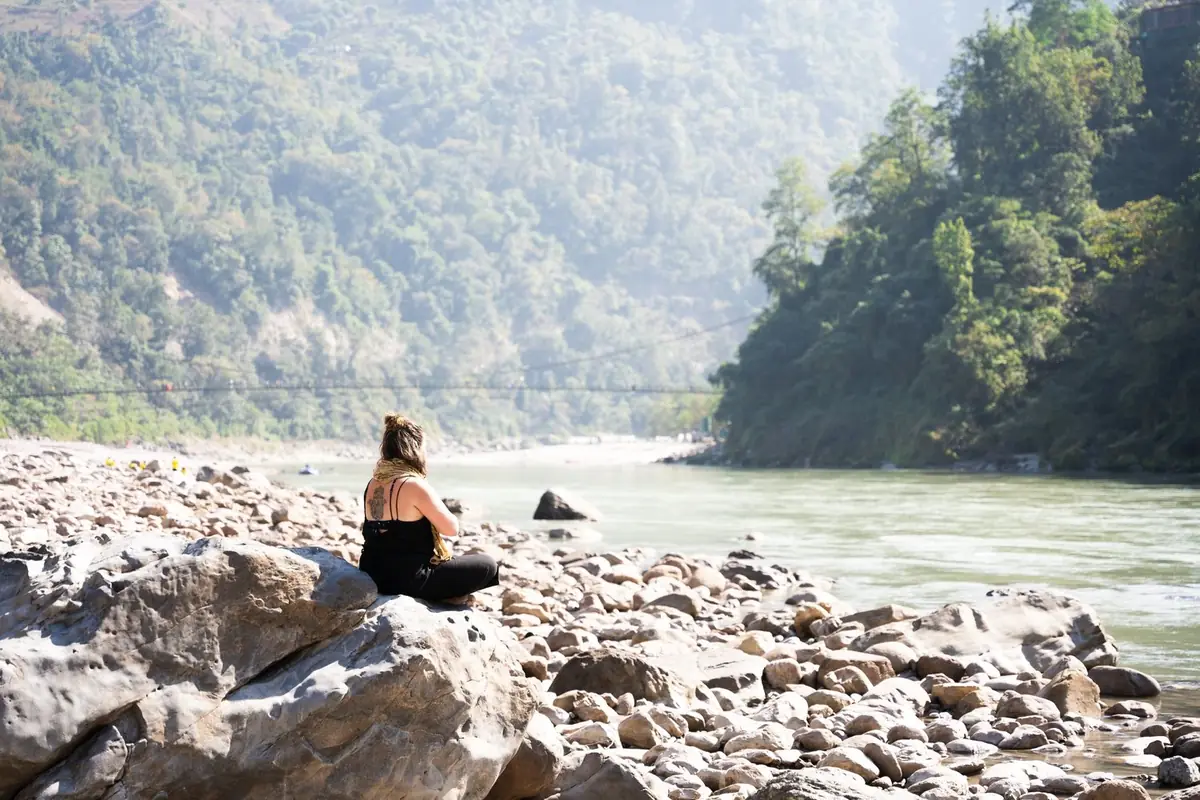
Pictured: Lina practicing by the Ganga, Rishikesh.
When teachers invite you to "come back to the heart," what part of you are they actually pointing to?
For most of us, the word heart triggers two images almost at once. There is the physical heart, the muscular organ that beats faster under stress and slows at rest. And there is the emotional heart, the softer, more tender centre that opens and closes with love, grief, fear and joy. Modern culture collapses these two together and calls the result "heart-led living." We are told to follow the heart, trust the feelings, lead with what we feel.
But the classical texts describe something deeper still. They point to a third heart, more subtle than the organ, more still than the emotions. It is called Hridaya. It does not beat. It does not feel. It simply knows.
This is the heart the yogis come home to.
What Is Hridaya?
The Sanskrit word is written as hṛdaya (हृदय), often shortened to hṛd in Hindi and in Ayurvedic compounds such as hṛd basti. Traditionally it is translated simply as "heart" or "centre."
When the word is broken down into its three syllables, a more layered meaning appears.
hṛ (to receive)
da (to give)
ya (to circulate, as in vyāna vāyu)
Hridaya is therefore the place of receiving, giving, and circulation. It is reciprocity itself, the continual movement of life passing inward and outward through the centre of our being.
Seen this way, Hridaya is the meeting point between the soul and the world. The senses, the jñānendriyas, bring experience inward. The action organs, the karmendriyas, send intention outward. The vessel through which the inner self interacts with the outer world is the heart.
At a deeper level still, Hridaya is described as the point where the universal self meets the individual self. It is where the infinite takes up temporary residence in the finite, where pure awareness takes the seat of the soul inside the body.
Anahata Is The Window, Hridaya Is The Sky Outside
It is worth distinguishing Hridaya from Anahata chakra, because the two are often confused.
Anahata is the chakra at the centre of the chest, a focal point we use in practice. It is the doorway, the window, the gateway. It has a location. It can be visualised.
Hridaya is what lies beyond the window. It is not a location but an experience. When we bring awareness to the heart centre, physically at first, then energetically, we are standing at the window. When we step through, what we find on the other side is vast. The texts say the space inside the heart is just as expansive as the space outside of it. It only appears small because we are looking at it from the outside.
Anahata is the window. Hridaya is the sky.
The Dahara Vidya: A Small Space Within The Heart
A traditional teaching describes a student coming to a teacher and asking, "Where is the heart?"
The teacher places the student's hand on their chest and says, "Here. This is the heart that keeps the body alive. You can feel it beating."
The student nods. "Yes. This is the heart I have always known. The one that races in stress and slows at rest."
"Is that all there is?" the student asks.
"Close your eyes," the teacher says. "Now feel what surrounds the beating. The warmth at the centre of the chest, the heaviness, the tenderness. There is something deeper than the beating."
The student sits with it, and finds that there is. "This is the emotional heart," the teacher explains. "The one that opens and closes, that loves and grieves. Most people stop here."
"Is there more?" the student asks.
The teacher is quiet for a long moment. Then he says that inside the heart there is a small space, no larger than a thumb. And within that small space the entire universe resides. The physical heart beats. The emotional heart feels. But this small space does not beat and does not feel. It simply knows.
This teaching comes from the Chāndogya Upaniṣad, where the practice of contemplating this small inner space is called the dahara vidyā, the knowledge of the small space.
Classical References
The theme of the heart as the dwelling place of the self appears again and again in the yogic and Upanishadic literature.
Chāndogya Upaniṣad
"In the city of Brahman there is a small lotus, a dwelling, and within it a small space. What is within that space should be sought and understood."
This is the dahara vidyā, the call to seek out and know the small space within the heart.
Kaṭha Upaniṣad
"Smaller than the smallest, greater than the greatest, the self is hidden in the cave of the heart of every being."
The heart is described as a guhā, a cave. The self dwells within it. Like the sacred caves of the Himalayas that yogis have sought out for thousands of years, the cave of the heart is a place of refuge, a portal through which the noise of the outer world cannot reach.
Yoga Sūtra III
Patañjali includes Hridaya in the list of objects suitable for saṃyama, the combined practice of dhāraṇā (concentration), dhyāna (absorption), and samādhi (complete awareness). The sūtra tells us that when saṃyama is performed upon the heart, the resulting siddhi is cittasaṃvit, knowledge of the mind.
This is a profound teaching. The entire framework of the Yoga Sūtra is oriented around understanding and quieting the mind. And yet Patañjali tells us that the way to know the mind is not to study it directly, but to sit in the heart. From the seat of the soul, the mind becomes visible, objectively, without identification. Complete surrender at the heart yields the knowledge that endless analysis of the mind cannot.
Embodied Application
In Meditation
The most practical instruction is also the most simple. Instead of meditating in the mind, meditate at the heart.
When we meditate in the head, our mantra, our visualisation, our object of concentration tends to play out on the screen of the mind. It remains another thought among thoughts. But when we consciously drop awareness from the head down into the chest, the same mantra begins to live in a different space. We are no longer watching meditation happen. We are sitting inside it.
Sit in the cave of the heart. Offer the practice on the altar of the heart. Look out through the window of the heart.
The more often we touch this space, the quicker the drop becomes. Eventually it happens by itself.
In Pranayama
The breath is the bridge. Practices that expand the ribcage three-dimensionally, such as the full diaphragmatic breath of Maha Yoga Pranayama, soften the tissues that surround the heart. As the chest moves forward, the upper back moves back, and the side ribs expand outward, the body learns that it is safe to open the space around the heart.
Many practitioners have a strong diaphragm but a ribcage that does not move. The sternum and the intercostal spaces are often guarded, sometimes unconsciously. Breath work that patiently expands this region creates the physical conditions for subtler experience.
In Asana
Asana supports this opening in several ways.
Lateral bends free the side ribs and lengthen the intercostal spaces.
Gentle back bends open the front body and invite the sternum to lift.
Forward folds in the upper back release the thoracic spine, which is often where holding sits most stubbornly.
The point is not to force the chest open through dramatic shapes. It is to slowly, intelligently, create enough space around the heart that when we lie down in śavāsana or sit for meditation, a softness is already present.
Daily Life Integration
Responding From Stillness
When we live primarily from the mind, we react. Thoughts, stories, and unresolved patterns drive our responses before we have even registered what happened. When we live from the heart, a small gap appears. Inside that gap is the witness, the quiet awareness that sees without being swept along.
We begin to respond rather than react. We speak from silence rather than from mental momentum.
Giving And Receiving
Remember the etymology. Hra. Da. Ya. To receive, to give, to circulate. The heart is not a place we retreat into. It is a place from which we engage the world more fully.
In conversation, this means we can truly listen. We can look another person in the eyes and hear what they are saying, rather than rehearsing our reply. This is rare in the modern world, and it is one of the reasons people come to their yoga teachers with their troubles. Listening is a gift that only a settled heart can give.
Heart-Led Living, Rightly Understood
The phrase "heart-led" is often used to mean "following the feelings." But feelings are still mind. They are subconscious beliefs, past experiences, and habitual stories projecting onto the present moment. Feelings are subtle, but they are still a veil.
To be truly heart-led is to anchor awareness in Hridaya, in the seat of the self, and from that anchor to engage with feeling, thought, action and relationship as they arise. It is not bypass. It is not avoidance dressed up as intuition. It is presence. Pure reciprocity with the moment, without being hijacked by the patterns of the mind.
This is why the fire of tapas must come first. Discipline and discernment make it possible to tell the difference between genuine inner guidance and the comfortable whisper of avoidance. With that clarity established, the heart becomes a reliable home.
Home Within
Ultimately Hridaya teaches that home is not a place, a person, or a set of circumstances. Home is an inner location we can return to in any moment. When the sense of home is internal, fear of losing external things begins to soften. Grief still moves through us. Stress still arises. But underneath it all, the small space in the heart remains untouched.
A Note On Ayurveda
Ayurveda recognises the heart on all of these layers. Hridaya is a major marma, a vital point where prāṇa and consciousness converge. Eight drops of ojas, the subtle essence of vitality and immunity, are said to reside in the heart. When they are depleted, life itself begins to fade, which is why the texts place such emphasis on preserving ojas through rest, nourishment, and a settled nervous system.
Hṛd basti, an Ayurvedic treatment in which a dough reservoir is built around the centre of the chest and filled with warm medicated oil, is used to nourish and pacify the heart on every level. It supports physical conditions of the heart, but it is also given for grief, emotional exhaustion, and the restless overthinking that silently erodes cardiac health. The experience of warm oil slowly steeping the heart centre is itself a meditation, much like śirodhārā at the forehead, but with a distinctly different quality.
Given how many people in the modern world suffer heart issues linked to chronic mental activity and stress, it is worth considering how much simple nourishment the heart is quietly asking for.
Key Takeaways
Hridaya is the spiritual heart, distinct from both the physical organ and the emotional centre.
Its etymology (hra, da, ya) points to receiving, giving, and circulation.
Anahata chakra is the doorway. Hridaya is the expansive experience that lies beyond it.
The Chāndogya and Kaṭha Upaniṣads describe the heart as a small space and a cave in which the self dwells.
The Yoga Sūtra teaches that saṃyama on the heart yields knowledge of the mind.
In practice, drop awareness from the head into the heart, meditate from the cave of the heart, and let pranayama and asana soften the space around it.
Truly heart-led living means being anchored in the self, not swept by the feelings of the mind.
Watch To The Full Episode
For the full conversation between Aaron and Paige on the layers of the heart, the story of the dahara vidyā, the Ayurvedic perspective on hṛd basti and ojas, and practical reflections on heart-centred living, view here.
Want to Learn More?
Ready to root your yoga practice in tradition? Join our upcoming 200-Hour Hatha Yoga Teacher Training in Sri Lanka (July 2026), a six-month immersive journey grounding you in the principles of Hatha Yoga and Ayurveda.