The Gayatri Mantra: The Prayer That Illuminates The Mind

Listen to this episode on Spotify →
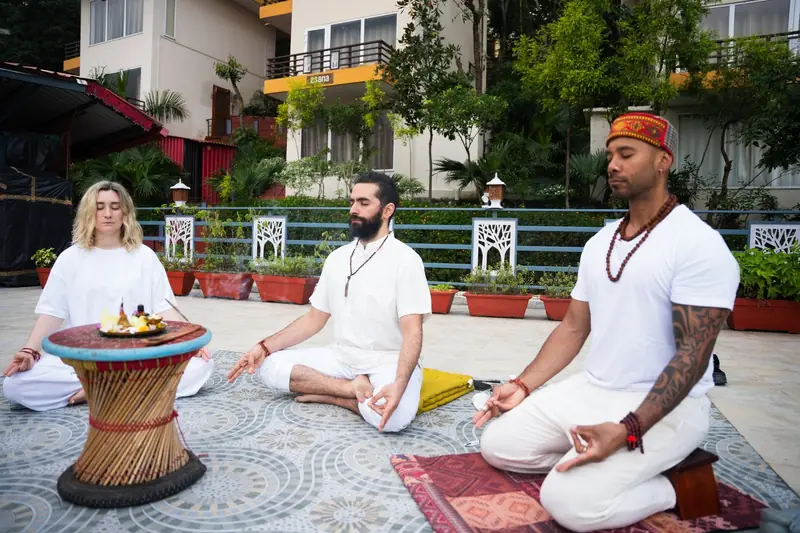
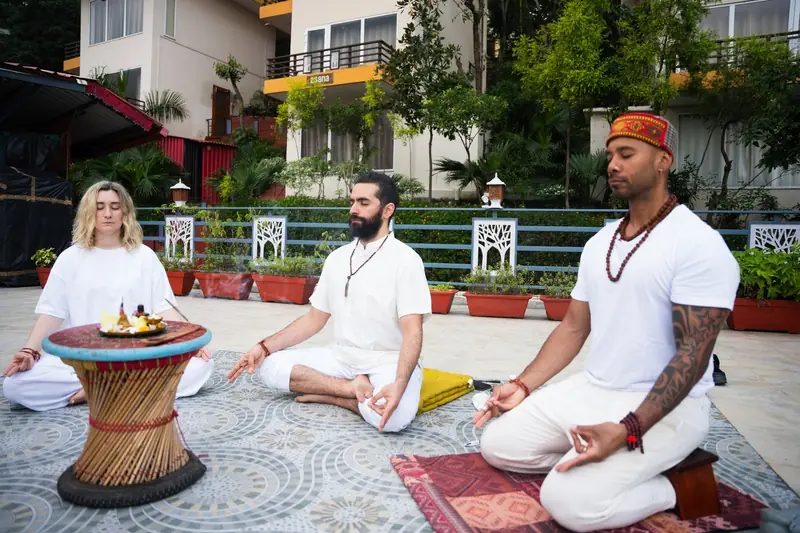
Pictured: Chris with hands in Anjali Mudra
If Om is the single syllable that holds everything together, what does the Gayatri Mantra do? It illuminates. Where many prayers reach toward the heart or the body, the Gayatri reaches toward the intellect. It is, at its core, a request for clarity of mind.
The ancient ṛṣis understood something practical about this. If the mind is clouded by illusion, the practices of yoga become almost impossible. We cannot discern truth from distraction while the lens is fogged. So before anything else, they asked for the lens to be cleaned. May our intellect be illuminated. For thousands of years, practitioners have offered that same invocation at sunrise and sunset. This is the Gayatri, the mantra that lights up the mind.
What Is The Gayatri Mantra?
The full mantra is most often chanted like this:
ॐ भूर्भुवः स्वः तत्सवितुर्वरेण्यं भर्गो देवस्य धीमहि धियो यो नः प्रचोदयात्
oṃ bhūr bhuvaḥ svaḥ tat savitur vareṇyaṃ bhargo devasya dhīmahi dhiyo yo naḥ pracodayāt
There is a traditional etymology for the word itself: gāyantaṃ trāyate iti gāyatrī, she who protects the one who sings her is Gāyatrī. This points to two things at once. Gāyatrī is a goddess, Gāyatrī Devī, the feminine form of the morning light. She is not the sun itself but the light of the sun, and what light does is reveal. In this context, the light of the morning sun is said to illuminate the mind, which is why she is so closely likened to consciousness.
Gāyatrī is also the name of a poetic meter, a chandas. The meter is twenty four syllables arranged in three lines of eight, an even eight by eight by eight. This is significant, because it is the same meter in which much of the Vedas were composed and recited. The steady rhythm was not decorative. It made an enormous oral tradition possible to memorise and transmit accurately across generations. So the mantra of the goddess is, quite literally, the rhythm of the Vedas. If a haiku is held together by its count of five, seven, five, the Gayatri is held together by its eight, eight, eight.
The Story Of The Condensed Vedas
There is a teaching story, drawn from the Manusmṛti, that explains why this mantra is said to contain all of Vedic knowledge.
The beings of the world came to Brahmā, the creator, and asked him to help them make sense of the universe. So he composed the three Vedas for them, some of the earliest texts on the planet, vast and detailed. But the Vedas were long and complex, and the seekers returned asking for something more condensed. Brahmā distilled them into three verses. Still too many syllables, they said. So he distilled the three verses into three words, bhūr bhuvaḥ svaḥ, three worlds held in three words. Still too much. And so he compressed those three words into a single syllable, Om.
The story is not really about impatience. It mirrors something we recognise in our own age, the constant wish to condense and compress until knowledge fits in the palm of the hand. What the tradition offers in return is reassurance. The whole of the Veda, the knowledge of nature itself, can be held within this one mantra, and the mantra itself can be held within Om. The simplest teaching always contains the largest one.
It is worth noticing that yoga as a whole grew outward from this same seed. From the Vedas came the Upavedas, including Ayurveda, then the Upaniṣads with their stories, then the Tantras, then the Yoga Sūtra. The teachings expand over time, but the essence stays simple, and what allows our understanding of that essence to deepen is precisely the thing the Gayatri asks for, the illumination of the mind.
A Word By Word Translation
The first line, oṃ bhūr bhuvaḥ svaḥ, is the vyāhṛti, the invocation of light across three planes. Om we explored in the previous episode. Bhūḥ is the bhūrloka, the physical realm, the body and the Earth. Bhuvaḥ is the bhuvarloka, the subtler space of the planets and, by extension, the realm of mind and emotion. Svaḥ is the svarloka, the spiritual or astral realm, the soul. Read together, the line offers up the whole of a person, mapping neatly onto the three bodies of the tradition, the gross body (sthūla śarīra), the subtle body (sūkṣma śarīra), and the causal body (kāraṇa śarīra).
A small but useful clarification here. The third word is svaḥ, not svāhā. Svāhā is a different word entirely, the name of the consort of Agni and the exclamation chanted as an offering is given to the fire, carrying the sense of completion or ending. Spoken quickly, svaḥ is often misheard as svāhā, but to end the line that way would, in effect, signal that the offering is already complete.
The remaining three lines hold the heart of the prayer. Tat means that, that truth. Savitur is the sun, another name for Sūrya. Vareṇyam means worthy of being chosen, adorable, worthy of worship. Bhargo is the radiance of that sun. Devasya tells us that sun is a deity, worthy of reverence. Dhīmahi means I meditate upon this. Dhiyaḥ refers to the dhī, the buddhi, the discerning faculty of the mind. Yo naḥ means may this, for us. And pracodayāt means may it illuminate, impel, inspire.
Read plainly, the mantra says something like this. Om, with my body, my mind and my soul, I meditate upon the radiance of that sun, which is worthy of my worship. May its light illuminate my intellect, so that I may see clearly.
It is telling that the prayer asks for the mind to be illuminated rather than the heart. In this tradition it is not the heart that is clouded by ignorance. It is the mind. The heart already knows. The mantra simply asks for the clouds to part so the rest of us can see what the heart sees.
The Essence Beyond The Syllables
There is a deeper layer that practitioners come to over long acquaintance with a mantra. We often speak of the progression from mantra to yantra to maṇḍala, from the word, to the form, to the manifestation. At some point the syllables themselves are released. The twenty four syllables condense into a single spanda, a pulsation, and that pulsation is the true essence of the Gayatri. Eventually the repetition becomes ajapa, self sustaining, repeating itself within the mind without effort. We learn the mantra in order, finally, to forget the mantra and rest in its experience.
A second story illuminates why this matters. The king Viśvāmitra had everything a king could want, yet he encountered the sage Vasiṣṭha, who possessed a wish granting cow born of his austerities. Viśvāmitra demanded the cow, then tried to seize it by force, and failed. Realising the cow had come from tapas rather than power, he resolved to undertake the same discipline. He sat in meditation for a very long time, and in the Ṛgveda the Gayatri is attributed to Viśvāmitra on account of that sādhana.
The point is that a mantra carries the state of awareness of the sage to whom it was revealed. When we practice the Gayatri ardently and patiently, the syllables eventually give way to spanda, the spanda gives way to a state of awareness, and that state of awareness is the very one Viśvāmitra reached. Practiced this way, mantras are not songs for entertainment. They are tools that grant access to the lived experience of yoga.
In The Classical Texts
The Gayatri appears throughout the tradition. The Chāndogya Upaniṣad declares that all this, whatsoever exists, is the Gayatri, and that speech is Gayatri, for it sings and protects all of this. Read alongside Sāṃkhya darśana, this points to the descent of consciousness into matter, the idea that creation begins with a vibration and a pulsation, and that vibration sings the world into being. In the Bhagavad Gītā, Kṛṣṇa names the Gayatri as the foremost among meters, saying that among the meters he is the Gāyatrī. And the Manusmṛti, which carries the story of Brahmā condensing the Vedas, says that one who receives the Gayatri at both twilights gains the merit of reciting the entire Veda. There is something quietly generous in that. We do not need to chant the whole of the Veda all day. We chant the Gayatri at sunrise and sunset, and we are nourished by the same wisdom.
The Ayurvedic Lens
In Ayurveda the Gayatri is understood as a heating, solar mantra. It invokes Sūrya and Savitṛ, drawing warmth and light into the body, which makes it inherently related to pitta doṣa. More specifically, it is associated with sādhaka pitta, the subtype that resides in the heart and the head and is responsible for transforming our experiences into wisdom. This is exactly the function the mantra serves, bringing clarity to the mind and the heart and integrating understanding into our being.
How it is practiced can be adjusted to constitution. For a vāta predominant person, external, audible chanting can help anchor awareness back into the body, and the even eight by eight by eight rhythm is naturally grounding and stabilising. For a pitta predominant person, who already carries heat, the invitation is toward slow, easeful repetition rather than racing through a count, perhaps choosing a smaller number of rounds, or moving through one hundred and eight very slowly while practicing non attachment and releasing any grip on the outcome. Internal repetition can also help reduce the heat generated through the vocal cords. For a kapha predominant person, the Gayatri is especially valuable at sunrise. Its invocation of warmth and illumination counters inertia and dullness of mind, and the ritual itself is a gentle way to rise with the sun and build momentum before more demanding practice.
There is also a beautiful complement to the mantra in the form of mudrā. Indu Arora's mudrā book shares a series of twenty four mudrās that can be practiced alongside the Gayatri, one for each syllable. This can serve vāta types by drawing them into the body, pitta types by giving the mind something to learn and master, and kapha types by sustaining engagement.
A Word Of Caution And Respect
The Gayatri is one of the most widely chanted mantras on the planet, and it is also one of the most contested. Some teachers hold that it is a closed or guru mantra, to be chanted only by those who have been initiated. Some say that once you begin, you commit to chanting it at both twilights for the rest of your life. Some hold that it should not be chanted by certain people at all. These are significant claims, and they are not made lightly. The mantra is the essence of the Veda, which is a sacred and originally oral religious text, and that alone asks for our cultural sensitivity and respect.
There is a traditional tale that makes the point vividly. A student begged his teacher to give him the Gayatri. The teacher refused, saying his ego was not yet ready, but the student insisted he would do whatever was asked. The teacher relented, with one instruction. Because the mantra holds the śakti of the sun, it could only be chanted while submerged in the cooling waters of the ocean. The student thought this silly, went home, and chanted it in his bedroom. He grew unbearably hot, could not cool himself in any water he tried, and by morning all that remained of him was a pile of ash. Whether or not we take the ending literally, the teaching is clear. This mantra carries real potency, and it asks to be received at the right time, ideally transmitted from teacher to student rather than picked up casually from a book or a podcast.
So how do we hold all of this? Perhaps the most grounded answer is to listen to our own intuition while remaining genuinely respectful of the tradition. Lineage based practice offers invaluable structure, but it can also become rigid, and the deeper teaching is that we already sense what is right for us in each moment. If you do feel called to the Gayatri, the gentle suggestion is to honour its traditional Vedic meter, to approach it as a japa practice chanted quietly within, and to hold it as something kept inwardly rather than broadcast. A secret held inside the mind has room to illuminate it.
Key Takeaways
The Gayatri Mantra is a prayer for the illumination of the intellect, the dhī, so that the mind can see clearly.
Gāyatrī is both a goddess, the feminine form of the morning light, and a poetic meter of twenty four syllables in three lines of eight, the same meter as much of the Vedas.
The mantra is said to contain all Vedic knowledge, mirrored in the story of Brahmā condensing the Vedas down to a single syllable, Om.
The third word of the first line is svaḥ, not svāhā, which is a separate word associated with offerings to the fire.
In Ayurveda it is a heating, solar, pitta related mantra linked to sādhaka pitta, and it can be adapted to vāta, pitta and kapha constitutions.
The Gayatri carries deep cultural and spiritual significance and is best approached with reverence, traditional meter, and ideally teacher to student transmission.
Listen To The Full Episode
This post is drawn from the second episode of our Mantra June series on the Om Som Yoga and Ayurveda Podcast, where we explore the Gayatri in much greater depth, including its translation, its stories and its place in practice.
Want to Learn More?
Ready to root your yoga practice in tradition? Join our upcoming 200-Hour Hatha Yoga Teacher Training in Sri Lanka (July 2026), a six-month immersive journey grounding you in the principles of Hatha Yoga and Ayurveda.