Chitta Vritti Nirodhah: Yoga Is Not About Stopping Your Thoughts
Listen to this episode on Spotify →
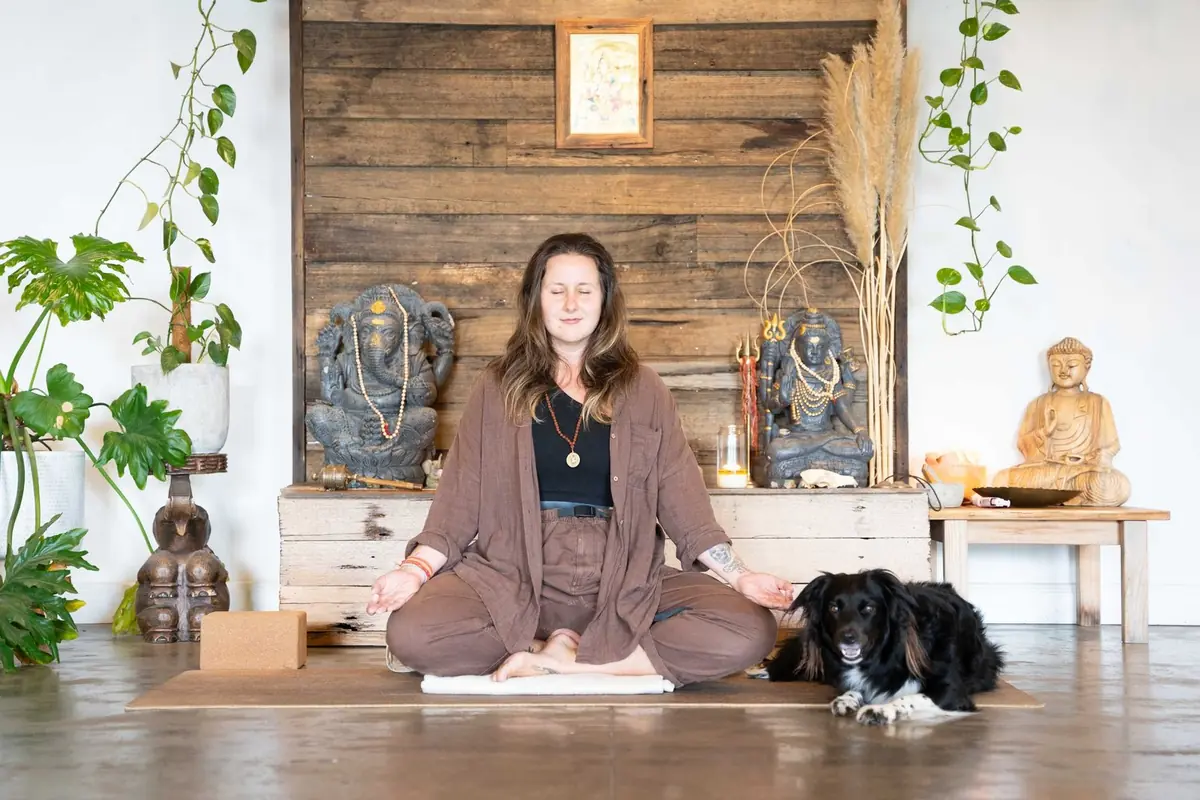
Pictured: Lina sitting in meditation
Most people who come to yoga have heard, at some point, that the purpose of the practice is to quiet the mind. And so they sit down, close their eyes, and try to stop thinking. Within moments, the mind is louder than before.
This is not a failure of practice. It is a misunderstanding of the instruction.
The second sutra of Patanjali's Yoga Sutra, yogash chitta vritti nirodhah, defines yoga itself. And while the words do describe a settling or cessation of mental movement, the teaching has nothing to do with force. The mind does not respond well to being told to stop. It responds to space. This post explores what that actually means, and how to work with it.
What Is Chitta Vritti Nirodhah?
Sanskrit: chitta vritti nirodhah (चित्त वृत्ति निरोधः)
Romanised transliteration: chitta vritti nirodhah
Literal translation: the cessation of the fluctuations of the mind-field
Each word carries its own precise meaning.
Chitta refers to the total field of the mind: the entire field of perception, memory, and cognition. It is not just the thinking mind, but the whole inner landscape through which experience moves.
Vritti means movements, waves, or fluctuations. It is the rippling of the mind, the constant arising of thoughts, impressions, reactions, and stories. The word shares its root with concepts of turning and revolving, which captures something important: vrittis are not still, they are in perpetual motion.
Nirodhah means cessation, ending, or the coming to rest of something that has been in movement.
Together, the phrase describes a condition in which the movements of the mind have settled, not been suppressed, but allowed to come to rest of their own accord.
The Story of Lake Manasarovar
In the yogic tradition, the mind is most often described through the analogy of a lake. The lake used in this classical teaching is Lake Manasarovar, an actual lake located in the Tibetan region beneath Mount Kailash, considered one of the most sacred bodies of water in the Hindu and Buddhist traditions.
The story goes like this.
At night, a full moon hangs in the sky above the lake. But strong winds are blowing across the surface, and the water churns with waves and ripples. The reflection of the moon shatters into countless fragments scattered across the surface. A group of monks come down to the water wanting to see the moon. Frustrated that they cannot, they attempt to smooth the surface with their hands. But every time they press at the water, it splashes back. The harder they try, the worse the disturbance becomes.
Then the senior monk arrives. He tells them to stop. What they are doing is futile. There is no point fighting the water. The only thing to do is wait for the wind to settle.
Slowly, as the wind calms, the surface of the lake softens. The ripples subside. The lake does not disappear, but it becomes transparent and reflective, and for the first time, the monks see the full moon clearly in its surface.
In this analogy, the moon is the self, your true nature, awareness itself. The lake is the mind. The wind is thought. And the instruction is not to flatten the mind by force, but to allow the winds to settle so that the mind can become what it already is by nature: clear, still, and reflective.
The First Four Yoga Sutras
Chitta vritti nirodhah does not stand alone. It is the second of four sutras that together form the opening teaching of the Yoga Sutra.
Sutra 1.1: atha yoganushasanam
Romanised: atha yoganushasanam
Literal: Now, the teaching of yoga begins.
Atha means now. Yoga is a practice of the present moment. It does not happen yesterday or tomorrow. It can only happen now.
Sutra 1.2: yogash chitta vritti nirodhah
Romanised: yogash chitta vritti nirodhah
Literal: Yoga is the cessation of the fluctuations of the mind-field.
This is the definition of yoga itself. Not the postures, not the breath, not the philosophy alone, but the condition in which the movements of the mind have settled.
Sutra 1.3: tada drashtuh svarupe avasthanam
Romanised: tada drashtuh svarupe avasthanam
Literal: Then the seer abides in its own true nature.
This is the result. When the mind becomes still and clear, awareness recognises itself. The seer, that which has always been watching, rests in its own nature rather than being pulled outward by the fluctuations.
Sutra 1.4: vritti sarupyam itaratra
Romanised: vritti sarupyam itaratra
Literal: At other times, there is identification with the movements.
This fourth sutra names what happens when the mind is not settled: we identify with the vrittis. We believe that we are the thoughts, the stories, the roles we play. This is the condition the practice works to undo, not by force, but through progressive clarification.
These four sutras read together tell the whole story. Yoga is now. Yoga is the settling of the mind. When the mind settles, awareness abides in itself. When it does not, we mistake the movements for who we are.
What Disturbs the Mind
The thoughts themselves are not the problem. This is an important and often overlooked distinction.
What agitates the mind is not the vrittis arising, but the things that generate them. Sensory stimulation, an overstimulating environment, the residue of a busy day, a strong coffee, a difficult conversation, all of these leave impressions on the mind-field, and those impressions produce movement. The thoughts are the effect, not the cause.
This is why the conditions in which we practice yoga matter. A quiet room, a cleared space, soft or absent music, an environment that is not competing for attention. These are not merely aesthetic preferences. They are part of the practice itself. By reducing external agitation, we remove the fuel that keeps the vrittis in motion. When we sit and wait without adding more disturbance, the mind begins to settle on its own.
The jar of muddy water is a useful image here. If you shake a jar full of dirt and water and then set it down, you cannot force the water to become clear. You can only leave it undisturbed. Given enough time, the sediment drops to the bottom and the water clarifies by itself. The mind works in the same way.
Practical Application
In Asana and Pranayama
The most reliable anchor for the settling mind is the breath. The breath is always present, available in any posture, with eyes open or closed. When the breath is slowed deliberately, the movement of the mind slows with it. Attention placed on the pauses at the end of the inhale and the end of the exhale brings the mind closer to stillness than any direct attempt to stop it. The breath, being internal and rhythmic, draws awareness inward and reduces the influence of external stimulation on the mind-field.
The practice is also supported by holding postures for longer than is comfortable. In a slow Hatha yoga class, staying in Warrior for seven breaths creates the conditions for vritti nirodhah in a way that constant movement does not. The urge to move on is itself a vritti. When you choose to stay, you begin to observe the mind rather than follow it.
In Meditation
The instruction shifts from stopping thoughts to observing them. When a student reports that they could not stop thinking during meditation, this is not a failure. The very fact that they noticed their thoughts means they were not entirely lost in them. There is already a gap between the thinker and the observer. The practice is to widen that gap, to recognise thoughts as objects of awareness rather than as the self, in the same way you would recognise an external object as separate from you.
Pauses are not something to force. They arise naturally when the conditions are right. Rather than pulling the handbrake on a mind running at full speed, the approach is to allow the pace to decrease gradually until stillness begins to emerge on its own. When those moments of pause appear, meet them with attention. Where awareness goes, that quality expands.
In Daily Life
The practice of chitta vritti nirodhah is the practice of choosing a response rather than producing a reaction. When the mind is unsettled, we react to whatever is happening around us. When the mind is calm, there is space between stimulus and response, and within that space, agency. The practice of arriving somewhere quietly before rushing into activity, sitting in the car for a few minutes after driving, pausing between tasks, walking into a meeting with a breath rather than a hurry, these are not indulgences. They are practice.
The capacity to be less reactive is built slowly, through repetition. Each time the mind is offered space rather than force, the habit of settling deepens.
Key Takeaways
Chitta vritti nirodhah translates literally as the cessation of the fluctuations of the mind-field, and is the second sutra of Patanjali's Yoga Sutra.
Chitta is the total field of the mind. Vritti means waves or fluctuations. Nirodhah means cessation or coming to rest.
The classical Lake Manasarovar analogy teaches that the mind cannot be forced into stillness, only allowed to settle when the conditions for disturbance are removed.
Thoughts are not the problem. What generates the vrittis, sensory agitation, external stimulation, and accumulated impressions, is where the practice begins.
The breath is the most accessible anchor for a settling mind: slowing it down and placing attention on the pauses reduces mental movement without requiring suppression.
Observing thoughts as objects of awareness, rather than trying to stop them, is the practical gateway into the state Patanjali describes.
In life, chitta vritti nirodhah develops through the repeated practice of pausing before reacting: choosing a response from a place of internal stillness rather than being swept along by circumstance.
Watch the Full Episode
Aaron and Lena explore chitta vritti nirodhah across this full episode, including the first four yoga sutras in sequence, the Lake Manasarovar story, and a candid conversation about what happens when you stop trying to force stillness in your practice.
Want to Learn More?
Ready to root your yoga practice in tradition? Join our upcoming 200-Hour Hatha Yoga Teacher Training in Sri Lanka (July 2026), a six-month immersive journey grounding you in the principles of Hatha Yoga and Ayurveda.