Asato Mā: The Mantra For Guidance on the Yoga Path

Listen to this episode on Spotify →
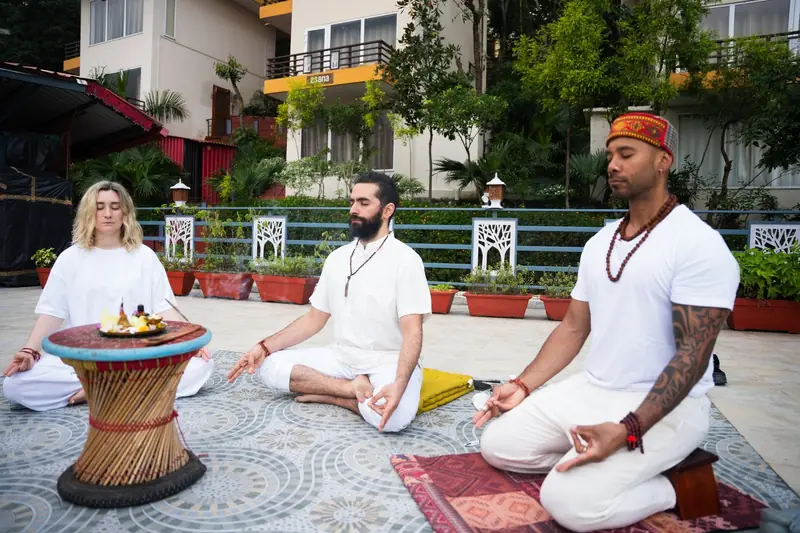
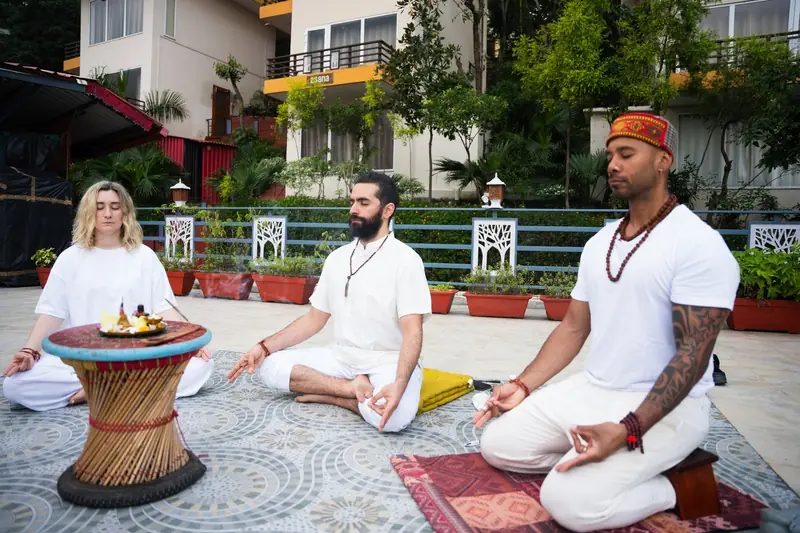
Pictured: Paige practicing by the Ganga, Rishikesh
Have you noticed how, when life turns foggy, the first instinct is to push harder? We try to think our way out, to force the path into view. Yet the more we push, the more lost we tend to feel. Clarity rarely arrives through effort. It arrives on a well-lit path, and often only once we are willing to admit that we cannot yet see where the path is taking us.
There is a mantra for precisely this moment. It does not ask for strength, certainty or a five year plan. It asks only to be led. This is the Asato Ma mantra, sometimes called the Pavamana Mantra, and it is one of the oldest and most loved prayers in the yoga tradition.
What Is The Asato Ma Mantra?
The mantra is short, and for those new to Sanskrit it is one of the more approachable of the longer prayers.
ॐ असतो मा सद्गमय ।
तमसो मा ज्योतिर्गमय ।
मृत्योर्मा अमृतं गमय ।
ॐ शान्तिः शान्तिः शान्तिः ॥
Om Asato Mā Sad Gamaya
Tamaso Mā Jyotir Gamaya
Mṛtyor Mā Amṛtaṃ Gamaya
Om Śāntiḥ Śāntiḥ Śāntiḥ
The structure is the same in each of the three lines. Each names a place we are moving away from, a place we are moving towards, and the same single request that joins them.
The word that carries the whole prayer is gamaya (गमय). It does not mean I will go, and it does not mean give me. It means lead me, or cause me to go. This is worth sitting with. The mantra does not ask for the truth to be handed over. It asks to be guided towards it so that we might walk there and recognise it for ourselves.
From there the meaning opens line by line.
Asat (असत्) is the unreal, the untrue, that which only seems to be. Sat (सत्) is the real, the true, that which abides. So the first line is, lead me from the unreal to the real.
Tamas (तमस्) is darkness, dullness and heaviness. Jyotir, from jyotis (ज्योतिस्), is light, and in this context the inner light of awareness. The second line is, lead me from darkness to light.
Mṛtyu (मृत्यु) is death. Amṛta (अमृत) literally means not dead, the deathless, and it is also the nectar of immortality. The third line is, lead me from death to the deathless.
The mantra then closes with Om Śāntiḥ Śāntiḥ Śāntiḥ, peace, peace, peace. Lead me, finally, to peace.
The Story Behind The Mantra
These three lines come from the Brihadaranyaka Upanishad, one of the oldest of the Upanishads. They are not free floating. They sit inside a passage of chants offered by priests in the setting of a great sacrifice.
In the Vedic world a sacrifice meant a fire ceremony, a havan or yagya, where an offering was placed into the flames. The Brihadaranyaka opens with the imagery of the cosmic horse, in which the entire universe is described as a single sacrificial animal. Its head is the dawn, its eye the sun, its breath the wind. The horse stands for totality, for the whole of existence offered up.
The teaching turns on a quiet understanding. The priests knew that the external offering, on its own, transforms nothing. The fire on the altar is a metaphorical fire. The true fire is the fire of awareness, the inner light that illuminates us, and it is what the outer ritual points towards that does the real work. We can fall into thinking that the things we do externally are themselves magical. The tradition gently corrects this. It is what they represent inwardly that creates the change.
So at the height of the ceremony, with the whole of the cosmos symbolically offered to the fire, a prayer is made. What makes this prayer remarkable is what it does not do. It is not addressed to any particular deity. It does not request that any specific thing be changed or granted. It is addressed to truth itself, and it asks only to be led from the unreal to the real, from darkness to light, from death to the deathless.
In so many of the old stories, the seeker asks for a boon. The strength of a thousand men. Indestructibility. The riches of a kingdom. Here, at the peak of the most total offering imaginable, the seeker asks for none of that. The request is for guidance on the path, and nothing more. It is a humble prayer, and that humility is the heart of it.
Lifted out of their original setting, these three lines have travelled through the tradition and are now chanted at the beginning of practices all around the world. You have very likely heard them before.
Philosophical Context
This is a mantra of guidance rather than of outcome, and that distinction matters. The Gayatri Mantra, for example, asks for the mind to be illuminated, a fairly specific request. The Asato Ma mantra asks only to be pointed in the right direction, then to be allowed to find the way. It is empowering in that sense. Lead me there, but let me walk it myself. Nothing is simply given.
Underneath this is a theme that runs deep in the tradition. The original teacher of yoga is awareness itself. The texts are full of teachers and lineages, and they are precious, but they exist to return us to the one teacher that was never absent. To follow this mantra is to ask consciousness itself to guide the practice.
The Yoga Sutra of Patanjali gives us a useful frame here. Among the obstacles to practice, Patanjali names bhrānti-darśana (भ्रान्तिदर्शन), false or mistaken perception. On the path of yoga, one of the most common forms of this false perception is the quiet conviction that we already know the path, that we understand the goal, or that asana is the whole of the practice. The Asato Ma mantra speaks directly to this. By humbling ourselves and admitting we cannot yet tell the unreal from the real, we stop mistaking the part for the whole, and only then can we truly begin to move.
Patanjali's own remedy follows soon after. Faced with countless practices, meditations and methods, the mind can freeze at the question of what to do. His instruction is eka-tattva-abhyāsa (एकतत्त्वाभ्यास), the practice of one principle. Just practice one thing. The mantra can carry this same request. Show me which single practice will lead me in this direction, and let me trust it.
Two further threads from the Sutra belong here. The first is the pairing of abhyāsa (अभ्यास) and vairāgya (वैराग्य), steady practice and non-attachment. Do the practice, and release your grip on the results. The second is īśvara-praṇidhāna (ईश्वरप्रणिधान), surrender to something greater than the small self. The Asato Ma mantra is an act of exactly this kind of surrender. Whether or not we give that something a name, we place our faith in it and ask to be guided.
Finally, the third line deserves its own note. The deathless, amṛta, is not a promise that the body will not die. The Upanishads describe it as a nectar of knowledge rather than a physical elixir, the knowledge of the self, which is also the knowledge of yoga. The Chandogya Upanishad describes this self as free from sorrow, free from old age, free from death, beyond the body and the breath and the mind. To ask to be led to the deathless is to ask to be led to that knowledge, and to the non-attachment through which it is realised.
Embodied Application
The most useful thing to know about this mantra is how it is best used. It is not primarily a mantra for japa, the silent or whispered repetition of a single sound over long periods. It is an invocation. It belongs at the threshold of practice, chanted once or three times before you begin.
In asana, let it set the tone before the first posture. You are admitting, in effect, I am about to practice and I do not fully know where it leads. Please guide me towards that in time. From this place, the practice becomes less about achieving a shape and more about steadiness and honest attention.
In pranayama, the same humility applies. Breath is subtle, and forcing it rarely serves us. Opening with this mantra is a way of softening the wish to control and replacing it with a willingness to be led, breath by breath.
In meditation, the mantra prepares the ground. Rather than demanding a particular experience, you ask only to be shown the practice that will move you in the right direction, and then you let yourself settle into it. Awareness resting in awareness is itself the destination, and this prayer simply turns the mind to face it.
Daily Life Integration
Off the mat, the Asato Ma mantra speaks to something many of us carry, the pressure to have it all worked out. We live in a world that seems to expect us to be the best at everything immediately, to be perceived as experts, to always know what we are doing. Yoga moves in the opposite direction. It is a slow burn and a slow remembering, and it asks us to make peace with not knowing.
This is where shraddha (श्रद्धा), faith or trust, becomes a practice in its own right. To chant this mantra is to accept that you can follow a path in the dark, trusting that it has been carved before you by countless practitioners across countless years. You do not have to see the whole road. You only have to keep treading it.
There is real relief in this. So much of our seeking takes the form of asking other people what we should do next, hunting for external validation, comparing ourselves to a polished image of certainty that no one actually possesses. The honest truth is that no one knows the whole of their path, because a single moment can change its course entirely. The mantra returns us to a steadier ground. It is alright not to know, so long as we keep walking.
Used this way, the mantra also cultivates bhāvana (भावना), a felt inner mood or atmosphere. You do not need a formal sitting to invoke it. You might hum it in the kitchen, or sing along to a recording while you drive. When you feel lost, or simply in need of a lift, returning to these few lines can quietly reorient the heart towards trust.
An Ayurvedic Lens
Ayurveda meets this mantra through the mind. In the Ayurvedic view, imbalance and disease are understood to arise first in the mind, which places great emphasis on cultivating a clear and steady inner state, consciously, emotionally and beneath the surface as well.
The language of the mantra maps neatly onto this. Tamas, the darkness and heaviness named in the second line, is one of the three gunas, the qualities of mind. The others are rajas, which is movement and activity, and sattva, which is clarity, lightness and balance. Jyotir, the inner light the mantra reaches towards, can be likened to sattva. In the Ayurvedic understanding, a sattvic mind is the great healer, the ground from which health returns.
The movement between the gunas is itself a kind of map. We often begin in tamas, in dullness and inertia. To shift it we usually need a little rajas, some activity to get things moving and break up the heaviness. From that more active state, we then calm the rajas and settle towards sattva. Tamaso mā jyotir, lead me from darkness to light, describes this very journey.
Sattva can be cultivated in countless small ways. A sattvic diet leans towards fresh, clean, minimally processed food, vegetables grown as close to nature as possible, and a lighter touch with the things that tend to dull or agitate, such as heavily reheated and frozen foods, excess caffeine, and an overload of meat, which is considered heavy and tamasic. The same principle extends beyond food. Through brahmacharya (ब्रह्मचर्य), the wise use of energy, and through care with what we take in through the senses, we filter what reaches the mind. Cultivate lightness in everything you do, and that lightness will guide you towards the light.
Key Takeaways
The Asato Ma mantra, or Pavamana Mantra, comes from the Brihadaranyaka Upanishad and is a prayer for guidance rather than for any particular outcome.
Its single repeated request is gamaya, lead me. It asks to be guided towards truth, light and the deathless, not to be handed them.
The three lines move from the unreal to the real, from darkness to light, and from death to the deathless, closing with peace.
It is best used as an invocation to open practice, not as a mantra for japa.
In the Yoga Sutra it answers bhrānti-darśana, false perception, and pairs with the instruction to practice one principle, eka-tattva-abhyāsa.
It is an act of surrender, īśvara-praṇidhāna, and a cultivation of faith, shraddha, on a path we cannot fully see.
Through an Ayurvedic lens, it describes the movement from tamas towards sattva, the clear and steady mind that is the ground of health.
The deepest meaning of the deathless is not bodily immortality but the nectar of self knowledge.
Listen To The Full Episode
This post draws on our conversation about the Asato Ma mantra in the Om Som Yoga and Ayurveda Podcast, part of our Mantra June series. In the episode we sit with the story behind the prayer, chant it together, and explore what it means to be led on a path we cannot yet see.
Want to Learn More?
Ready to root your yoga practice in tradition? Join our upcoming 200-Hour Hatha Yoga Teacher Training in Sri Lanka (July 2026), a six-month immersive journey grounding you in the principles of Hatha Yoga and Ayurveda.