Āharaṇa: Drawing Breath, Blood & Awareness Through The Body
Listen to this episode on Spotify →
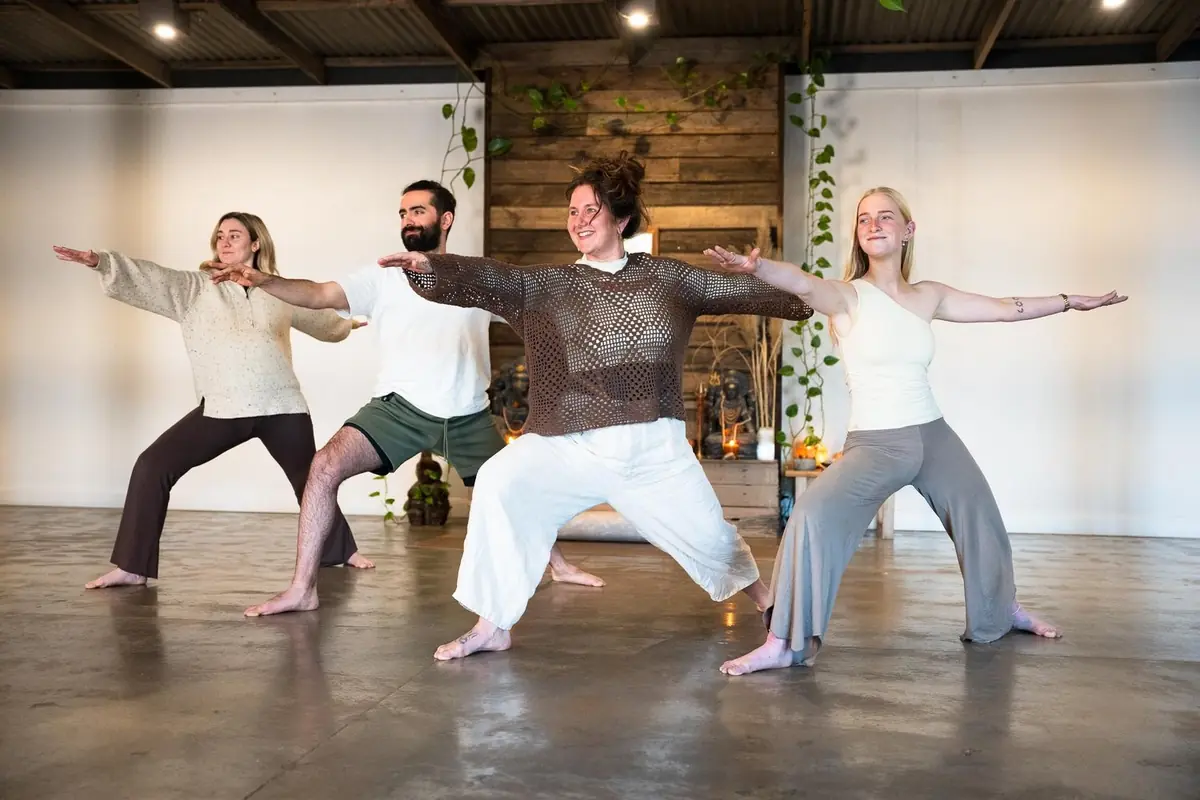
Pictured: the teaching team in Virabhadrasana II (Warrior 2)
When The Breath Becomes A Burden
There is a moment in many practitioners' lives when the breath, which was once a refuge, starts to feel like a task. The instructions begin to pile up. Pull the navel in. Squeeze the pelvic floor. Lift the chest. Open the heart. Hold the breath here. Release the breath there. The body becomes a checklist of activations, and somewhere along the way the simplicity of the breath gets buried under the weight of doing it correctly.
This episode of the Om Som Yoga and Ayurveda Podcast was a long awaited conversation with Simon Borg-Olivier, co-founder of Yoga Synergy and one of the most respected voices bridging traditional Hatha Yoga with modern physiotherapy. After sixty years of embodied practice, Simon has arrived at a teaching that turns much of modern yoga on its head. Rather than tightening, gripping and forcing, he invites us into the quieter art of āharaṇa, the drawing in of breath, blood and awareness through a body that is firm but calm.
What Is Āharaṇa?
Āharaṇa (आहरण) comes from the Sanskrit root √hṛ, meaning to carry or to bring, with the prefix ā- meaning toward. Together they form a verb of drawing in, fetching, gathering toward the centre.
In a yogic context, āharaṇa describes the inward gesture that underlies natural breathing and embodied awareness. It is not the muscular act of pulling something inward by force. It is the subtle invitation that allows breath to descend into the lower abdomen, blood to circulate without strain and consciousness to settle into the body.
The teaching shares a family resemblance with āhāra, the Sanskrit word for nourishment or intake, often used in Ayurveda to describe what we take in through food, breath, sense impressions and thought. Where āhāra is what we receive, āharaṇa is the way we draw it in.
The Boy Who Learned Not To Breathe
Simon's story begins in Malta, where his father, a former soldier and free diver in the Mediterranean, taught him to swim a length of an Olympic pool underwater before he could swim across it on the surface. By the age of six, he had already learned what he later realised was the most important yogic skill of all, the art of how not to breathe.
Not long after, his family met a Rhodesian Olympian named Basil Brown on the boat from Europe to Australia. Basil introduced young Simon, his sister and his own children to Uḍḍīyāna Bandha, Nauli and Bhālabhāti style breath work, all of which require the practitioner to be comfortable with breath retention. Because Simon could already hold his breath underwater, these practices came easily.
In his late teens, a Tibetan lama gave him deep teachings and pointed him toward yoga. The first class he attended was disappointing. Then, after breaking his neck in gymnastics, dislocating a hip in TaeKwonDo and getting shin splints from aerobics, he stumbled into an Iyengar class where the teacher gave precise structural instructions that finally made the postures click. Shortly after, he was sent to study in India with Sri B. K. S. Iyengar. He later studied with Sri K. Pattabhi Jois, Sri T. K. V. Desikachar, and Shandor Remete, before becoming a physiotherapist and university lecturer himself.
What emerges from this long arc is a teacher who has spent five decades testing what actually works in the body, and what only looks like it works.
Where East And West Meet At The Core
One of the most striking parts of the conversation was Simon's careful mapping of how different traditions describe the same place in the body.
In Western physiotherapy, the lower abdomen is recognised as the home of the enteric nervous system, often called the gut brain. In Chinese tradition, it is the dāntián, the place from which all movement should originate. The Japanese call this same region the tanden, the centre of the hara. In the Indian texts, it is the kanda, said to be the origin of seventy two thousand nāḍīs. In the Tibetan tradition, the term tsittiney refers to the heart essence where all the subtle channels meet. Even some Indigenous Australian cultures speak of the nadukuru, the origin of all movement.
Across continents and centuries, the message is consistent. Breath, thought and movement should begin at the core of the body. This is the home of āharaṇa.
Sthira Sukham Āsanam: The Forgotten Half Of The Sūtra
In the Yoga Sūtra of Patañjali, sūtra 2.46 reads:
Sthira sukham āsanam स्थिरसुखमासनम्
The literal translation is "the seat is steady and easeful." Most modern teaching emphasises the sthira, the steadiness, and quietly forgets the sukham, the ease.
Simon's entire approach can be heard as a return to this missing half. He calls it being firm but calm. The body can be strong without being braced. The core can be active without being clenched. The breath can move freely even while the muscles are working hard. Steadiness and ease are not opposites. They are partners, and the loss of one always corrupts the other.
The Belly That Stays Soft
If there is one teaching from Simon that has rippled through the wider yoga world, it is this. The lower abdomen does not need to be sucked in.
For ninety to ninety nine percent of practice time, Simon suggests the lower abdomen should remain soft enough that the diaphragm can descend on the inhale and the breath can fill the space below the navel. This is not laziness. It is the precondition for natural breathing, parasympathetic nervous system activity, and the immune, digestive and reproductive functions that depend on it.
He is careful to clarify a common misunderstanding. Soft does not mean limp. His own abdomen, he points out, is one of the strongest muscles in his body. The distinction is not between strong and weak. It is between two different kinds of muscular activation. One inhibits the diaphragm. The other does not.
When the four oblique muscles co-activate on their own, they pull the navel toward the spine, narrow the waist, expand the chest and inhibit the diaphragm. This is the tightening most people have been taught to call a strong core. When the rectus abdominis joins the obliques, or when the body leans back so the lower abdomen pushes gently outward against the practitioner's own fingers, the abdomen becomes firm in a different way. The diaphragm is free. The breath can still descend into the belly. The core is doing its job without locking the breath.
Bandha Reconsidered
Most modern teaching presents the bandhas as muscular contractions. Mūla bandha becomes a tightening of the pelvic floor. Uḍḍīyāna bandha becomes a sucking of the navel toward the spine. Jālandhara bandha becomes a chin lock.
Simon's reading, drawn from his own physiotherapy research and from older texts in the Hatha Yoga tradition, is significantly broader. Bandha, he argues, is the co-activation of opposing muscles around a joint complex. It is a subset of mudrā, which means an energy or blood control gesture. There are not three bandhas, but at least nine main joint complexes where bandha can be created, and each one has two forms: a high pressure form that compresses and a low pressure form that expands.
When the chest expands on a relaxed inhale, that is one form of uḍḍīyāna bandha. When the chest compresses on a forceful exhale, that is another. When the lower abdomen pushes outward against the fingers as the practitioner leans back, that is an expansive form of mūla bandha. When it pulls inward through engagement of the obliques, that is a compressive form. Both are real. Both are useful. Neither is the whole picture.
The crucial point is that the most common modern combination, namely a clenched anus mistaken for mūla bandha and a sucked in navel mistaken for uḍḍīyāna bandha, inhibits the diaphragm, locks the spine, forces the breath into the upper chest and pushes the nervous system into a sympathetic dominant state. What looks like an open heart is actually a closed root, sacrum and navel, with the breath squeezed upward by the closure of everything below.
Embodied Application
Āsana
In a posture, the question is no longer how hard can I grip, but where can I soften and still be supported. The lower abdomen stays available to the breath. The pelvic floor stays soft enough that the perineum can respond, rather than seizing in a permanent contraction. The collarbones stay slightly behind the pubic bone, with the chin gently lifted away from the throat. The body finds its strength through alignment and through the natural co-activation that happens when we move from the core, rather than through bracing and clenching.
Simon points to the jump back, jump through transition in Aṣṭāṅga Vinyāsa as a practice where these inner activations happen naturally. A child does not need to be told to engage mūla bandha and uḍḍīyāna bandha to lift their body off the ground. The activations arise on their own when the movement initiates from the core.
Prāṇāyāma
Natural breathing, in Simon's description, has five qualities. The inhale is low, descending into the lower abdomen. The exhale is relaxed and passive. The breath travels through the nose. It is minimal, invisible and inaudible. And it can be forgotten, allowed to work on its own.
The diaphragm is the bridge between conscious and unconscious control. We can move it deliberately, and it also moves without our involvement. The pelvic floor, the lips, the jaw, the eyes and the salivary apparatus all share this dual nature. By gently engaging these bridges with awareness, the breath organises itself.
A safe controlled pause, in Simon's view, looks like this. Breathe in normally. Allow a passive exhale. Forget the breath for a moment. Move the fingers, the shoulders, the lips, the eyes. The pause arrives on its own.
Meditation
In meditation, Simon offers a subtle but important warning. Observing the breath tends to change it. For the beginner, watching the breath becomes a form of subtly directing it, which interferes with the very stillness the practice is meant to invite. Instead, he points to the bridges between conscious and unconscious as anchors of awareness. Lengthen the fingers. Soften the shoulders. Free the neck. Relax the pelvic floor. Soften the abdomen. Allow the face. The breath will quieten on its own.
Daily Life Integration
Most modern bodies live in a chronic state of mild tightening. The belly is held in for vanity. The pelvic floor is gripped from a misunderstanding of pelvic floor exercises. The shoulders are pulled back. The chest is lifted. The breath rides high in the upper ribs. The nervous system stays in a low grade flight or fight, and the immune, digestive and reproductive systems quietly pay the price.
The first practice is not a special technique. It is a permission. Soften the belly. Let the sitting bones drop. Bend the knees slightly. Allow the pelvic floor to rest. Let the breath fall into the lower abdomen. Almost immediately, the nervous system begins to recalibrate.
Simon's five place reset is a practice that can be woven into any moment of the day, whether at a desk, on a yoga mat, while walking or while waiting at the lights. Connect with the fingers and shoulders. Connect with the neck. Connect with the pelvic floor and feet. Connect with the lower abdomen and lower back. Connect with the lips, jaw and eyes. Lengthen, soften, gently move. The breath will look after itself.
A Note On Hyperventilation And Breath Retention
A significant portion of the conversation was given to the dangers of casual breath work. Hyperventilation, often presented as a path to a prāṇic high, blows off carbon dioxide. With less CO₂, blood vessels to the brain constrict, the nervous system enters a stress state, and oxygen has more difficulty leaving the haemoglobin to enter the cells. The body responds by releasing adrenaline, cortisol and endorphins. The combination produces a sensation that resembles the effects of caffeine, marijuana and a mild opioid all at once. It feels spiritual. It is closer to chemical stress.
Breath retentions performed with the chin lifted and the chest expanded can pull blood out of the brain, causing fainting. Retentions performed with the head up while bearing down can push blood into the brain, risking burst blood vessels. Simon's teachers always insisted on a chin down, neck back position for retentions, and on minimal breathing rather than maximal breathing as the true direction of prāṇāyāma.
This is not a teaching against breath work. It is a teaching for respecting it.
Key Takeaways
Āharaṇa means drawing in. It describes the soft, inward gesture by which breath, blood and awareness move into the body, rather than being forced.
The lower abdomen is the universal core. Almost every traditional culture identifies it as the seat of breath, movement and intelligence.
Sthira sukham āsanam means firm but calm. Both qualities are required. Steadiness without ease is rigidity.
For most of practice, keep the lower abdomen soft enough that the breath can descend into it. Soft is not weak.
Bandha is the co-activation of opposing muscles around a joint, with two forms, expansive and compressive. It exists throughout the body, not only at three locations.
The most common modern combination of pelvic floor clenching and navel suction inhibits the diaphragm and locks the body into low grade stress.
Natural breathing is low, relaxed, nasal, minimal and forgettable.
Engage the bridges between conscious and unconscious to anchor awareness without interfering with the breath.
Hyperventilation and untrained breath retentions can be genuinely dangerous. Approach prāṇāyāma with respect and qualified guidance.
Listen & Watch The Full Episode
The full conversation with Simon goes much deeper, including a guided exploration where you can feel each of these teachings in your own body. It is a generous and patient hour with one of the most experienced teachers practicing today.
Want to Learn More?
Ready to root your yoga practice in tradition? Join our upcoming 200-Hour Hatha Yoga Teacher Training in Sri Lanka (July 2026), a six-month immersive journey grounding you in the principles of Hatha Yoga and Ayurveda.