Shunya: The Yogic Practice Of Embracing The Void
Listen to this episode on Spotify →
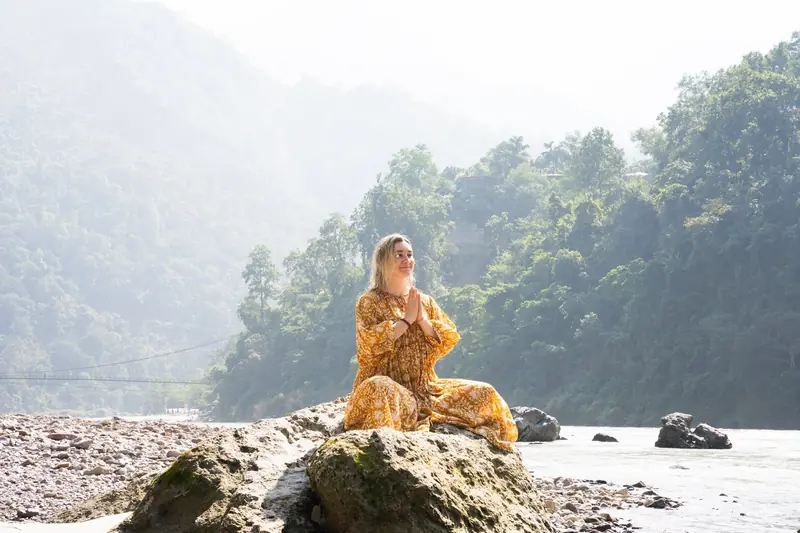
Pictured: Paige practicing by the Ganga, Rishikesh
The Difference Between Quiet And Silence
Have you ever sat in a perfectly quiet room and still felt the noise inside your own head?
Quiet is external. Silence is internal. You can be alone in a silent room with a screaming mind, and you can be in a crowded train carriage with an inner stillness that nothing seems to touch. The yogic tradition makes this distinction very carefully, because it points to something we cannot manufacture by changing our environment. The deeper silence the practice points to is not something we create. It is what is already there when the mind stops moving.
That stillness has a name. The tradition calls it shunya.
What Is Shunya?
Shunya, written in Sanskrit as शून्य, literally means void, empty, or zero. It is the same root that gave the mathematical concept of zero to the world through the Indian tradition. In yoga and tantra it is not used to describe a lack of something. It is used to describe the spacious ground beneath all experience.
Shunya is the space within us that has no label, no shape, no story and no boundary. It is what remains when the activity of the mind temporarily falls away. It is ungraspable by definition. The moment the mind tries to name it, it collapses back into thought, and shunya seems to vanish.
This is why the tradition treats shunya less as a concept to understand and more as a quality to recognise directly through practice.
A Story From The Kena Upanishad
There is a beautiful story in the Kena Upanishad that points exactly to this teaching.
Brahman appears before all the gods. None of them can recognise what they are seeing. There is no object, no being, no shape that they can place. Indra, the king of the gods, approaches and opens his mouth to ask what this great presence is. The moment he tries to label it, the Brahman vanishes.
Indra turns to Uma, the goddess of wisdom, and asks what he has just witnessed. She replies that it was the Brahman, and that it is through the Brahman that all the gods shine. Their light is not their own.
The teaching of the story is not what Brahman said, because Brahman said nothing. The teaching is the vanishing itself. As soon as the mind reaches out to grasp the ungraspable, the ungraspable disappears.
This is shunya. It is the very thing that withdraws the moment we try to define it, and yet it is the silent ground from which everything arises.
Where Shunya Sits In Yogic Philosophy
In Samkhya, the philosophical map of how consciousness descends into matter, shunya sits high on the map, closer to the unmanifest than to the world of objects. It belongs to the layer of experience that cannot be reduced to thought, language or form.
The Tao Te Ching expresses the same recognition in its opening line. The Tao that can be named is not the eternal Tao. The more we try to box these realities into definitions, the further we drift from the reality itself.
In the Yoga Sutra of Patanjali, Sutra 1.2 tells us:
योगश्चित्तवृत्तिनिरोधःYogaḥ chitta vṛtti nirodhaḥ
Literally, yoga is the cessation of the movements of the mind. When the vrittis settle, what remains is not blankness. What remains is shunya. The fullness of presence with no object inside it.
In the tantric view this becomes a profoundly practical teaching. By recognising that there is a space within us with no label, we give the mind permission to rest. We stop spending energy on the constant work of thinking, naming and managing. The mind softens. Prana is conserved. Awareness becomes available.
Shunya In Embodied Practice
Shunya is not an idea to memorise. It is a direct experience that the practices of yoga are designed to make accessible.
In Asana
In asana, shunya appears in the moment a posture becomes stable enough that the mind has nothing left to fix. The body is supported, the breath is even, the effort is appropriate, and a quiet opens behind the form. This is why classical Hatha Yoga places so much emphasis on steadiness before fluidity. We are not searching for sensation. We are creating the conditions for the noise of the mind to settle so that something deeper can be felt.
In Pranayama
In pranayama, shunya is found in the natural pauses between the breaths. The space at the top of the inhale and the space at the bottom of the exhale are not gaps to fill. They are doorways. Kumbhaka, the retention of the breath, is one of the most direct ways the tradition teaches us to enter this space, because when the breath stops, the mind tends to follow.
In Meditation
There is a classical meditation technique for moving toward shunya step by step. We begin by listening to external sounds. We let the attention move closer, to sounds within the body. Then closer still, to the thoughts themselves heard as inner sound. Then we begin to notice the silence between the thoughts. Eventually the silence itself becomes the object of awareness, and finally even that object is allowed to dissolve.
Yoga nidra works through a similar path. It often begins with that same drawing in of sound from the outside world to the inside, and culminates in the cognition of nothingness. In the classical sense, yoga nidra is the practice of shunya.
Kaya Sthiram, the practice of body stillness, is another doorway. Resting attention on the stillness of the body, the stillness of the space around the body, the stillness between the breaths and the stillness between the thoughts, the practitioner is drawn inward toward the same silent centre.
Shunya In Daily Life
The fruit of this practice is presence. Not a dramatic, heightened presence, but the simple capacity to be in the world without needing to think about the world all the time.
Shunya in daily life looks like being able to sit with someone in silence without rushing to fill the gap. It looks like being comfortable in your own company without reaching for the phone. It looks like the pause between a stimulus and your response, the moment where wisdom has room to enter.
There is a quiet cultural recognition of this happening right now. People are sitting in empty boxes for hours, filming themselves doing nothing, calling it raw dogging life. The vocabulary is new, but the impulse is ancient. The nervous system knows it needs to stop. What the tradition offers is a much more efficient route. What someone might be trying to access through an hour of unstructured boredom is often available in five or ten minutes of guided meditation.
This is also where Ayurveda offers a useful framework. A mind weighed down by tamas, dullness and heaviness, cannot drop into shunya directly. It first needs movement, and that movement is rajas. Asana, breath and a little heat are used to break up the dullness. Then once the mind is active, the practice begins to settle it, and that settling is the movement toward sattva. From a sattvic state, the mind naturally turns inward, and shunya becomes accessible. This is why the sequence of practice matters. We do not skip steps. We move from tamas to rajas, and from rajas to sattva, and from sattva we are quietly drawn into the void.
It is important to remember that shunya is not lack. As Paige put it in the episode, nothingness is not a lack. It is the potential for anything to arise. The silence between two notes is what allows music to exist. The space between two words is what allows meaning to exist. The pause between two thoughts is what allows wisdom to exist.
Key Takeaways
Shunya means void, empty or zero. It is the spacious silence at the centre of experience.
Quiet is external. Silence is internal. Shunya is the deepest layer of that internal silence.
The Kena Upanishad teaches that the ungraspable disappears the moment the mind tries to name it.
In Samkhya, shunya sits closer to the unmanifest than to the world of form.
Asana creates stability so the mind has nothing to fix. Pranayama uses the pauses in the breath. Meditation moves from external sound to internal silence to the dissolution of silence itself.
Yoga nidra and Kaya Sthiram are direct practices of shunya.
The Ayurvedic path moves from tamas to rajas to sattva, and from sattva into shunya.
Shunya is not lack. It is the potential for anything to arise.
Listen & Watch the Full Episode
If this exploration of shunya has resonated with you, listen to our full conversation on the Om Som Yoga and Ayurveda Podcast, where we unpack the practice in detail and share more on the this rich yogic concept.
Listen here.
Want to Learn More?
Ready to root your yoga practice in tradition? Join our upcoming 200-Hour Hatha Yoga Teacher Training in Sri Lanka (July 2026), a six-month immersive journey grounding you in the principles of Hatha Yoga and Ayurveda.